
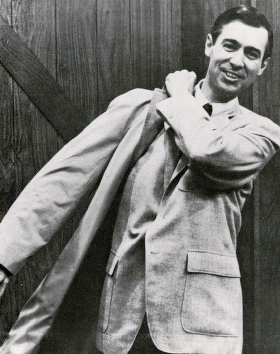
During the last several weeks, my wife and I have been reading The Good Neighbor: The Life and Work of Fred Rogers, by Maxwell King. We read out loud to each other when we’re in the car or doing chores at home. I found out about the book in the alumni magazine from Duquesne University in Pittsburgh, where I received my M. A. in History. At Duquesne’s commencement this year, King and Rogers’s widow Joanne Rogers both received honorary doctorates. The book came out last year, and it’s the first full biography of Rogers.
I remember watching Mister Rogers’ Neighborhood when I was growing up in Western Pennsylvania in the early 1970s. At some point, I decided that I was too old, that the show was too slow, and that I liked Sesame Street and The Electric Company better. I did not realize that Rogers and his program were key to the development of WQED in Pittsburgh and Public Broadcasting nationally. This book sets Rogers’s life in context of the national development of educational television for kids. It also provides evidence that for many children – often those going through difficult life situations – watching Mister Rogers’ Neighborhood was a transformative experience.
Rogers grew up in the small town of Latrobe, Pennsylvania, east of Pittsburgh. He was the only child of a wealthy family, and he struggled with asthma and social awkwardness at school. So he often would go to his attic and play with puppets, writing elaborate scripts for puppet shows and performing them for his family. He also played the concert grand piano (!) that his grandmother bought for him. He got his B. A. in music, became a concert-level musician, and wrote an opera at Rollins College in Florida. After he graduated, he decided he wanted to work in broadcast television.
He began his career with NBC in New York City, then went to work for WQED, a public station in Pittsburgh. There he wrote and operated the puppets for The Children’s Corner for seven years. At the same time, he attended Pittsburgh Theological Seminary and became an ordained minister in the mainline Presbyterian Church with the call to serve the community through television. In 1963 he moved to Toronto and created Misterogers for the Canadian Broadcasting Company. He returned to Pittsburgh three years later and recreated the show for WQED. By the early 1970s, the show was broadcast nationally.
King’s book does an excellent job describing the influences on Rogers’ development, including his mother’s love, his father’s money, his grandparents’ encouragement, the outlet of music and puppetry, and the educational theory of Benjamin Spock, Erik Erikson, and especially Margaret McFarland. King is also at pains to explain that Fred Rogers was in real life who he was on the television screen: a kind, encouraging man who cared about everyone he met. He especially cared about children. Born into a wealthy family, he never wanted for anything, but he was not pretentious. He was highly creative and had a perfectionist streak, which at times led him to become angry with coworkers and with his own two sons. Finally, he was intensely dedicated to friends, and he put off getting treatment for the ailment that eventually killed him—stomach cancer—because he did not want to back out on commitments he had previously made to others.
The author, Maxwell King, was a journalist for the Philadelphia Inquirer for almost 30 years, eventually serving as Editor. He was then President of the Heinz Endowments, directed the Fred Rogers Center for Early Learning and Children’s Media at Saint Vincent College in Latrobe, and most recently was President and CEO of the Pittsburgh Foundation. Because he was writing the biography of a late twentieth century television celebrity, there are thousands of hours of shows and interviews, and reams of material to sift through. King’s training in journalism is evident, as he often allows his sources to tell the story: Fred himself, his wife Joanne, his coworkers, relatives, acquaintances, and fans of his work. However, this often means long sections of direct quotes, some of which repeat points made previously. While early chapters are chronological, later chapters are thematic, which also makes for quite a bit of repetition. Perhaps my wife and I noted this more because we were reading it out loud, but at the end of the book’s 360-plus pages of text, we thought that it might have been perhaps a 80-100 pages shorter.
There are some interesting comparisons between Fred Rogers and Laura Ingalls Wilder. Both created artistic works for children that had widespread influence almost immediately. Both used materials from their upbringing – Laura’s life story and Fred’s memory of his family’s neighborhood in small-town Latrobe. Both shared an upbringing and lifelong affiliation with the church, although Fred became a pastor and Laura never officially joined a congregation. The most striking difference between the two was the Rogers’s family’s wealth in comparison to the Ingalls’s family’s relative poverty.
I’ve been writing the chapter about Laura and Almanzo’s early years in Mansfield, Missouri, and that has brought me face to face with their daughter Rose Wilder Lane’s childhood. In fact, there might be more interesting comparisons between Fred Rogers and Rose Wilder Lane. Both were only children brought up in families with strong mother figures. Both were very artistic and creative individuals who followed their own paths. Ultimately, however, Fred was much more comfortable with who he was and a much more successful person. He never had to work for a living the way that Rose had to, and he didn’t face the difficulties or financial reverses that she faced. But I also think that his settled Christian faith provided ballast for the difficulties in life that he did face, and that kind of faith was one thing that Rose did not have for most of her adult life.
I certainly have a lot fewer sources for Laura’s life than King had for Fred’s, and I’m planning for my book to be much shorter than his. Caroline Fraser (Prairie Fires) has written the long and exhaustive book on Laura and Rose. I’m just hoping to tell their story in light of Laura’s faith commitments.
Thanks again for reading.
Picture credit: KHUT (CC0) at the Wikimedia Commons
Links:
Publisher’s site for The Good Neighbor
Duquesne’s May 2019 Commencement
The Fred Rogers Center for Early Learning and Children’s Media at Saint Vincent College
My blog entry on Caroline Fraser’s Prairie Fires

 The Faith of Laura Ingalls Wilder
Never thought of comparisons between Rogers and Wilder. Very interesting.
LikeLike