Iowa and Missouri

two book events in April

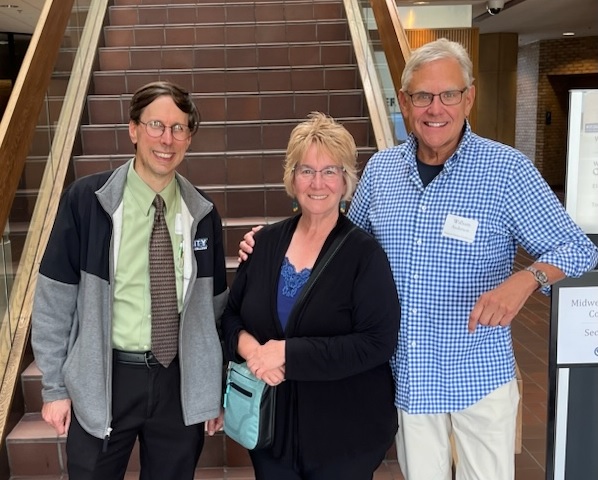
Photo by Michelle Underwood

Summer has arrived in Chicagoland. Finals week at Trinity was the last week of April and Commencement was May 2. May 15 was the last day for faculty members on nine-month contracts. As June approaches, I’m in fewer meetings. I’ve begun thinking about the two history courses I will be teaching in the fall: History 204, the first half of the American History survey, and History 401, the Senior Seminar.

I enjoyed two book events in April. The first was an online Iowa History 101 event sponsored by the State Historical Society of Iowa (SHSI) on April 10 at noon. The zoom session was attended by about a dozen people. My talk addressed what we know about Laura’s faith and about Laura and Rose’s contributions to the Little House books, particularly as they address Christianity and the church. I also discussed the Ingalls’s family’s one-year stay in Burr Oak, Iowa, in 1876 and 1877. There were some great questions at the end. The session was recorded and a link is at the end of this post.

Then I was able to travel to the Missouri Cherry Blossom Festival in Marshfield, Missouri. I was there on Friday, April 25 and Saturday, April 26. The mornings and early afternoons of both days I was able to sell and sign books (I took copies of both A Prairie Faith and my second book, Almost Pioneers) in Marshfield’s Community Center, along with a number of movie and television stars from the mid to late twentieth century. Nine actors were there from “Little House on the Prairie,” including Dean Butler, who played Almanzo, and Alison Arngrim, who played Nellie Oleson. There were also three actors from “The Waltons,” and others from “Leave it to Beaver,” “Dallas,” “Barney Miller,” It’s a Wonderful Life, and a variety of other shows and movies. Michelle Underwood, a southwest Missouri author who also works at the Laura Ingalls Wilder Home in Mansfield, had a table next to mine. She has written a book giving a “behind the scenes” look at the Wilder Home. We enjoyed talking while we worked to attract the crowds who waited in line to get autographs from the “Little House on the Prairie” stars. I ultimately sold about twenty books.

On Friday afternoon I went to the Marshfield Assembly of God church to receive the Ella Dickey Literacy Award. Bill Anderson presented me with the award. The other awardees were the Rev. John Marshall, a retired Baptist Pastor who has written a book on the faith of Abraham Lincoln, and Paul Landis, a Secret Service Agent for John F. Kennedy who has written a memoir about his experiences. I was honored to receive the award, which is named after a beloved, long-time librarian in Marshfield.
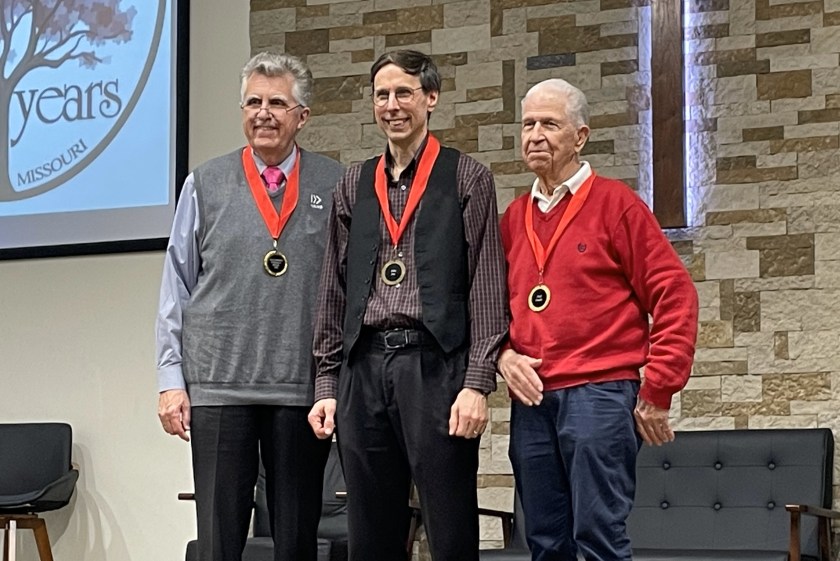
John Marshall, me, and Paul Landis. Photo by Sarah Manley

Later Friday afternoon, I attended the Dred Scott Reconcilation Forum, hosted by Lynne Jackson, a descendant of Dred and Harriet Scott. She interviewed Dr. Bryan Moore, the pastor of Jubilee Community Church in north St. Louis and a distant relative of Nat Turner. I also got to judge a cherry pie contest. On Saturday morning, I attended Rev. Marshall’s session about Lincoln; his comments were very insightful. It was great to catch up with Bill Anderson and Sarah Manley. Many thanks to Sarah for taking the pictures during the ceremony. Many thanks also to Rev. Nicholas Inman, Director of the Laura Ingalls Wilder Home in Mansfield and the driving force behind the Festival, for his gracious invitation.

Now I’m just waiting to hear the announcement of the Book of the Year for Biography from the website Foreword. A Prairie Faith is one of eight finalists. Lord-willing that will be announced in June.

If you’re interested in having me speak, please let me know (john.fry@trnty.edu). Thanks for reading!

Links:

Trinity Christian College

Iowa History 101 Recording

STL listing of events at Missouri Cherry Blossom Festival

My second book: Almost Pioneers: One Couple’s Homesteading Adventure in the West

Michelle Underwood’s website

Michelle’s Laura Ingalls Wilder’s Rocky Ridge Farm: A Detailed Look Behind the Scenes

Bill Anderson’s website

Paul Landis’s The Final Witness: A Kennedy Secret Service Agent Breaks His Silence After 60 Years

John Marshall’s Lincoln and Christianity: Essays on Lincoln’s Religious Life

The Laura Ingalls Wilder Home and Museum in Mansfield

Foreword Book of the Year Finalist Announcement

List of Foreword Book of the Year (INDIES) Finalists for Biography

Foreword’s Listing for my book
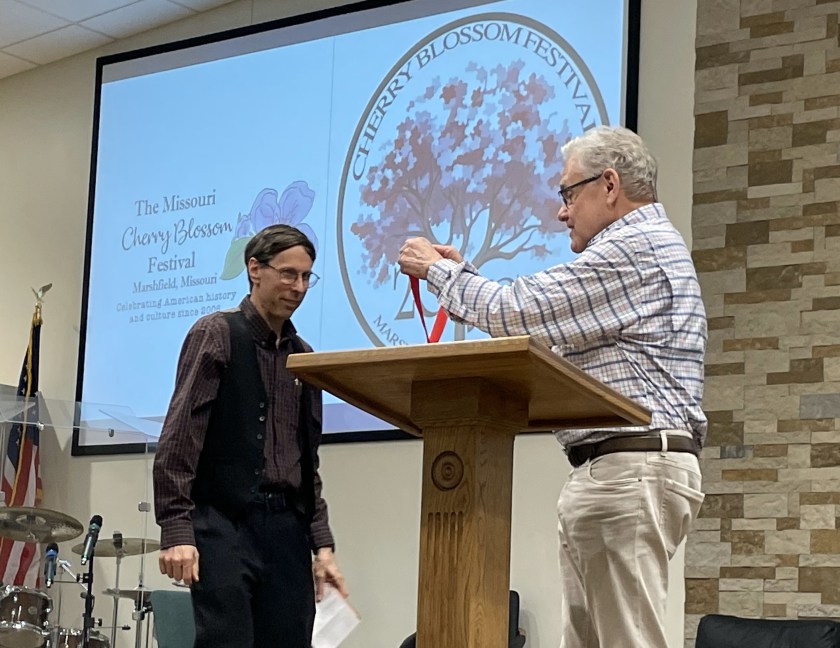
Picture of Bill Anderson giving John Fry the Ella Dickey Literacy award.

Bill Anderson presenting me with the Ella Dickey Literacy Award. Photo by Sarah Manley

Book Tour – Summer 2024

Michigan!

The spring semester at Trinity Christian College wrapped up at the beginning of May. My summer involves work for my role as Dean of Faculty at Trinity and preparations for the 2024-2025 academic year. This fall, I am returning to teaching half-time and will be teaching first-year students for the first time since spring 2021. I have been talking with colleagues and making plans.

In addition, last week I was able to travel to Michigan for several speaking opportunities:

On Wednesday, May 29, I drove to Ann Arbor and spoke that afternoon at the Malletts Creek branch of the Ann Arbor District Library. There were seven in the audience in person and six on the livestream of the event. Many thanks to Sam Root for organizing things, to Lucy for hosting, and to James for taking care of all of the technology. (After the event, I was able to see my beloved Pittsburgh Pirates play the second game of a doubleheader with the Detroit Tigers at Comerica Park.)

On Thursday and Friday, May 30 and 31, I attended the Midwestern History Conference (MHC) in the Eberhard Center at Grand Valley State University in Grand Rapids. It was the first time that I had been to the MHC since 2019. That was the year that Bill Anderson, John Miller, and I did a session on writing about Laura Ingalls Wilder. I also presented some of my early research on Wilder there in 2017. It was great to be back and to see some old friends. I chaired a session on Friday morning, and Friday afternoon I presented a paper about Wilder’s faith on a panel about Religion in the Midwest. Thanks to Patrick Allen Pospisek for organizing the conference and accepting my paper, to David Mislin for chairing my session, and to David Zwart for putting me up Thursday night and for being a good friend and colleague for so many years. It was also great to see Bill Anderson and Cindy Wilson.

Me, Cindy Wilson, and Bill Anderson Photo by Bill Anderson

Finally, on Thursday night I was able to give a book talk at Schuler Books in Grand Rapids. Schuler books is an enormous independent bookstore that also has locations in three other Michigan cities. About forty people came, including some former colleagues from Trinity who now live in western Michigan. The question and answer period was especially lively, and I also had a great time talking to people after signing books. Many thanks to Elizabeth Bosscher for taking care of arrangements, to Indigo for hosting and keeping things moving, and to Yudha Thianto for making me Indonesian food for dinner.

Schuler Books in Grand Rapids

I believe that the rest of the summer will be pretty quiet. I will be doing a zoom for the Conference on Faith and History in early July, which will become a podcast that I can post afterwards. I also have some hopes of speaking at some public libraries or bookstores in Chicago. Then in September I’ll be heading to Missouri for Wilder Days in Mansfield and Lord-willing several other events. If you are interested in having me speak at your local bookstore, church, public library, or other community group, please contact me at john.fry@trnty.edu.

You can also keep checking my page dedicated to Book Talks, both upcoming ones and previous ones. Thanks again for your support and encouragement!

Links:

Trinity Christian College

Ann Arbor ad

Midwestern History Conference – Includes a program you can download

Post on the 2017 MHC

Post on the 2019 MHC

Cindy Wilson’s Author Site

Bill Anderson’s Author Site

Schuler Books Ad

Conference on Faith and History Podcast Series

Wilder Days at the Laura Ingalls Wilder Historic Home and Museum in Mansfield

LauraPalooza 2022

a group that loves to learn new things

Last week I attended LauraPalooza 2022: The Wilder Side. The conference was sponsored by the Laura Ingalls Wilder Legacy and Research Association (LIWLRA). It is (obviously) the only conference of its kind, half academic conference and half fan gathering. I had attended the first LauraPalooza in 2010 in Mankato, Minnesota, and the fourth in Springfield, Missouri, in 2017. This year’s was the seventh, and it was held in Burlington, Vermont.

It was great to be back with a group of people who are interested in pretty much everything about Laura Ingalls Wilder. There are multiple worlds associated with Wilder:

1) The world of the historical Laura, who lived from 1867 to 1957, her husband Almanzo, who lived from 1857 (maybe 1859) to 1949, and their daughter Rose Wilder Lane, who lived from 1886 to 1968.

2) The fictional world of the Little House books, published between 1932 and 1943. The books were the product of a collaboration between Laura and Rose.

3) The world of the television series, “Little House on the Prairie.” Nine seasons aired between 1974 and 1983, and it has never been off the air (it immediately went into syndication and is still on cable stations and streaming services).

4) The world of the historical sites that one can visit to see the landscapes where she lived and walk in her footsteps, in Wisconsin, Kansas, Minnesota, Iowa, South Dakota, Missouri, and New York.

This year, there were presentations about all these worlds, and the last day of the conference was a bus trip to the Wilder Homestead in Burke, New York. The Wilder Homestead is where Almanzo Wilder, Laura’s husband, grew up in the late 1850s, 1860s, and 1870s.

There were almost one hundred in attendance. The community that gathers at LauraPalooza is striking for several reasons:

  • It is a group that loves to learn new things. This year, they invited Robert Goodby, an anthropologist who studies Native Americans in New England, to talk about the world of Indigenous peoples in upstate New York and how they are addressed in Farmer Boy, the Little House book about a year in Almanzo Wilder’s childhood.
  • It is also a group that loves to read. One of the keynote speakers was Mitali Perkins, whose book Steeped in Stories argues for the benefits of children reading a lot of different stories. In addition, since I was presenting a paper, I was included in the Authors’ and Artists’ reception. I took copies of my second book, Almost Pioneers, which is not about Laura Ingalls Wilder. I still sold all the copies that I took. Dr. Goodby also sold some copies of his book.
  • Finally, it is a group that understands the nuance involved in understanding people who lived in the past, and therefore didn’t think the way we do today. Wilder’s attitude toward—and her writing about—people of other cultures was at times negative, dismissive, and lacking in understanding. But it is possible to condemn that and still appreciate the positive aspects of her life and written work. IT’s like applying the Biblical instruction to love your neighbor as yourself to our neighbors who lived in the past.

At one point, attendees were asked to put up our hands to indicate how many conferences we had attended. It appeared that the two biggest groups were those who were first time attendees (one of the advantages of having the conference in different locations) and those who had attended all six conferences. Fascinating.

Seven highlights:

  • Robert Goodby, “The Wilder Homestead in An Indigenous Landscape: Native American History and Farmer Boy.”
  • Barb Bousted’s update of her research on the Hard Winter of 1880-1881.
  • Mitali Perkins, “Steeped in Stories: The Power of a Multi-Storied Child.”
  • Melissa Stoller’s reflection on the Laura and Almanzo’s age difference when they got married, in the context of late nineteenth century marriage statistics.
  • Michelle McClellan’s overview of the development of the Wilder Homestead as a historic site.
  • Patty Dowd Schmitz’s presentation about the location of the hill in the “Grandpa’s Sled and the Pig” story from Little House in the Big Woods.
  • Chris Czajka and Caroline Curvan’s backstage tour of the making of the PBS American Master’s Documentary, “Laura Ingalls Wilder: From Prairie to Page.”

I was somewhat reluctant to make such a list because such lists inevitably leave some people out. I think that I probably learned something from every presentation.

I presented some of the conclusions from my book about Wilder’s faith and got some excellent feedback, both during the question and answer period, and later on that day. It was also a blessing to talk at length with Bill Anderson, who has been an incredible help throughout my project. I will refrain from listing the many old friends I saw and new friends I made because I would certainly forget someone. I had some new Facebook friend requests when I got home.

I was not able to go to the Wilder Homestead on Friday because I had to get back to the Midwest. My first grandchild was born early Saturday morning.

Many thanks to those in the LIWLRA who made everything possible. Particular thanks are due to Lauri Goforth and Sue Poremba, the conference Co-Chairs, to Carole Nebhut and her son Adam for taking care of everyone’s audio-visual needs, and to Sarah Manley for her calm and steady leadership of the organization. I hope that everyone has been able to rest this week after all of their work. Many thanks also to my institution, Trinity Christian College, for paying for my trip to Burlington.

Stay tuned for more updates.

Links:

LauraPalooza 2022

The Laura Ingalls Wilder Legacy and Research Association (LIWLRA)

The Wilder Homestead

Robert Goodby

Mitali Perkins

Almost Pioneers

PBS American Masters documentary on Laura Ingalls Wilder

Bill Anderson

Trinity Christian College

The Big Woods and COVID-19

“She was glad that the cozy house, and Pa and Ma and the firelight and the music, were now. They could not be forgotten, she thought, because now is now. It can never be a long time ago.” (95)

It was just over a month ago when the administration of Trinity Christian College, where I work, announced that due to COVID-19, courses for the rest of the spring semester would be conducted online, all of the resident students had to move home, and all spring events on campus (athletic, theater, music, art, etc.) were canceled. It was Thursday, March 12. The announcement came at noon, and the Chaplain’s office quickly organized a final worship service that afternoon as a way for students, faculty members, and staff members to communally grieve the losses that confronted us and express our trust in God and our Lord Jesus Christ. I found my daughter, who is a senior at Trinity, and she put her head on my shoulder and we cried together. That event now seems like a long time ago.

The next week, the Governor of Illinois issued a stay-at-home order. I moved enough out of my office to teach and do my work as an Academic Dean from home. My oldest son was sent home from his college in Pennsylvania to finish the semester online, and plans were underway for my two sons who are in high school to begin online classes. So my four children and I are now all doing online education. So far the bandwidth has held out. My wife is also at home because her work as a nanny and a volunteer at a thrift store both were suspended. Everyday life at my home during the last month has been transformed completely. Now is now.

I would not want to put my losses up against others who have lost a lot more. I am able to work from home and receive a paycheck. Although they have lost paying jobs at their schools, several of my children work at a local greenhouse which is still open, so they can still make some money for college. And there have been compensations. There are six people at the table every day for dinner. My wife has been baking large loaves of delicious homemade bread that we’ve been toasting and covering with the apple butter she made and canned last fall. There is more time for board games in the evening. We have popped corn and watched movies together. There are livestream services on Sunday morning and evening, and Sunday School, Youth Group, and mid-week Bible studies online.

Several weeks into the online, stay-at-home version of life and work, Bill Anderson (William Anderson, author and probably the greatest living authority on Laura Ingalls Wilder) emailed me a link for a New Yorker article that mentions Little House in the Big Woods in relation to the author and her family’s entry into quarantine in London. Margaret Mead, a long-time author for the New Yorker, she speaks of how her husband, her son, and her three stepsons, had all loved the book when they were children. Mead read the book out loud to her son again, and they decided to grow some vegetables in their window boxes. She ends by describing her stepson who lives in rural upstate New York with his partner and their son.

Last week, I got an email from a librarian at the Christian college I attended in Pennsylvania (and where two of our sons will be attending this fall). It included a link to a blog entry from a young Christian woman reflecting on the importance of stories when confronting new realities, like COVID-19. She specifically mentions the Little House books and the Lord of the Rings trilogy by J. R. R. Tolkien.

In between these emails, I was contacted by Jared Burkholder, a historian at a Christian college in Indiana. He is teaching an online course on the History of the American West and wondered if we could record an interview about Laura Ingalls Wilder and the Little House books that he could have his students watch. I said I’d be glad to do so. We recorded the interview this past Monday, using Zoom. It was a lot of fun.

One of the questions he asked me about concerned reasons for the persistent popularity of the Little House books. I thought about the New Yorker author and the Christian blogger and said that I thought that the books combine two features that are often seen as appealing to either the cultural right or the cultural left: an incredibly attractive vision of family life and loving depictions of wilderness and the natural world. Cultural conservatives are often drawn to the Little House books’ depictions of the nuclear family. Pa represents the male head of household and the provider; Ma is the civilizer of the home. Together they support their children, and the books describe how real girls and young women feel when confronted with real challenges in growing up. Cultural liberals and environmentalists are drawn to the books’ detailed and evocative descriptions of wilderness, wild animals, and the landscape of the American west. And in fact, both of these things transcend cultural (and political) categories. Mead, who I would think leans to the left, appreciates Big Woods’s description of a happy home. I lean to the right and love the Little House books’ description of the physical environment, animals, and nature. The result is that the books continue to speak to tens of thousands of people.

So I decided to read Little House in the Big Woods yesterday and think about what it might say to the world in which I live today, the world shaped by COVID-19. It was especially appropriate for me to do it yesterday morning, because an April storm had caused several inches of snow to fall in Chicagoland. I immediately identified with the events in Chapter 7, “The Sugar Snow,” except we don’t have any real maple syrup in the house. I was again amazed at the book’s detailed descriptions of how food was prepared and preserved, its depictions of how young children feel and act, and its vision of how a family could feel they had everything they need, even as they have so much less than we do today. This is the accomplishment of the collaboration between Laura Ingalls Wilder and her daughter Rose Wilder Lane: many people today, 150 years after the events depicted and almost 100 years after the words were written, can identify with the stories. When I’ve been surprised by the usefulness of an online tool during the last several weeks, I’ve found myself thinking—like Pa did of the mechanical thresher in Chapter 12, “That machine’s a great invention!” (91) The very next chapter (the last of the book) depicts Pa’s love for natural beauty and wildlife as being so great that he is unable to shoot the deer or bear that walked into the clearing where he was hunting to bring home meat for his family. When he tells Ma and the girls, Laura says “I’m glad you didn’t shoot them!” and Mary adds “We can eat bread and butter.” (94) I agreed.

As a historian, I know that the world that is created in Little House in the Big Woods was not exactly how it was for Laura Ingalls Wilder during the years that she and her family lived in the log cabin outside of Pepin, Wisconsin. They had relatives and neighbors much nearer than the book suggests.  But ultimately, Little House in the Big Woods is a book of stories, and stories can teach even when they are not historically accurate.

I may try to read The Long Winter next week as a different way into the COVID-19 quarantine experience.

I realize that this entry has been mostly about me. Thanks for reading anyway.

(Quotes and page numbers are from Laura Ingalls Wilder, The Little House Books, edited by Caroline Fraser, Volume I (New York: Library of America, 2012).

Links:

Trinity Christian College, where I work.

Geneva College, where two of my sons will attend next fall, Lord-willing

Margaret Mead, “Returning Once More to a Little House in the Big Woods,” New Yorker, March 4, 2020.

Venia “On Stories and Facing a Quarantine,” Sola Gratia, April 3,

2019 Midwestern History Conference

Last Thursday and Friday, I attended the Midwestern History Conference in Grand Rapids, Michigan. I had a great time.

The conference was sponsored by the Midwestern History Association and hosted by the Hauenstein Center for Presidential Studies at Grand Valley State University (GVSU). It was held at GVSU’s Pew Campus in downtown Grand Rapids.

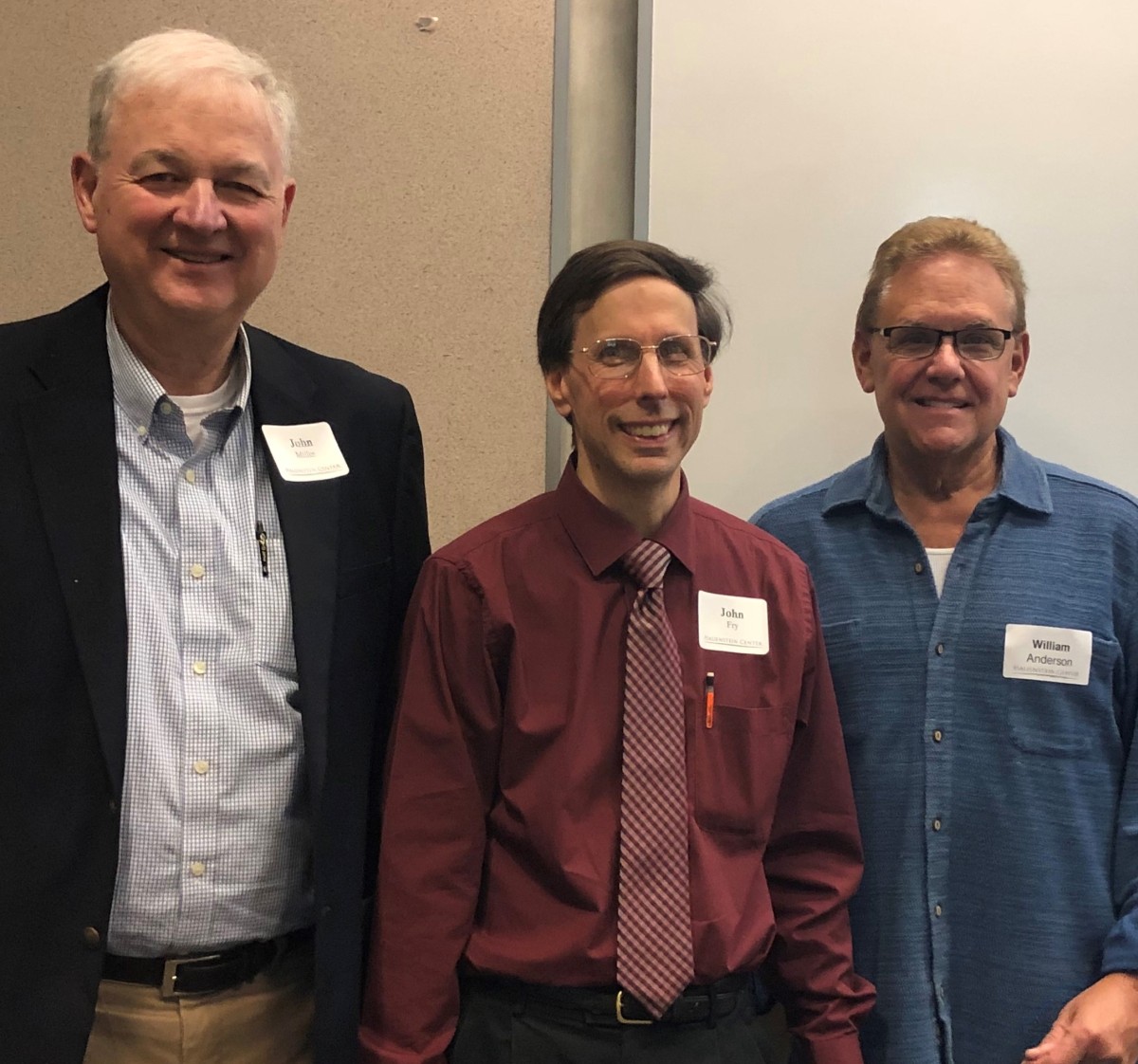
I presented on a panel on Thursday morning titled “‘Everyone Has a Wilder Story:’ Laura Ingalls Wilder, the Midwest, and Historical Research.” It was a privilege to join Bill Anderson and John Miller. We each told the story of how we came to research and write about Laura Ingalls Wilder. Bill has been writing about Laura since the 1960s and has published over twenty-five books. I have previously mentioned four on this blog (links are at the end). John has written three books about Wilder and De Smet, South Dakota, including the most scholarly biography to date, Becoming Laura Ingalls Wilder. They included me, even though I did not read the Little House books when I was a child and I did not grow up in the Midwest. There were around fifteen attendees at our session, which was respectable, given the fact that there were nine other sessions going on at the same time. (I attended other sessions with only five people in the audience.) Discussion during the Q&A was also robust.

I used some of my presentation to reflect on “Everyone has a Wilder Story” in a second way. I think that many people today have a story that they tell about Wilder – about who she really was, and about how we should understand her life and respond to it today. This “Wilder story” guides how they read the Little House books and Wilder’s other writings, and it guides how they view her legacy. So I used my presentation to roll out some possible “Wilder stories,” some tentative ways of understanding Laura’s faith. I don’t think that any of these will come as a surprise to regular readers of this blog

– First, Laura was a committed Christian, attended Christian worship services, read the Bible, and prayed her entire life. She engaged in Christian practices that built her relationship with God and Jesus Christ.

– On the other hand, she never publicly identified with an individual body of believers – she never officially joined any church.

– On a third (?) hand, the original, handwritten manuscripts of the Little House books have more straightforward and positive descriptions of God, Christianity, and the church than appear in the published Little House books. These accounts were changed—most likely by her daughter Rose, who was agnostic when they were written—into the more negative depictions that appear in the published books.

– On a fourth (!) hand, Laura can probably not be understood as an Evangelical Christian. Her descriptions of God, Christianity, and church emphasize God’s power, His laws, and individual moral choices. Her writings almost never mention Christ, forgiveness of sins, or salvation.

It’s complicated. The more I engage the faith of Laura Ingalls Wilder, the more I despair of having just one ‘Wilder story,’ or a simple way of describing her faith. But if I was to have to give an overarching narrative for Laura’s life, I might say that she believed that people do not live by bread alone. Bread is necessary, but faith, community, and family relationships are more important. There are ironies here, too. Her relationship to the church she attended and the community she lived in was often ambivalent. Her own relationship with her own daughter was marked by misunderstandings and, at times, open conflict. Yet in the midst of these difficulties, Laura and Rose together created, in the Little House books, an immensely attractive vision of human flourishing that influenced millions of Americans during the middle to late twentieth century.

Other highlights of the conference included Anna Lisa Cox’s plenary talk on Thursday night and a session I chaired on Friday about music in the Midwest. Many thanks to Trinity Christian College for a travel grant to go to the conference. Thanks also to David Zwart, who teaches at GVSU, for letting me crash at his place on Wednesday and Thursday night.

As always, thanks for following along.

Links:

2019 Midwestern History Conference

Hauenstein Center

Post on Bill Anderson’s Laura Ingalls Wilder: A Biography

Post on Bill Anderson’s The Selected Letters of Laura Ingalls Wilder

Post on Bill Anderson’s Little House Sampler and Little House Reader

Post on John Miller’s Becoming Laura Ingalls Wilder

Anna Lisa Cox

Trinity Christian College

David Zwart


Pioneer Girl Perspectives

At the end of last week, I was able to read the new book of essays from the South Dakota State Historical Society Press, Pioneer Girl Perspectives: Exploring Laura Ingalls Wilder. The book was edited by Nancy Tystad Koupal, who organized the Laura Ingalls Wilder: A 150-Year Legacy conference in Sioux Falls at the end of April. I bought the book at that conference. (All hyperlinks will be at the bottom of this post, with an explanation.)

The book is divided into four sections:

“Working Writers” – This section begins by reprinting the speech Wilder gave at the Detroit Book Fair in 1937. Then Wilder biographer Nancy Fraser links Rose Wilder Lane to the yellow journalism of the early twentieth century to explain Lane’s use of the “Bloody Benders” story in her attempts to get a publisher for Pioneer Girl. Finally, Lane biographer Amy Mattson Lauters reviews the many different types of prose that Rose published.

Beginnings and Misdirections” – Wilder expert William Anderson gives a brief history of the Pioneer Girl manuscript between Wilder’s death in 1957 and its publication in 2014. Literary scholar Michael Patrick Hearn engages how Pioneer Girl and the Little House books were written and compares them to other works of literature. Finally, Noel Silverman, counsel for the Little House Heritage Trust, in an interview with Koupal, provides what he believes are the reasons for the Little House books’ enduring popularity.

Wilder’s Place and time – Historian and Wilder biographer John E. Miller describes the Midwestern context of Wilder’s life and work, comparing it to works by Harvey Dunn, Willa Cather, and Frederick Jackson Turner. Then historian Paula Nelson places Wilder’s views on family, women’s roles, farming, and woman suffrage into historical context.

Enduring Tales and Childhood Myths – Wilder biographer Sallie Ketcham examines the different ways that Little House in the Big Woods displays the characteristics of a fairy tale. Historian Elizabeth Jameson considers how Wilder’s troubled and poverty-ridden childhood, as described in Pioneer Girl, was transformed into the happy childhood of the Little House books. Finally, literature scholar Ann Romines considers possible reasons there are no old people and why nobody dies in the Little House books.

Overall, it’s an excellent book. It’s slightly larger than a normal hardback, and the dust jacket is beautiful. It includes many illustrations from the original Helen Sewell editions of the Little House books, as well as historical photos of Wilder, Lane, and others. Many of the essays fill in gaps of Wilder scholarship or just bring together what we already know in helpful ways.

Like all books of essays, however, some chapters are more insightful than others. All of the authors of the book spoke at the 150-Year Legacy conference, and my blog post on the conference mentions what I found most memorable. After reading their work, I believe that Fraser, Anderson, and the historians (Miller, Nelson, and Armitage) have the strongest essays. Silverman’s observations are also quite helpful.

Two sections of the book provide food for thought for my project on the faith of Laura Ingalls Wilder. First from Miller’s essay:

Wilder kept a list of favorite Bible verses close at hand and sometimes devoted all or part of her Missouri Ruralist column to the need for people to get and treat each other benevolently in a Christian fashion. Although her particular religious beliefs and doctrinal positions cannot be known, we can speculate that her high degree of religiosity placed her in conformity with the conservative religious and political views of the majority of her neighbors. Springfield, the largest city in southwestern Missouri and located just fifty miles west of Mansfield, was a hotbed of old-time religion. Among other things, it became a center of gospel and country music, served as worldwide headquarters for Assemblies of God churches, and housed the regional offices of several other denominations. (p. 155)

So Miller says that her exact beliefs cannot be known. It’s sometimes difficult to be working on a project that Wilder scholars say can’t be done. I guess that I may not be able to pinpoint particular doctrinal positions, but I believe that the available evidence points in some particular directions. I agree that Wilder’s faith was probably influenced by her living in Southwestern Missouri for most of her adult life.

Paula Nelson’s essay makes several observations about Wilder’s Missouri Ruralist articles, about her church life, and about Wilder’s childhood experience with God:

Laura Ingalls Wilder’s life philosophy shines through her columns, no matter the specific topic, and her ideals sprang from her deep Christian faith, learned at her mother’s knee and practiced as a Congregationalist in her earlier life. She and Almanzo became Methodists in Mansfield, where there was no Congregational church, but she recalled a religious experience from her youth in her autobiography. The Ingalls family was in dire straits during their second stay in Minnesota, and the young Wilder was intensely worried. Her bedtime prayers were more fervent than usual, she said, when “gradually I had a feeling of a hovering, encompassing Presence of a Power, comforting and sustaining and thought in surprise ‘That is what men call God!’” Congregationalists required a testimony of religious awakening for full membership in the church in the nineteenth century, and this experience may have been hers. (p. 184)

Wilder’s religious experience in Pioneer Girl is central to any understanding of her faith. I appreciate Nelson’s suggestion that this testimony could have been used to gain full membership in the Congregational church in Missouri or Dakota. I need to track down if there are church records that place when she became a member. Unfortunately, the climax of the story is misquoted here: it’s actually “This is what men call God.” (Pioneer Girl: The Annotated Autobiography, p. 137, emphasis mine) It’s also important to note that the Wilders attended the Methodist Church in Mansfield but never became members.

Thanks again for sharing the journey with me. Comments are welcome.

(Page numbers are from Pioneer Girl Perspectives: Exploring Laura Ingalls Wilder, Nancy Tystad Koupal, ed. [Pierre: South Dakota State Historical Society Press, 2017].)

Links:

Laura Ingalls Wilder: a 150-Year Legacy Conference Site

My blog entry on the conference

Nancy Fraser’s forthcoming biography of Wilder: Prairie Fires

(Members of my family have been reading Nicholas Carr’s The Shallows: What the Internet is Doing to Our Brains. It has challenged me to consider whether having the hyperlinks in the text of my blog entries encourages people to read poorly. So I thought I’d see what things looked like if I put all the links at the bottom of the post.)

“I Remember Laura”

Last week, when I would normally have tried to read a Laura Ingalls Wilder book and write a blog entry, I was working on the draft of my article “The Faith of Laura Ingalls Wilder.” I actually succeeded in writing an additional seven pages (I now have twenty-one pages written.) I’m hoping to finish the article next week so that I can circulate it to some of my colleagues here at Trinity Christian College. We have a reading group of scholars from several disciplines—history, English, music history, theology—who read each other’s work and share comments and suggestions.

This week, I was able to work through I Remember Laura”: Laura Ingalls Wilder, a book edited by Stephen W. Hines and published in 1994. The book’s dust jacket has this additional subtitle (though the title page does not): “America’s favorite storyteller as remembered by her family, friends, and neighbors.” The book is a collection of a number of different types of materials, including some of Wilder’s columns from the Missouri Ruralist, some articles in other publications about Wilder and her daughter Rose Wilder Lane, and some first-hand reminiscences gathered by Hines from people who knew Wilder at the end of her life.

I used the verb “work through” at the beginning of the previous paragraph because there is much material here that is also published in other books. Almost three entire chapters are Missouri Ruralist pieces that I had already read. Other chapters republish articles from a variety of sources that are available elsewhere. There is also much material here that does not bear on Wilder’s faith. For instance, one chapter reproduces recipes from people who knew Wilder.

The unique material the book provides is in Hines’s interviews with people from Mansfield, Missouri who knew Laura, Almanzo, and Rose. Most knew them during the 1940s and 1950s, when the Wilders were in their eighties. In addition, the interviewees were quite advanced in years when Hines met with them during the early 1990s. Still, there is some new information here.

As far as material that bears on Wilder’s faith, there are several new revelations and several that connect to other bits of information I turned up previously. One thing I did not know was that her parents had given her a family Bible when she got married to Almanzo. She gave that Bible to Nava Austin, a friend, before she died:

She gave me her family Bible, the one her mother and father gave her when she and Almanzo were married. The family Bible had clippings and obituaries in it, including one for their boy. I thought Rose was the only child they ever had because Mrs. Wilder herself never mentioned anything about a son.

It was a huge Bible, and there were obituaries for both her mother and father. I’d never seen a Bible like it before, and she had pictures tucked away in it. If I am not mistaken, there was a paper clipping of when she and Almanzo got married. (117-119)

This Bible was never mentioned in either of the books that describe her wedding: Pioneer Girl or These Happy Golden Years. It is also not mentioned in The First Four Years.

“I Remember Laura” also includes an account from Carleton Knight, the pastor of the Methodist Church in Mansfield from the mid-1940s to the early 1950s. He and his wife visited the Wilders at their home a number of times. Almanzo often was working in his workshop or somewhere outside on the farm. Laura would take graham crackers and put powdered sugar icing on them to serve to her guests. Otherwise, the pastor didn’t remember much about their meetings.  However,

One thing I do remember so much is that when she came to church, even in the summer, she nearly always wore a red velvet dress, a dark maroon red, with a lace collar. Her black shoes had a big old silver buckle on them. That was her Sunday outfit. Her hair was beautiful and white and done up in a knot on the back of her head.

By that time she wasn’t terribly active. I never heard anyone say that she taught Sunday school, though she might have done before we came.” (225)

The one bit of information about Wilder’s faith that connects to another book is provided by Iola Jones. Jones spoke of taking Wilder to the Methodist Church for worship services after Almanzo’s death:

Mrs. Wilder had a good sense of humor and lots of wisdom, really; and she put it across in such an interesting way. She had been quite active in her church. In fact, she went to church with me quite a lot, which was a pickup in her activity because before that she hadn’t been going. You see, I don’t think she ever drove, so I think Almanzo’s death kept her in.

She did talk about spiritual things, and we went together to the Methodist Church where she had always gone. I can remember her telling me one time that she had memorized a book of the Bible, but I don’t remember which one. She just didn’t talk about herself a lot.  (136)

 The idea that Wilder had told someone that she had memorized a book of the Bible is striking. This connects to a letter to a Suzanna that I noted in my blog entry on William Anderson’s book, The Selected Letters of Laura Ingalls Wilder: “The whole book of Psalms is a favorite of mine and I can repeat all. Can you?” (Laura Ingalls Wilder, The Selected Letters of Laura Ingalls Wilder, edited by William Anderson [New York: HarperCollins, 2016], 342). Can it be that she told multiple people that she had memorized all 150 Psalms? Fascinating.

It’s late Friday afternoon and I must post this. Thanks for reading.

(All page numbers are from Stephen W. Hines, ed., “I Remember Laura:” Laura Ingalls Wilder [Nashville: Thomas Nelson, 1994].)

Correspondence at the Hoover Library

Earlier this week I posted the first of two entries about the research I did last week at the Herbert Hoover Presidential Library in West Branch, Iowa. This is the second. (I’m feeling pretty good about two posts in the same week; I haven’t done that since January…)

The Rose Wilder Lane Papers at the Hoover Library include six boxes that are categorized the “Laura Ingalls Wilder Series.” These boxes contain correspondence, some typescript drafts of several of the Little House books, the original manuscript of The First Four Years, some clippings, and hardcover copies of the books. I was able to look through all of these materials. What I found most enlightening, however, were the letters in the collection from Laura to Rose. Many of these are reproduced in The Selected Letters of Laura Ingalls Wilder, edited by William Anderson. However, some are not included. I found three that shed light on Wilder’s faith.

The first is from Wilder to her daughter, Rose Wilder Lane, on August 19, 1937. Actually, it is a series of “character sketches” that Wilder had written roughly twenty years earlier, “when Wilson was president.” Laura had meant to give these notes to her daughter so that Rose could use them in a short story. The letter is reproduced in Selected Letters, but the character sketches are not. Thankfully, the Hoover Library houses them.

The sketches are of Christians who were part of the Mount Zion church in rural Wright County. Uncle Alf Mingus and Brother Frank Ellis were pastors there, and the pillars of the church were Aunt Julie Mingus, Eppie Mingus, Aunt Anne Bradshaw, and “Aunty Pickle” (yes, really). All the families in the church were farmers, including the pastors. They were all good farmers. The women of the church got together to spin and sew and gossip, but the gossip was edifying, not negative. The church community cared for those who were less fortunate, supported formal education and music instruction for their children, and inculcated good morals: “In all the hunt for illicit liquor no still has ever been found in the neighborhood.” The church building was the center of community entertainment. At the end of her descriptions, Wilder draws this contrast: “Not all communities are like the ones I have described. There are three not far away where the churches declined, were allowed to go into decay, and the wholesome life of the community and the value of its property declined with them.” (Rose Wilder Lane Papers, Laura Ingalls Wilder Series, Herbert Hoover Presidential Library, Box 13, Folder 193)

Wilder’s depictions are of a church that served as the social center of its community, which was a popular idea among many mainline churches in the early twentieth century, because Social Gospel pastors argued that the church should be just that. Wilder’s descriptions are heartfelt. She argues forcefully that an active church community can make a great difference in the life of a rural neighborhood. It’s interesting that she wrote these for Rose, who had rejected the church. Perhaps this was a way to introduce the topic of Christianity into their correspondence.

The second letter is from Laura to Rose on February 20, 1939. Much of this letter is also reproduced in Selected Letters (192-193). About a page and a half is not reproduced. The excised material is the revelation that several of Laura and Rose’s acquaintances had begun attending the Roman Catholic Church. Wilder is incredulous; she could not understand why they would have done so.  Their decision caused troubles for one of the families, and in fact one member had decided to move to a different part of town. This kind of genteel anti-Catholic sentiment was also widespread among Protestants during the nineteenth and early twentieth centuries, and it’s not surprising that Wilder was susceptible to it. I don’t believe that this is a breakthrough discovery, but it is another reference point for constructing Wilder’s adult religious beliefs.

The final letter is one Laura wrote a month after the previous one. It was written on March 17, 1939, and it appears on pages 193-196 in Selected Letters. However, there is a section of news about women in the Mansfield community that was omitted from the book. It contains this account concerning the Methodist church:

          The leaders in the Methodist Aid have told Mrs. Hoover that they don’t need her help any more when they serve dinners. Mrs. Davis said Mrs. Hoover was heart broken over it because she always had helped. “But you know she is 74 years old and not much help any more.”

          A picture of me two years from now! I told the bunch talking about it that Mrs. H. ought to have done as I did – ‘quit while the quitting was good’ and Mrs. Craig said, ‘You and me both.” (Rose Wilder Lane Papers, Laura Ingalls Wilder Series, Herbert Hoover Presidential Library, Box 13, Folder 195)

I’m working to fit all of this in with what I’ve already put together about Wilder’s faith in previous posts. It seems that she was a committed Protestant Congregationalist, but willing to worship in a Methodist church when a Congregationalist church was not available. She was not a Presbyterian, as multiple times she criticized predestination and strict Sabbath-keeping. She worshiped regularly at the church in her community, but it appears not so much when she was out of town. Her faith was important to her, but she also was pretty private about it. Her expression of Christianity in her Missouri Ruralist articles tended towards moral injunctions, not a celebration of God’s forgiveness through Christ. She had good memories of growing up in the church, though those memories as presented in the Little House books are distorted by her daughter’s influence.

I have a couple more books to read through (including A Little House Sampler and A Little House Reader), and then I need to put together an outline and start writing my paper for the Conference on Faith and History this fall. Thanks for reading and commenting.

Page number references are to Laura Ingalls Wilder, The Selected Letters of Laura Ingalls Wilder, edited by William Anderson (New York: HarperCollins, 2016).

The Selected Letters of Laura Ingalls Wilder

I’m very sorry to have been away from the blog for three weeks. My daughter graduated from Chicago Christian High School on June 2, which meant visits from both my parents and my wife’s parents. We also have had some  car trouble. During that time, my school, Trinity Christian College, went public with the news that I’ve been awarded a travel grant to do research at the Herbert Hoover Presidential Library. But during the last two weeks I was able to get time to read the new Selected Letters of Laura Ingalls Wilder, edited by William Anderson.

As I’ve said in a post on Anderson’s biography of Wilder, Anderson is the foremost living authority on Wilder. He has read everything that there is to be read about Wilder and the books. He has written quite a bit himself. He has worked with the organizers and caretakers of all of the various Wilder historical sites. Now, he has edited a collection of over 400 letters Wilder wrote to a variety of correspondents, including family members, personal acquaintances, business contacts, and fans of the Little House books. The book provides a brief introduction for almost all of the letters, providing background on the recipient and placing the letter in context of Wilder’s life. It is a wonderful collection.

As I worked through the 380 pages of letters, I found myself thinking that this volume could have been several smaller books. One book might have focused on the correspondence between Wilder and her daughter Rose Wilder Lane as Wilder was writing several of the books and Lane was editing them for publication. These letters give an in-depth look at the collaboration between mother and daughter. They also take up about 120 pages of the book before they abruptly end, for Lane burned a lot of letters (!!!) during the weeks after Wilder’s death, both at Wilder’s home in Missouri and in her own home in Connecticut. (xviii) Wilder’s personal letters to fans of the books who wrote her could have been another volume; they occupy another 100 pages at least. But perhaps just the one volume is best. The letters are given in strict date order, and the collection is divided into six chapters chronologically.

Small collections of letters give fascinating looks at different parts of Wilder’s person and life. Selected letters home to her husband Almanzo while she was visiting Rose in San Francisco in 1915 show her ability to describe scenes exquisitely. (All of these letters were published by Harper in 1974 as West From Home.) A later automobile trip to California with Rose and one of Rose’s friends in 1925 is similarly fascinating. Later, we can follow her correspondence with her agent, George Bye, as she tries to get the best terms possible in book contracts with Harpers. The last chapters of the book feature dozens of letters to complete strangers who enjoyed the books and wrote her.

Several letters shed light on the question of Wilder’s faith:

– One of the first letters in the book is to the secretary of the Eastern Star Chapter of the lodge in DeSmet as Wilder prepared to move to Missouri. (5) I’ve looked back at John Miller’s biography and realize now that he also mentions that Almanzo and Laura were both active in the Eastern Star, which is an adjunct organization to the Freemasons, but for some reason I hadn’t thought about this until reading this letter. Membership in a Masonic organization would not have been acceptable for some Christian denominations, like the Presbyterians, who saw the Masons as teaching ideas in competition with or even contrary to Christianity. But apparently this was fine with the Congregationalist church where she and her parents were members and the Methodist church she attended in Missouri.

– There is also a letter on 29 September 1952 written to a correspondent only identified as Suzanna:

“My favorite quotation is from the nineteenth Psalm.

‘The heavens declare the glory of God and the firmament sheweth his handiwork.’

The whole book of Psalms is a favorite of mine and I can repeat all. Can you?

I hope you win the trophy for the second time.

Sincerely, your friend

Laura Ingalls Wilder” (342-343)

Anderson does not provide any introduction to the letter, so the reader is left to surmise that Suzanna was a young person who was involved in some kind of competition, probably one that required interaction with the Bible. Perhaps it involved memorization; Wilder had won such a competition when her family lived in Walnut Grove (see my post on Pioneer Girl). Was Wilder asserting that she had memorized the entire book of Psalms or something else? The letter is tantalizingly short. It does show that Wilder had much more than a passing acquaintance with God’s word.

– Like the previous letter provides some evidence about Wilder’s relationship to the Bible, two other letters to a neighbor named Dorothy mention prayer: The first, on 21 July 1955, says: “It is wonderful that you will pray for me. I need it. I will remember you in my prayers every night.” (372) The second is undated and says “I thank you for your sweet note and shall remember you when I say my prayers. I hope you will do the same for me. One needs the prayers of their friends.” (372) Out of 400 letters in the book, only two mention prayer, but together they use the word “pray” or “prayers” four times.

– There are three points in the letters where Wilder swears. In each instance the word is damn, it is used in a letter to Rose (the correspondent she was closest to), and it is in response to frustration: with a neighborhood interpersonal challenge (85), with the New Deal (112), or with the writing process (156). This is not to say that this means that Wilder was not a Christian. But it is not something we normally think about Laura Ingalls Wilder doing. It does fill out her character a bit.

– Finally, Wilder mentions attending church in Mansfield to Rose (188), to her editor at Harpers (246), and a librarian in California (320).

I think that one might infer one of several things from the evidence provided in her letters. The church and Christian practices like Bible-reading and prayer are mentioned a handful of times in a very large amount of correspondence. One might conclude that therefore faith must not have been very important to Wilder. However, as has been suggested in previous blog entries, it might also mean that while faith was actually very important, Wilder saw it as an intensely personal part of her life. It was not something that she shared readily with others. Lane was an avowed atheist during the 1930s, so in their correspondence perhaps Wilder stuck to topics that they agreed on, like politics, or that greatly concerned them, like work on the Little House books. One also might appreciate why Wilder didn’t mention Christianity to business acquaintances or fans.

I’m glad that I read this book before I travel to Iowa to do research at the Hoover Library at the beginning of next week. I’m sure I’ll have a lot to write about when I get back.

All page number references are to Laura Ingalls Wilder, The Selected Letters of Laura Ingalls Wilder, edited by William Anderson (New York: HarperCollins, 2016).

Laura Ingalls Wilder: A Biography

I took a week off from Laura Ingalls Wilder last week and painted the bathroom at our house. I also attended a conference on African Americans in the nineteenth century West. Trinity Christian College was a co-sponsor, and a colleague of mine in the History Department, David Brodnax, was a co-organizer of the conference and presented a paper. It was a great conference. But I’m back now.

This week I read Laura Ingalls Wilder: A Biography by William Anderson. Anderson is the foremost living authority on Laura Ingalls Wilder. He was reading, thinking about, and writing about the Little House books as a child during the 1950s and 1960s. He wrote his master’s thesis on Wilder and the books, and he wrote a series of pamphlets during the 1970s for the Ingalls and Wilder historical sites. He has written or edited a series of books and collections of Wilder’s works, most recently The Selected Letters of Laura Ingalls Wilder, which just came out this year.

Laura Ingalls Wilder: A Biography was published in 1992. It was aimed at younger readers, and it has been a steady seller for HarperCollins ever since. At the time, Anderson was one of the few who had read Pioneer Girl, and he used both it and the Little House books to shape his narrative. He also had read deeply of Wilder’s papers in the collections of the historical sites, especially in De Smet, South Dakota and Mansfield, Missouri. Anderson’s narrative is lively and direct. He traces Wilder’s life clearly in 232 pages. One feature of this work is that he includes a number of poems that Laura wrote as a teenager, which show her growing ability to put words together in evocative ways.

From the point of view of my project to understand Wilder’s faith, this book does not necessarily add anything to what I had learned from Pioneer Girl or John Miller’s biography. Anderson describes Wilder’s childhood experiences with the Congregational Churches in Walnut Grove and De Smet, her religious experience as a teen in Walnut Grove, and her recitation of 104 Bible verses to win a prize. In his account of Wilder’s adult life, several times Anderson notes her consistent attendance at Sunday Services at the Methodist church in Mansfield.

I’m looking forward to reading Anderson’s edited book of letters, Lord-willing soon.