LauraPalooza Paper

important but not central…

Greetings. The fall semester has started here at Trinity Christian College, and I have started a new position: Dean of Faculty. That has meant that I have been busier than usual with meetings and emails. I am also teaching a course this semester – the Senior Seminar for History Majors, which has been going well. The seven students have begun working on their major research projects and are narrowing down their topics, asking questions about them, and thinking about their significance.

I was very glad to send in the manuscript of my book to my editor at Eerdmans Publishers on August 12, the last day of my sabbatical. The editors of the series The Library of Religious Biography are reading it and will be getting me their comments by the end of this month.

For those of you who were not able to attend LauraPalooza, I thought that I would share the paper that I presented. It gives some of my conclusions and some of my evidence.

“‘On the Pilgrim Way:’ The Faith of Laura Ingalls Wilder”

John J. Fry

LauraPalooza 2022: The Wilder Side

Burlington, Vermont, 14 July 2022

I’d like to start by thanking the LIWLRA Board for accepting this paper, and Kimberly Endicott for chairing this session. I should also say thanks the school where I teach history, Trinity Christian College in Palos Heights, Illinois, for supporting my research. Finally, thanks to all of you for coming and making LauraPalooza 2022 possible.

For the last five years, I have been working on a book about Laura Ingalls Wilder that pays particular attention to her Christian faith. The nature of Laura’s Christianity has not always received extended attention. I think that some biographers have ignored or downplayed her religious beliefs, others have taken them for granted, and still others have addressed them but not fully considered their complexity or significance. For instance, the 2020 PBS American Masters documentary, Laura Ingalls Wilder: Prairie to Page, does not mention Christianity beyond the use of the word “churches” two times by Marta McDowell and several images of churches in towns where Laura lived. My book will provide a comprehensive look at Wilder’s faith. I examine what she believed, how Christianity shaped her identity, and how it influenced her behavior.

The Challenge. Some here know the challenge that faces a researcher hoping to describe the nature of Laura’s faith: she didn’t talk or write about it very often. In fact, Pioneer Girl gives one reason why in this description of a young man in Walnut Grove:

Howard Ensign had joined the Congregational church after their revival and would testify at prayer meeting every Wednesday night. It someway offended my sense of privacy. It seemed to me that the things between one and God should be between him and God like loving ones [sic] mother. One didn’t go around saying ‘I love my mother, she has been so good to me.’ One just loved her and did things that she liked one to do. (Pioneer Girl, 136)

But accepting that Wilder was generally private about expressing her religious beliefs does not mean that one cannot piece together a description of her faith. I am very glad to be sharing some of my conclusions with you today. They fall under three headings: “Laura’s Faith,” “Laura and her daughter Rose,” and “So What?”.

Laura’s Faith

Committed Christian. It seems clear that Laura Ingalls Wilder was a committed Christian, for several reasons. First, this conclusion is supported by her life-long Christian practices and her patterns of church belonging. Her family began attending Sunday School and Sunday morning worship services in Walnut Grove, Minnesota, and she attended for the rest of her life. While she lived in the upper Midwest, she attended Congregational Churches with her family. When she and Almanzo moved to the Ozarks, she attended Sunday School and Sunday morning worship at the Mansfield Methodist Church. She also read the Bible, probably daily. She had memorized large numbers of scripture verses when she was a child, and she knew the Bible very well as an adult.  Thousands of visitors to one of the historic sites have taken home a reproduction of the handwritten guide to Bible verses for specific occasions that she kept in her personal Bible. Finally, there is evidence from across her life—from childhood to old age—that she prayed every day before she went to bed.

In addition, Laura included Christianity, the church, and faith in her writing. Her columns in the Missouri Ruralist did not mention Christianity explicitly very often, but when they did, Laura presented traditional Protestant views of God, God’s laws, and God’s goodness. Prayer, Bible reading and memorization, and Sunday School and Sunday worship appear in Pioneer Girl and later in the Little House books. And she did describe a personal experience with God’s presence in Pioneer Girl.  It was in the context of difficult times for the Ingalls family while they were living in Walnut Grove. Her father was doing odd jobs to support the family. At one point, Laura was paid to stay with a woman whose husband was frequently traveling. This meant that Laura, as a pre-teen, often spent the night away from her own home. On one occasion, she was particularly troubled:

The rest of the days were lonely and I was homesick. I knew things were not going well at home, because Pa could not get much work and we needed more money to live on.

One night while saying my prayers, as I always did before going to bed, this feeling of homesickness and worry was worse than usual, but gradually I had a feeling of a hovering, encompassing Presence of a Power, comforting and sustaining and thought in surprise ‘That is what men call God!’ (Pioneer Girl, 137)

As many Christians in times of distress and need have found, in this moment she felt peace and strength that seemed supernatural. It was real enough that she remembered it over fifty years later when she sat down to write the first draft of Pioneer Girl, despite what she thought about those who talked publicly about their relationship with God. This experience is transformed in By the Shores of Silver Lake in a chapter titled “On the Pilgrim Way,” which is where I got the title for my book and my talk today.

Important but not Central. Having said this much about the importance of Wilder’s faith to her worldview and to her life choices, I also believe that the distinction can be made that Christianity was important but not central to her life. There were limits to the commitment she showed to the church and Christian beliefs and practices. Here is some evidence:

First, it seems clear that she attended Sunday School and morning worship services in Mansfield, but not the evening worship service. It also appears that this was her family’s pattern in Walnut Grove and in De Smet. For several stretches while her daughter Rose was living at Rocky Ridge, Rose kept a detailed diary about what she did. It provides evidence that Laura and Almanzo went to Sunday School and morning worship, but that they did not go to the evening service.

Second, there is also no mention, in any of Laura’s writings about her cross-country travels, that she ever attended worship services on Sunday while away from home. This is the case in the diary she wrote on the trip from De Smet to Mansfield in 1894. She records that they rested on Sunday, but they did not go to church. Here is an example: “August 26, Sunday, Monotonous, writing, reading, & sleeping. Saw a girl with fire red hair & a fire red dress.” (Diary, 26 August 1894) In the letters she wrote to Almanzo from San Francisco in 1915, and in diaries she kept on trips to De Smet in 1931 and 1938, there is ample evidence that travel, sight-seeing, and other activities were pursued on Sunday rather than worship.

Third, there is the fact that she and Almanzo never officially became members of the Methodist Church in Mansfield. Various answers may be given for why they never joined, and it is unclear what to make of this fact, but it is true. At the same time, we do know that Laura became a member of the Order of the Eastern Star in Mansfield, and she was very active in the leadership of that organization for over twenty-five years.

Neta Seal. If I am correct that Laura’s faith was important but not central to her life, her younger friend Neta Seal serves as an illustrative contrast. The Baptist Church, both locally and in its broader regional and national contexts, was central to Neta’s life. While Laura attended meetings of the Methodist Ladies Aid Society occasionally, Neta attended meetings of the Baptist Ladies Aid Society and the Baptist Women’s Missionary Union every month. She frequently hosted meetings of one of the two groups. For many years, Neta taught a children’s Sunday School class at the Baptist church and held parties for them at her home. She also attended ordination services at Baptist churches in other areas of Wright County. In 1953, she accompanied the pastor of Mansfield’s Baptist Church and his wife to the Southern Baptist Convention in Houston, Texas. In August of 1956, she both took young people to a local Baptist camp and hosted the Business Circle of the First Baptist Church in her home. Neta Seal’s Baptist Christianity were absolutely central to her life. This was not the case for Laura Ingalls Wilder.

Laura and Rose

These are some of my conclusions about Laura’s faith in the book. But one of the reasons that I first wanted to research Laura’s faith is that when you read the Little House books, at times the description of the church is not positive. Because the books were the product of a collaboration between Laura and Rose, I wondered if there might be differences between what Laura wrote in her handwritten drafts and what appeared in the published books.

Collaboration. I was able to look at all the original manuscripts and compare them to what ultimately was published. A couple initial notes:

I think that the best way of describing the creation of the books is as a collaboration between Laura and Rose. Rose was not just an editor. She reorganized material, changed descriptions into dialogue, and sometimes added entire scenes. Both Laura and Rose contributed to make the series as excellent as it is.

When Rose made changes to the books, she ran those changes past Laura. As the first three books were written, the two women were living on the same property and this process was conducted in person. For the next three books, Rose was living in another city (or another state), so the process took place in letters, and we can follow it. For the last two books, we do not have correspondence. We can’t really draw a sharp line between what Laura wanted in the books and what Rose wanted, since Laura in some way always accepted the changes that Rose made.

But I think that we can identify in many cases where ideas about faith, Christianity, and the church originated—Laura or Rose—and what their content and tone was.

With those caveats, I think that we can see that in fact the collaboration between the two women points in multiple directions when it comes to God, Christianity, and faith.

Negative edge. First, at times, straightforward and positive descriptions of Christianity in an original manuscript are more negative when they appear in the published book. In general, that would mean that Laura was positive, and Rose was less so. Because Rose was a deist who was had some cultural attractions to Islam, I was expecting this. The last time that I spoke at LauraPalooza in 2017, I gave several longer examples of this from Farmer Boy and On the Banks of Plum Creek. This time I thought I would just give two quick examples from These Happy Golden Years. Both involve the pastor of the Congregational Church in De Smet, Rev. Brown. The first time that Sunday School and worship are mentioned in the manuscript, we are told that “Laura knew the sermon would be long but after she made sure she would remember the text when Pa asked her to repeat it, she let her thoughts wander to other things.” (These Happy Golden Years manuscript, Tablet 1, 39) This becomes in the published book: “Reverend Brown preached one of his long, stupid sermons… Laura made sure that she remembered the text, to repeat at home when Pa asked her; then she need not listen any more.” (These Happy Golden Years, 575) In a later account, the manuscript reads “Reverend Brown was preaching earnestly and everyone was quiet and attentive when Laura saw a stray kitten walking up the aisle.” (These Happy Golden Years manuscript, Tablet 5, 279) The published book has: “Reverend Brown was preaching earnestly and Laura was wishing that with so much sincerity he could say something interesting, when she saw a small plump kitten straying up the aisle.” (These Happy Golden Years, 712-713) These changes can be seen as Rose making feelings more intense. Rose’s editing often did this. In this case what was made more intense was a negative view of Brown. There are other examples of changes making the resulting text less positive, and I can share some of them if you are interested.

Deeper Engagement. The surprise I encountered was that there are places where references to prayer, to Bible passages, and to other Christian concepts do not appear in the original manuscript, but they do in the published book. That would mean that Rose was adding material that addressed faith, the church, and Christianity, in effect providing a deeper engagement with faith than Laura originally had. This is particularly the case in The Long Winter.

The Long Winter is the Little House book that engages with faith the most, I believe because the extreme difficulties encountered by the Ingalls Family cause them to turn to God for help, encouragement, and comfort. In the first chapter, Pa explains to Laura that God is the one who tells muskrats when to build houses with thicker walls. This explanation is not in Laura’s handwritten        manuscript. Later in the book, Laura thinks “Oh, that I had the wings of a bird” to flee the coming winter. This is a reference to Psalm 55:6. This does not appear in the manuscript either. On Laura and Carrie’s first day of school in town, the teacher opens by reading Psalm 23. This is not mentioned in the manuscript. After a harrowing walk home from school through a blizzard, Laura thinks [quote] “It was so wonderful to be there, safe at home, sheltered from the winds and the cold… this must be a little bit like Heaven, where the weary are at rest. She could not imagine that Heaven was better than being where she was, slowly growing warm and comfortable.” (The Long Winter, 227) This observation is not in the manuscript. Mr. Foster is jokingly called “A mighty hunter before the Lord,” a reference to Genesis 10:9. Ma comments on a man’s actions by saying “Pride goes before a fall,” a slight misquoting of Proverbs 16:18. Late in the book, Carrie wonders whether they could possibly eat grass, and Pa says, “No, Nebuchadnezzar,” a reference to the Babylonian king eating grass in Daniel 4:32-33. None of these Biblical notes appears in the original manuscript. (The Long Winter, 288, 298, 354) Finally, the published book mentions Laura and Mary saying their prayers four times, but the original manuscript only mentions prayer once. There are engagements with faith in the manuscript that are left pretty much unchanged in the book. But it seems that Rose knew many scripture passages, and she worked intentionally to use them to contribute to the overall effect of the book. The original manuscript had envisioned Christianity as an important part of the fictional Ingalls family’s navigation of the hard winter, and Rose added additional material to confirm, enhance, and deepen that vision. There are other examples of this deepened engagement, and I can share some of them if you are interested.

So What?

So what? Clearly, my research suggests that Laura was a committed Christian. And I think it is clear that for Laura, Christianity was important but not central to her life. This can help us understand her life and her writings.

Laura’s Life. As far as her life goes, I think that this understanding helps to locate her on the spectrum of Christian commitment, identity, and practice. Some people are more devout than others. If I want to love my neighbor the way I love myself, including my neighbor who lived in the past, I should recognize that people in the past were the people that they were, not who we might want them to be.

The Little House Books. The idea that Christianity was important but not central to Laura also provides a way of understanding the treatment of faith in the Little House books. It appears that Christianity was important but not central to the fictional Ingalls family. In only The Long Winter can faith be seen as close to the center of the narrative and the characters’ lives. Christianity is mainly addressed in one chapter each of Little House in the Big Woods and Farmer Boy, and it is almost completely absent from Little House on the Prairie. The church appears more in On the Banks of Plum Creek, but not until its twenty-fourth chapter. By the Shores of Silver Lake again confines consideration of Christian ideas to one chapter. In the last two books, the church is one of the two institutions (the other is the school) which organizes the Ingalls family’s life. But the depiction of the church in those books is soured by the depiction of Rev. Brown, which is distinctly unfavorable.

Enduring popularity. Finally, the idea that faith is important in the Little House books, but it is not central, may also have contributed to the books’ enduring popularity. Christians who read the books encounter families who are committed to God, faith, and the church. For those who are not Christians, faith is not central enough to interfere with the enjoyment of the books for other reasons.  (Including the wonderfully direct prose, the deeply moving descriptions of family togetherness, and Laura’s passion for nature and wilderness.)

Laura Ingalls Wilder was a Christian. Her faith was important to her life, and she nurtured that faith by reading the Bible, praying, and attending worship. Unlike others in Mansfield like Neta Seal, while Christianity was important to her, it was not central to her life.

Thanks for listening. I’d be glad to take questions.

Works Cited:

All works are by Laura Ingalls Wilder.

Diary, in Wilder, Laura Ingalls Papers, Microfilm Collection available at The State Historical Society of Missouri, folder 33, (unpaginated).

The Long Winter, in The Little House Books. Volume Two. Edited by Caroline Fraser. New York: Library of America, 2012.

Pioneer Girl: The Annotated Autobiography. Edited by Pamela Smith Hill. Pierre: South Dakota State Historical Society, 2014.

These Happy Golden Years manuscript, Burton Historical Collection, Detroit Public Library, Detroit, Michigan.

These Happy Golden Years, in The Little House Books. Volume Two. Edited by Caroline Fraser. New York: Library of America, 2012.

Thanks for reading!

Links:

Trinity Christian College

Eerdmans Publishing

Library of Religious Biography

LauraPalooza 2022

The Laura Ingalls Wilder Legacy and Research Association (LIWLRA)
American Masters Biography

De Smet, South Dakota

On Thursday, June 21, I visited De Smet, South Dakota.

I went to De Smet with John Miller, Laura Ingalls Wilder scholar and author of Becoming Laura Ingalls Wilder. We had a great time. He is thinking of writing something more about De Smet, so he wanted to go to the Laura Ingalls Wilder Memorial Society and see what they had in their archives. I wanted to look through their archives for information about the Congregational Church and its pastors. So I followed him west on U. S. route 14 from his home in Brookings to De Smet.

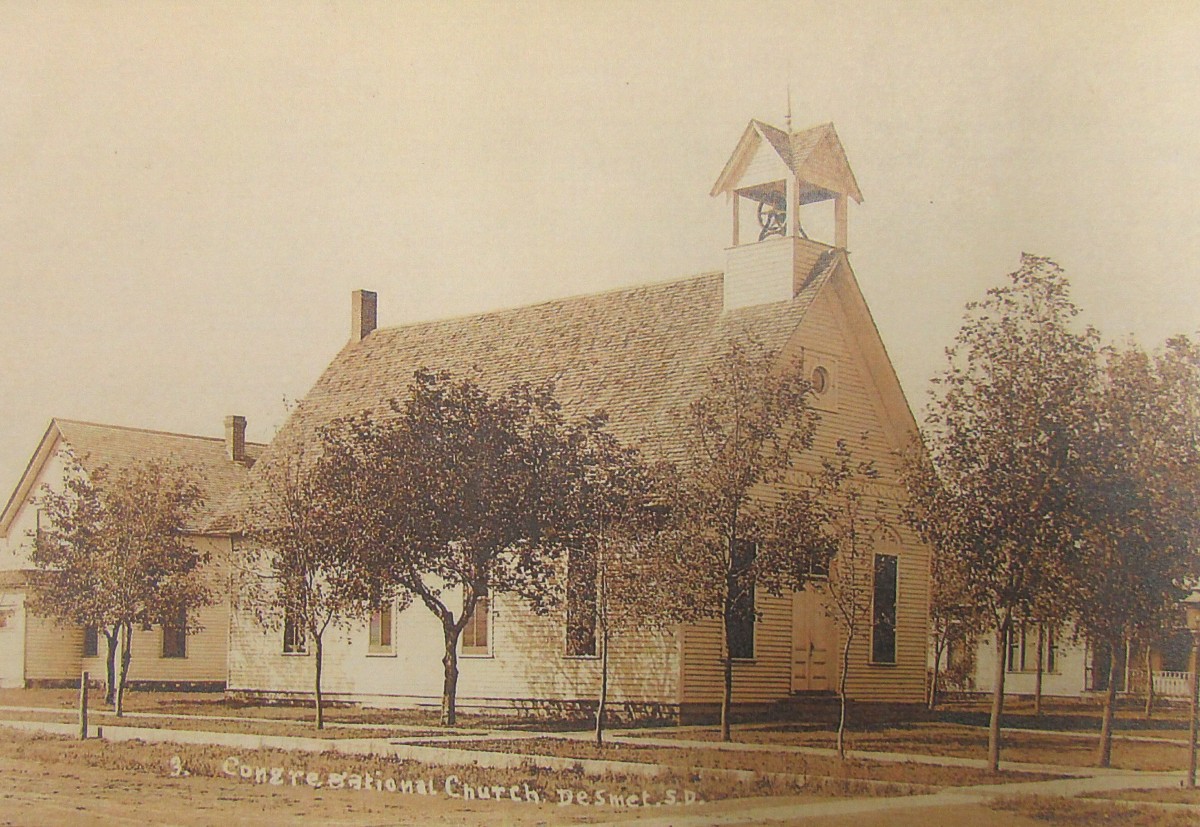
Our first stop was at the De Smet Community Church, which until last year was the De Smet Congregational Church. Laura’s parents and sister Mary were founding members of this congregation in 1880. The church moved to a new building on route 14 in 1966, and the old Congregational Church building was taken over by a Christian and Missionary Alliance (CMA) Church. So we also stopped by the CMA Church building. Charles Ingalls helped to build part of this structure in 1882. It was greatly enlarged (another wing was added) in 1909.

We then visited the Laura Ingalls Wilder Memorial Society. Tessa Flak, the director of the Memorial Society, very graciously gave us access to whatever we wanted to look at in their archives. I worked through several vertical file folders on the Congregational Church, Reverend Edward Brown, and Reverend Edwin Alden. I also looked at some letters written in 1930 by Laura and her sister Carrie Ingalls Swanzey about their early experiences in De Smet, including descriptions of early church services. By far the most fascinating piece from Carrie’s letter:

At the time there was just one other little girl in town my age. The first Sunday services were to be held in the depot. The men fixed the benches early in the morning and father came home and said the seats were all ready. So this little girl and I went over to take a look. No one was there and we went in and found that the seats were just a good jump apart. We started. I was the best jumper, could go the whole length without a miss or stop. The other girl did her best which was not bad, and I suppose we “yelled” our best too. Fun, never have had so much since. Then in the door came Rev. Woodworth-who was to preach that morning and he said “I don’t think that [sic] a very good way for little girls to act in the House of the Lord.” We disappeared.

But that goes to show how these early pioneer church people remembered a place which, if only for the time being was dedicated to the worship of God.

I found some other primary source material that will be a great help for the project. More on this later.

By the time I had looked at what I thought there was to see in the archives, it was early afternoon. I said goodbye to John because I wanted to take the Memorial Society’s tour of the Surveyors’ House and he had to head back to Brookings for a book discussion. The Ingalls family lived in the Surveyors’ House during the winter of 1879-1880. It has been moved into De Smet from outside town where it sat next to Silver Lake. This house is described in Pioneer Girl and (appropriately enough) By the Shores of Silver Lake. Like other historic homes connected with Laura, this house is quite small, much smaller than the impression you get from reading the novel. It is truly a little house.

After the Surveyors’ House, I drove to the historical marker where Laura and Almanzo’s homestead was located, north of town. All one can really see is a rise surrounded by hay fields. Then I went to the site of Silver Lake, to the southeast of town. The lake no longer exists, though there is a wetland. Then I drove past the grounds for the Wilder Pageant (“These Happy Golden Years,” plays weekends in July) to the Ingalls Homestead.

There is a rock with a historical marker on the northwest corner of the homestead, facing across the fields and big slough towards De Smet. This corner belongs to the Memorial Society, so there are signs for the Memorial Society’s homes and tour there. But the rest of the 160 acres that was proved up on by Charles and Caroline Ingalls belongs to a family-owned business called the “Ingalls Homestead: Laura’s Living Prairie.” The owners have created a hands-on experience for families that immerses you in the world of Laura Ingalls Wilder. There is a building with information about all of the places where the Ingalls family lived. There are replicas of a dugout cabin and the house that the Ingalls built on the homestead. There is a stable, and pony rides, and covered-wagon rides, and fields of corn, oats, and wheat. One can twist hay and make a rope. One can also camp there – there are spots for RVs and tents, or you can sleep in one of their covered wagons. There is an authentic one-room schoolhouse on the southwest corner of the property.

Finally, there is a church on the northeast corner of the property. The West Bethany Lutheran Church was built in 1905 about ten miles north and east of De Smet. The last services were held there in 1969. In 2009, the building was moved to the Ingalls Homestead. So I walked across the fields to this church. The building is incredibly well preserved and restored. I would estimate it could hold 60-70 people. There is also a full basement, and I thought – they must hold weddings here. It could be the perfect site for a destination wedding and reception for a Laura Ingalls Wilder enthusiast. One of the employees later told me that they have had several weddings in the church.

So I spent the late afternoon walking over the Ingalls Homestead, imagining what the land might have looked like and been like when Laura spent her adolescent years there.

My final stop in De Smet was at the De Smet Cemetery, where I visited the graves of Charles and Caroline Ingalls, their daughters Mary and Carrie, and the infant son of Laura. I then got on the road home. I drove the rest of the way from Sioux Falls, South Dakota, to Chicagoland on Friday, June 22.

I am very appreciative to my family for allowing me to take an entire week in Laura Ingalls Wilder country. It was good to see the places where she grew up in the upper Midwest. I still have not visited the Little House on the Prairie site in Kansas, but I hope to get there next year. I am just about done with chapter 2.

Thanks again for reading.

(The quote from Carrie Ingalls Swanzey is from her letter to Mr. Mallery, 11 April 1930, Collections IIA4a, Box 028A; and the picture of the De Smet Congregational Church is from the Congregational Church Folder in the Vertical File, both at the Laura Ingalls Wilder Memorial Society Archives, De Smet, South Dakota.)

Links:

The Laura Ingalls Wilder Memorial Society

The Ingalls Homestead

John Miller’s Amazon Page

My post on Becoming Laura Ingalls Wilder


Walnut Grove, Minnesota

On Wednesday, June 20, I visited Walnut Grove, Minnesota.

The Ingalls family lived on a farm about a mile and a half north of Walnut Grove from 1874 to 1876.  They initially lived in a dugout cabin next to Plum Creek, then Charles Ingalls built a wood frame house for the family in 1875. Unfortunately, a locust infestation destroyed the family’s wheat crop, and while he was able to get work in Eastern Minnesota to support the family, Charles could not pay off the debts involved in buying the frame house. These events are detailed in On the Banks of Plum Creek.

When they finally lost the farm, the family moved to Burr Oak, Iowa for a year. They returned and lived in the town of Walnut Grove from 1877 to 1879. Laura attended school and church in town and worked serving at a hotel. It was also during these years that Mary Ingalls got sick and became blind. These stories are presented in Pioneer Girl, but not in the Little House books. Much of this period is lost in the gap between On the Banks of Plum Creek and By the Shores of Silver Lake. Some of the events and themes of town life from this period are included in the later Little House books set in De Smet, South Dakota.

The land where the Ingalls dugout once stood is now owned by the Gordon family. They have prepared a parking area near to Plum Creek and the dugout site. Visitors who pay $5 per car ($30 per tour bus) can drive back, wade in Plum Creek like Laura, and see where the dugout was located. There are also two half-mile hiking trails.

The forecast that morning was for rain starting at around ten o’clock in the morning, so I hurried from my hotel in Springfield, Minnesota, to the dugout site. I arrived at about quarter to nine, put my $5 in the pay box (it’s completely on the honor system), and drove to the creek. When I got out of the car, I was shocked at how quiet it was. I could hear the creek, which was running very high and fast because it had rained most of the previous day. I could hear the birds in the trees around the creek. And that was it. There wasn’t any distant traffic noise. I was the only one visiting the site. I walked to the creek, crossed it on the bridge provided, and walk up the bank to where it is believed that the dugout was. I could see what Laura described in Plum Creek as the tableland. I looked across the fields and see the water tower in Walnut Grove.

I walked both hiking trails. The uneven landscape reminded me of the farm I grew up on in Western Pennsylvania. As I child I had also played next to a creek, though it was much smaller than this one. I have lived so many years right next to Chicago that I had forgotten what exactly this was like. However, eventually my shoes and socks were soaking because of the wet grass I was walking through; each step brought a squish. As a result, the spell was a bit broken by the time I got back to the rental car. I took off my shoes and socks and put on a pair of sandals. I then walked back to the creek and put one foot in, just so I could say that I did. The water was very cold. As I drove back to town a little after ten, the rain started.

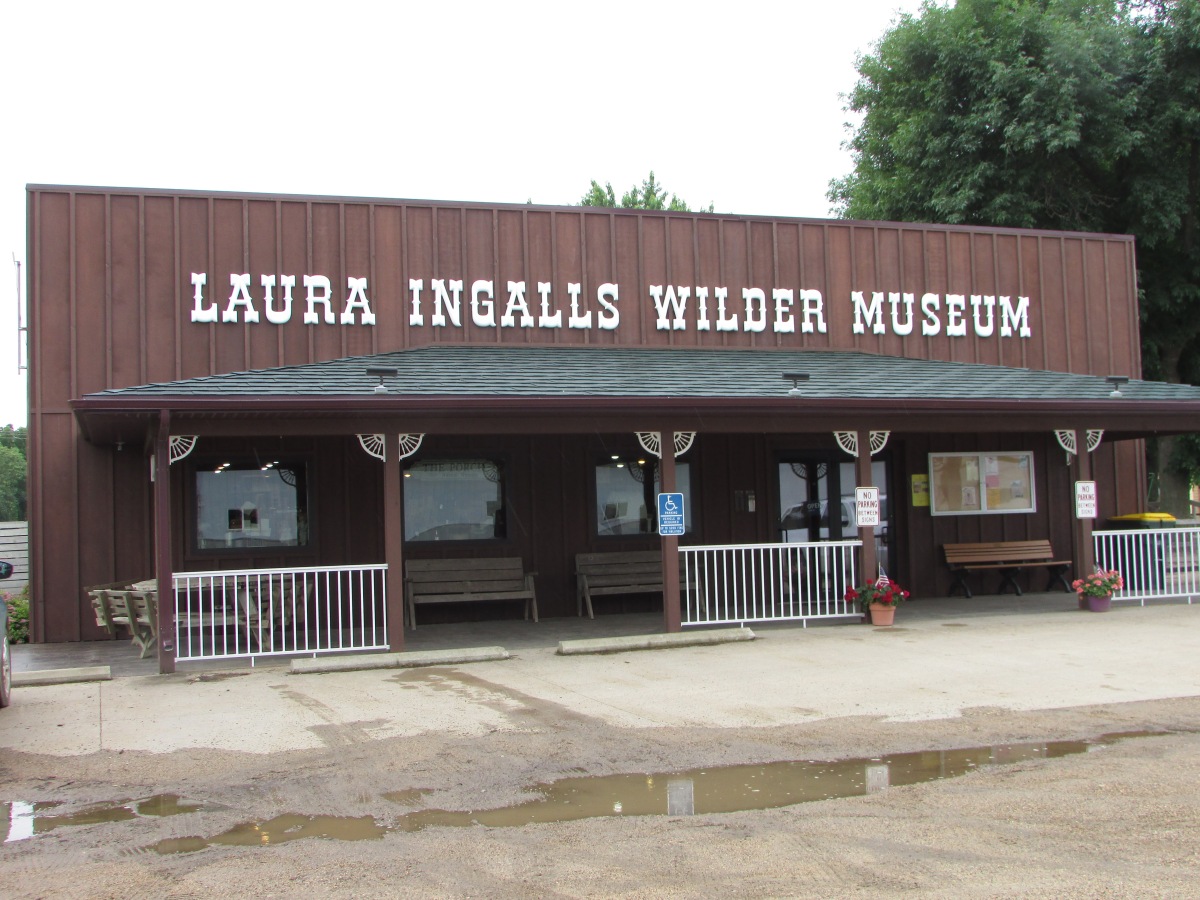
The Laura Ingalls Wilder Museum in Walnut Grove is much larger than its counterpart in Pepin. There are eight different buildings, each containing historical materials of different types. There is a railroad depot (pulled to Walnut Grove from another town) with two main rooms. One room contains materials about the Little House books and the historic Walnut Grove, including a quilt owned by Laura (and donated by Roger MacBride) and a pew from the Congregational Church. The other room is dedicated to the Little House on the Prairie television show, which was set in Walnut Grove during its entire nine year run (although it was shot in California). There is a replica sod house the size of the dugout on Plum Creek, and a replica settler’s house the size of the frame house the Ingalls lived in on their farm. “Grandma’s House” was built in 1890 and brought to the site. It includes exhibits of sketches by Garth Williams, the illustrator of the 1953 edition of the Little House books, old time kitchens, dolls, and military service.  There are also areas for children to play. There is a replica one-room schoolhouse and a small chapel built by a high school shop class in 1983. The last building, “Heritage Lane,” contains old print shop equipment, a telephone switchboard, a post office, a telephone booth, a covered wagon, and materials about American railroads. In between the buildings there are prairie grasses and flowers.  So there is a lot to look at and do in a small area. It would provide a lot of opportunities to families with young children.

Charles and Caroline Ingalls were founding members of the Congregational Church in Walnut Grove in 1875. When the family lived in town, Laura attended both the Congregational Church service on Sunday morning and the Methodist Church service on Sunday afternoon for a year.  This was because the Methodist Church was having a contest to see who could memorize 104 Bible verses, two for each week of the year. Laura succeeded and was awarded a reference Bible. The Methodist Church did not have their own building, so they met in a hall upstairs of the grocery store owned by William Masters. Pioneer Girl also describes revival services in both churches, a Sunday School picnic, and an experience with God’s presence which caused Laura to observe, “’That is what men call God.’” (Pioneer Girl, 137)

The Laura Ingalls Wilder Museum recently was able to purchase the Masters Building. Charles Ingalls helped to build this building, and this is where the Methodist Church held services at the beginning. Laura also lived in an apartment there while helping William Masters’s son Will’s wife Nannie. I was privileged to sit in the upstairs of that building with Joel McKinney, the Collections Manager for the Museum. The building was used as a private residence from about 1900 to several years ago. The inside has just been gutted, so Joel showed me the original floor joists, which are exactly two inches by twelve inches, and studs, which are exactly 2 inches by four inches. We talked about the history of the town and about what Laura would have seen when she looked out of the windows that floor of the building during a Methodist worship service. I really appreciated his hospitality and his insights.

The Congregational Church in Walnut Grove closed in 1952, and the historical papers of the church were given to the Methodist Church. Unfortunately, the Methodist Church experienced a break-in some years ago, and someone poured ink on all of the historical papers of both the Methodist and Congregational Churches. They had to be thrown out. Certainly a great loss for my project.

Next stop: De Smet, South Dakota.  Thanks for reading.

(Quote is from Laura Ingalls Wilder, Pioneer Girl: The Annotated Autobiography, edited by Pamela Smith Hill, [Pierre: South Dakota State Historical Society Press, 2014].)

Links:

Walnut Grove, Minnesota

The Laura Ingalls Wilder Museum in Walnut Grove

The Dugout site

Pepin, Wisconsin

On Tuesday, June 19, I visited Pepin, Wisconsin. Laura Ingalls Wilder was born in a log cabin about seven miles north of Pepin, at the site of what is now the Little House Wayside Cabin, a replica house and historical marker. The Wayside Cabin is built to correspond to how the cabin is described in Little House in the Big Woods. There is also a Little House on the Prairie Museum in town.

Pepin sits on the shore of Lake Pepin, a widening of the Mississippi River. Across the river is Minnesota. The town was founded in 1855 as a steamboat landing. The Ingalls family bought the land and built the cabin in 1863. Mary Amelia Ingalls was born in the cabin in 1865, and Laura Elizabeth Ingalls was born there in 1867. They left for Kansas in 1868, but returned in 1870 to live there several more years. They moved to Walnut Grove, Minnesota in 1874. Their experiences in Wisconsin are collapsed into the one year described in Little House in the Big Woods. They are also described in Laura’s memoir Pioneer Girl.

The Laura Ingalls Wilder Museum in Pepin has several rooms full of old tools, clothes, kitchen technology, and artifacts from World War I. It does have one quilt that belonged to Laura Ingalls Wilder and one that belonged either to Laura or her daughter Rose Wilder Lane. It also has some artifacts from the Barry Corner School that Laura and Mary attended with their cousins, including an attendance sheet with their names on it. The museum has a room with a replica covered wagon, a fishing boat, a steamboat that children can play in, and other toys for the kids (sunbonnets, etc.) In the final room, there is a replica one-room schoolhouse with a looping video about Pepin with information drawn from the book The Village of Pepin in the Time of Laura Ingalls Wilder, which I bought at the gift shop. Some of the houses built before the 1860s still stand.

None of the sources about Laura Ingalls Wilder’s life mention that the family attended church services when they lived in Wisconsin. Most biographers suggest that the seven miles to Pepin was too far for a weekly journey. I believe that there was a Methodist Church in Pepin at the time, but not a Congregational Church. The family later attended Congregational Churches in Walnut Grove, Burr Oak, and De Smet.

I did discover that there are two country churches not far from the Wayside Cabin. On this trip, I was able to drive to them: the Lund Mission Covenant Church and the Sabylund Lutheran Church. One can actually see the steeple of the Lutheran church from the parking area at the Wayside Cabin. The website for the Lund Mission Covenant Church says that it was founded in 1874, which was the same year that the Ingalls family left. The Sabylund Lutheran Church apparently was founded in 1856, so it would have been in existence when the Ingalls family were living in Wisconsin, although I don’t yet know if it would have been in its current location. If it was, it would have been in walking distance from the Ingalls’ cabin. The distance would certainly be less than the mile and a half that the family walked to church in Walnut Grove, Minnesota. The current Sabylund Lutheran Church building is a large brick structure that was built in 1893, or at least that’s what the cornerstone says. I have reached out to both churches via phone and email but have not yet been able to make a connection. I do have a suspicion that the Lutheran Church may have initially conducted services in German or perhaps Swedish or Norwegian. The Mission Covenant Church may have held services in Swedish.

I also walked along the shore of Lake Pepin, since that is mentioned in Big Woods. There is a public beach that is both sandy and pebbly; Big Woods tells the story of Laura picking up pebbles on the beach. The beach also has a lot of shells.

My next stop was Walnut Grove. Thanks for reading.

Links:

Laura Ingalls Wilder Museum in Pepin

The Wayside Cabin

Lund Mission Covenant Church

Sabylund Lutheran Church

Burr Oak, Iowa

This week I am taking a research trip to some of the places where Laura Ingalls Wilder lived. I thought I’d process some of what I’ve learned by blogging about it.

Yesterday, I drove from Chicagoland to Burr Oak, Iowa, in the northeastern corner of the state. The Ingalls family lived in this town for right around a year, from fall 1876 to 1877. Laura was 9-10 years old. Their time in Burr Oak is not mentioned in any of Little House books; it comes in the lost years between the end of On the Banks of Plum Creek and By the Shores of Silver Lake.

In some ways, the family’s time in Burr Oak was the nadir of Laura’s childhood. The Ingalls family had lost their home in Walnut Grove, Minnesota, because of the locust plague. They had then moved to southeastern Minnesota to live with extended family for a short period of time. Their youngest child and only son Charles Frederick (everyone called him Freddie) got sick and died there. Then they moved to Burr Oak, where Charles Ingalls briefly worked for the Steadman family, owners of a hotel named the Burr Oak House or the Masters Hotel. Ma made meals for the guests and boarders, and Mary and Laura served them. Later, Charles worked for a feed mill. The family remained in debt. There was a saloon right next to the hotel, and the young girls were exposed to lawlessness and immorality.

Burr Oak was founded in 1850, before the Civil War. By the late 1870s, it was a town that the railroad passed by; instead stagecoaches rolled through Burr Oak to take people to railway stations. As a result, the community’s best years were behind it. It could no longer support two hotels, and the Steadmans sold Masters Hotel and moved to southern Iowa late in 1877. Finally, Burr Oak was very small when the Ingalls lived there – about 200 people. (It is smaller today; my tour guide said its population is about 169.)

The building that was the Masters Hotel still stands. After more than a hundred years as a private residence, it was purchased in 1973 and opened as the Laura Ingalls Wilder Park and Museum in 1976. It is unique in that it is the only one of Laura’s childhood homes that still stands on the same site. Like the other Ingalls and Wilder homes in existence (Almanzo’s childhood home near Malone, New York, the Surveyors House in De Smet, South Dakota, and the two houses on the farm near Mansfield, Missouri), the building is very small. It is hard to believe that it served as a hotel. The main floor has a barroom and parlors, the Steadmans’ room, and a wealthy permanent boarder’s room. In the upstairs there are four rooms – three for hotel guests and one for another permanent boarder. The stagecoach driver slept right at the top of the steps. Finally, there is a downstairs that has the kitchen, dining room, and a kitchen bedroom where the Ingalls family slept. The building is built into a hill, so that the main floor opens onto the main street and the downstairs opens onto the back yard which runs down to a small creek. With the exception of the downstairs dining room, I don’t think that any of the rooms in the building is larger than twelve by twelve feet. The Steadmans and Ingalls families had five members each, all sleeping in one small room.

The Ingalls family only lived in the hotel for several months. Then they moved to an apartment upstairs of the grocery store, two doors down from the hotel (on the other side of the saloon). Several months later, after a fire at the saloon, they moved several blocks away to a rented house. It was there that Laura’s youngest sister Grace was born.

Laura’s memoir Pioneer Girl has a section on Burr Oak, even though the Little House books do not. There are stories of local young men getting drunk at the saloon and harming others and themselves. Also during this year, a local wealthy couple offered to adopt Laura. She and Mary did have good experiences attending school with Mr. Reed, a good teacher, elocutionist, and disciplinarian. Laura also tells of visiting the cemetery to get some solitude.

When the Ingalls lived in Burr Oak, they attended the Congregational Church. There was also a Methodist Church. The year after they left, a Seventh Day Adventist Church was built. The Congregational Church building was moved to a different part of town in 1907 and used as a private residence. However, the church bell was sent to a Friends (Quaker) church in Hesper, Iowa, about five miles away. The Hesper Friends Church has since closed, but the bell has been given to the Wilder Park and Museum, which while I was there was having a small enclosure built next to the Hotel building so that visitors can hear it ring.

It was good for me to have a view of the hotel and its surroundings for when I write the chapter on Burr Oak and Walnut Grove. I was also able to see the site where the Congregational Church stood. The Methodist Church building has been renovated and added onto, but the shell is what stood here in the late 1800s. And the Advent Christian Church building is also now is owned by the Wilder Park and Museum. Director Barb Olson opened that building so that I could see the inside of it.

The last thing I did before getting on the road was visit the Burr Oak Cemetery. There I saw a number of gravestones from the late 1800s. I was walking where Laura Ingalls Wilder once walked, looking at the landscape that she once saw. While that landscape has changed in many ways in the nearly 150 years since she lived there, I did feel a powerful sense of connection to the past and to her life.

Many thanks to Barb and Laura Ingalls Wilder Park and Museum workers Anastacia, Anna, and Kelly! Also, if you’re reading this and live within striking distance of northeastern Iowa and don’t have plans for this weekend, consider going to Burr Oak for the Laura Days Celebration. It starts Friday evening and and includes a 5k race, live musical entertainment, food, games for the kids, and a Little Miss Laura and Young Almanzo contest.

Thanks for reading. Feel free to make comments.

Links:

The Laura Ingalls Wilder Park and Museum

Support the Park and Museum by buying stuff at their store

Laura Days

Pioneer Girl: The Annotated Autobiography

My blog post on Pioneer Girl


A Prairie Girl’s Faith

At the beginning of 2018, I mentioned at the end of my post on Caroline Fraser’s Prairie Fires that I might be posting less often this semester because I hoped to be writing the first chapter of my book. When I looked at the blog and saw that the last entry was uploaded on February 23, I realized that the first part of that statement was true. Unfortunately, the second part is not – I have been swamped by grading and administrative work here at Trinity Christian College this semester. It’s good work, but it’s not work on the book.

However, lately I was able to read Stephen Hines’s A Prairie Girl’s Faith: The Spiritual Legacy of Laura Ingalls Wilder. I learned last summer that this book was coming out, and it made me nervous. This was right when I was hoping to get a book contract from Eerdmans. Would his project steal my thunder? Would Hines say everything I had to say? I believed at the time that I would approach the subject of Wilder’s faith in a much different way than Hines would, but I was not sure. As it turns out, I did not need to be anxious. A Prairie Girl’s Faith is not the book that I would write or that I hope to write.

Stephen Hines has described himself as a “literary prospector” who looks for unpublished works by famous writers that are not under copyright and therefore can be collected and republished. Hines has been editing books of Wilder’s writing since the early 1990s. Most of these book have reprinted collections of Wilder’s articles in the Missouri Ruralist. The most complete of these books is Laura Ingalls Wilder: Farm Journalist, from 2007. He also published Saving Graces: The Inspirational Writings of Laura Ingalls Wilder in 1997. I have written blog posts on both of these books.

A Prairie Girl’s Faith is not a biography of Laura Ingalls Wilder. It is not a scholarly examination of the nature of Wilder’s faith either. It is more a collection of Hines’s reflections and observations about aspects of Wilders’ life and writings. Most of these reflections have to do with Wilder’s faith, though he also engages the relationship between Wilder and her daughter Rose Wilder Lane and their literary collaboration on the Little House books. Since I hope to write a scholarly biography that examines the nature of Wilder’s faith, I was relieved to discover this. This also means that I should judge the book that Hines wrote, not the book that he didn’t write.

On these terms, the book includes some good insights. Hines has read the Little House books many times. He details how he first found them as a child in rural Kansas and also how he read them aloud to his wife in the kitchen during their early marriage. He knows the Little House books inside and out. He has also read Wilder’s recently published memoir Pioneer Girl and other important works about Wilder and Rose by William Anderson, John Miller, Pamela Smith Hill, William Holtz, and Dale Cockrell. He engages the many ways that the Little House books mention faith, especially descriptions of Sunday School, church worship services, and hymns sung by the Ingalls family. Hines’s extensive familiarity with Wilder’s Missouri Ruralist articles is also clear throughout the book.

Several chapters treat Wilder’s childhood, as described in the Little House books. Several chapters engage the relationship between Laura and Rose and the writing of the books. There is a chapter on the hymns referenced in the Little House books. And there is a chapter of recipes from Caroline Ingalls and other women from De Smet taken from a cookbook published in 1915.

The book also provides some background information about the Congregational Churches in Walnut Grove, Minnesota, and De Smet, South Dakota. An Appendix on De Smet reproduces some articles from the De Smet News and the Kingsbury County News about churches in De Smet. I had never seen these articles before, so they were very helpful.

Hines correctly notes that the central values of Laura and Rose were not the same, and he understands that Rose’s collaboration in the publishing of the Little House books may have shaped how those works depict Christianity. He writes in one chapter,

In fact, it is possible that Rose may have tried to downplay her mother’s faith in the Little House books. For example, in Laura’s original Pioneer Girl manuscript she spoke several times about asking for forgiveness for wrongdoing. But this act of contrition did not show up as many times in the Little House series. However, admittedly, that subtle difference may provide scant actual proof. (62)

As I have written in other blog posts, I believe that Rose did shape the depictions of Christianity in the Little House books. However, the evidence I use is the comparison of Laura’s original manuscripts of Farmer Boy and On the Banks of Plum Creek and the final published works. So I think that there is more evidence (I prefer using “evidence” to “proof”) for these changes than Hines does. But I think his observation is insightful, especially since he is just comparing Pioneer Girl to the Little House books.

The concluding chapter is titled “What Laura Means to Us.” Hines’s summary reads, “I like to think we can still learn lessons from Laura’s accumulated experience and reflection, among which is tolerance for other’s failings, courage to start all over again after disaster strikes, and a belief that God holds the future in his hands and intends no ill will for his children.” (158) I agree that these are lessons that one can learn from the Little House books, and I appreciate this clear and pithy assessment of some aspects of their abiding value.

Unfortunately, at times the book presents accounts from the Little House books as if they are literal descriptions of what happened during Wilder’s childhood, the same as accounts from Pioneer Girl. But it seems clear to me that the descriptions and narratives in the Little House books were formed and shaped in a multitude of ways for a number of different reasons. Some of the shaping is for narrative purposes. Some of the shaping has to do with audience. Some of the shaping, I believe, was done by Rose and not by Laura. So I would find Pioneer Girl to be a much more reliable source than the Little House books for how Laura experienced faith.

I also find it striking that the book does not mention Laura’s most clear description of an experience of God’s presence. As a child in Walnut Grove, she describes “One night while saying my prayers, as I always did before going to bed, this feeling of homesickness and worry was worse than usual, but gradually I had a feeling of a hovering, encompassing Presence of a Power, comforting and sustaining and thought in surprise ‘This is what men call God!’” (Pioneer Girl: The Annotated Autobiography, ed. by Pamela Smith Hill, [Pierre: South Dakota State Historical Society Press, 2014], 137) Hines mentioned this account in the introduction of Saving Graces. I was shocked that it is not included in this volume.

Finally, the book often presents Christianity as “Christian values” or the “values of hearth and home.” For instance, when arguing that Laura should be credited with supplying the central themes of the books, not Rose, Hines asserts “And whatever else they are, Laura’s books are a story about building a home in the wilderness; they are not about raw nature itself, however raw that nature can be. No, the Christian family values of the books are overwhelming. The sacredness of home and hearth are everywhere present.” (69) Admittedly, in other parts of the book Hines does assert that Laura did have a personal relationship with God through Christ. In my work on Wilder, I hope to press more consistently beyond vaguer notions of values Wilder’s relationship to the gospel of sin and salvation in Christ.

Still, I’m grateful to Hines for raising some of the issues I hope to address in my book, and for pointing me in some new directions in terms of sources. Thanks for reading.

(Quotes are from Stephen W. Hines, A Prairie Girl’s Faith: The Spiritual Legacy of Laura Ingalls Wilder [New York: Waterbrook, 2018].)

Links:

Doing fewer blog posts this semester

Trinity Christian College

Book contract from Eerdmans

Hines as Literary Prospector; also here

Post on Saving Graces: The Inspirational Writings of Laura Ingalls Wilder

Post on Laura Ingalls Wilder: Farm Journalist

Post on Pioneer Girl: The Annotated Autobiography

Post on Rose’s shaping of the depiction of Christianity in the Little House books

Pioneer Girl Perspectives Review

Well, last Friday I was mentioned that I might not blog as much this semester, and here I am posting a week later. . .

Last year I wrote a review of Pioneer Girl Perspectives, a book of essays from the South Dakota State Historical Society (SDSHS), for The Annals of Iowa, a historical journal published by the Iowa State Historical Society.  The Annals gave permission to the Pioneer Girl Project of the SDSHS to reproduce that review on their website:  https://pioneergirlproject.org/2018/01/25/a-worthy-companion-review-of-pioneer-girl-perspectives/

It’s slightly briefer than my blog post on the book.  Thought you might be interested.  Best wishes.

Other links:

My blog post on Pioneer Girl Perspectives

The Annals of Iowa


Pioneer Girl Perspectives

At the end of last week, I was able to read the new book of essays from the South Dakota State Historical Society Press, Pioneer Girl Perspectives: Exploring Laura Ingalls Wilder. The book was edited by Nancy Tystad Koupal, who organized the Laura Ingalls Wilder: A 150-Year Legacy conference in Sioux Falls at the end of April. I bought the book at that conference. (All hyperlinks will be at the bottom of this post, with an explanation.)

The book is divided into four sections:

“Working Writers” – This section begins by reprinting the speech Wilder gave at the Detroit Book Fair in 1937. Then Wilder biographer Nancy Fraser links Rose Wilder Lane to the yellow journalism of the early twentieth century to explain Lane’s use of the “Bloody Benders” story in her attempts to get a publisher for Pioneer Girl. Finally, Lane biographer Amy Mattson Lauters reviews the many different types of prose that Rose published.

Beginnings and Misdirections” – Wilder expert William Anderson gives a brief history of the Pioneer Girl manuscript between Wilder’s death in 1957 and its publication in 2014. Literary scholar Michael Patrick Hearn engages how Pioneer Girl and the Little House books were written and compares them to other works of literature. Finally, Noel Silverman, counsel for the Little House Heritage Trust, in an interview with Koupal, provides what he believes are the reasons for the Little House books’ enduring popularity.

Wilder’s Place and time – Historian and Wilder biographer John E. Miller describes the Midwestern context of Wilder’s life and work, comparing it to works by Harvey Dunn, Willa Cather, and Frederick Jackson Turner. Then historian Paula Nelson places Wilder’s views on family, women’s roles, farming, and woman suffrage into historical context.

Enduring Tales and Childhood Myths – Wilder biographer Sallie Ketcham examines the different ways that Little House in the Big Woods displays the characteristics of a fairy tale. Historian Elizabeth Jameson considers how Wilder’s troubled and poverty-ridden childhood, as described in Pioneer Girl, was transformed into the happy childhood of the Little House books. Finally, literature scholar Ann Romines considers possible reasons there are no old people and why nobody dies in the Little House books.

Overall, it’s an excellent book. It’s slightly larger than a normal hardback, and the dust jacket is beautiful. It includes many illustrations from the original Helen Sewell editions of the Little House books, as well as historical photos of Wilder, Lane, and others. Many of the essays fill in gaps of Wilder scholarship or just bring together what we already know in helpful ways.

Like all books of essays, however, some chapters are more insightful than others. All of the authors of the book spoke at the 150-Year Legacy conference, and my blog post on the conference mentions what I found most memorable. After reading their work, I believe that Fraser, Anderson, and the historians (Miller, Nelson, and Armitage) have the strongest essays. Silverman’s observations are also quite helpful.

Two sections of the book provide food for thought for my project on the faith of Laura Ingalls Wilder. First from Miller’s essay:

Wilder kept a list of favorite Bible verses close at hand and sometimes devoted all or part of her Missouri Ruralist column to the need for people to get and treat each other benevolently in a Christian fashion. Although her particular religious beliefs and doctrinal positions cannot be known, we can speculate that her high degree of religiosity placed her in conformity with the conservative religious and political views of the majority of her neighbors. Springfield, the largest city in southwestern Missouri and located just fifty miles west of Mansfield, was a hotbed of old-time religion. Among other things, it became a center of gospel and country music, served as worldwide headquarters for Assemblies of God churches, and housed the regional offices of several other denominations. (p. 155)

So Miller says that her exact beliefs cannot be known. It’s sometimes difficult to be working on a project that Wilder scholars say can’t be done. I guess that I may not be able to pinpoint particular doctrinal positions, but I believe that the available evidence points in some particular directions. I agree that Wilder’s faith was probably influenced by her living in Southwestern Missouri for most of her adult life.

Paula Nelson’s essay makes several observations about Wilder’s Missouri Ruralist articles, about her church life, and about Wilder’s childhood experience with God:

Laura Ingalls Wilder’s life philosophy shines through her columns, no matter the specific topic, and her ideals sprang from her deep Christian faith, learned at her mother’s knee and practiced as a Congregationalist in her earlier life. She and Almanzo became Methodists in Mansfield, where there was no Congregational church, but she recalled a religious experience from her youth in her autobiography. The Ingalls family was in dire straits during their second stay in Minnesota, and the young Wilder was intensely worried. Her bedtime prayers were more fervent than usual, she said, when “gradually I had a feeling of a hovering, encompassing Presence of a Power, comforting and sustaining and thought in surprise ‘That is what men call God!’” Congregationalists required a testimony of religious awakening for full membership in the church in the nineteenth century, and this experience may have been hers. (p. 184)

Wilder’s religious experience in Pioneer Girl is central to any understanding of her faith. I appreciate Nelson’s suggestion that this testimony could have been used to gain full membership in the Congregational church in Missouri or Dakota. I need to track down if there are church records that place when she became a member. Unfortunately, the climax of the story is misquoted here: it’s actually “This is what men call God.” (Pioneer Girl: The Annotated Autobiography, p. 137, emphasis mine) It’s also important to note that the Wilders attended the Methodist Church in Mansfield but never became members.

Thanks again for sharing the journey with me. Comments are welcome.

(Page numbers are from Pioneer Girl Perspectives: Exploring Laura Ingalls Wilder, Nancy Tystad Koupal, ed. [Pierre: South Dakota State Historical Society Press, 2017].)

Links:

Laura Ingalls Wilder: a 150-Year Legacy Conference Site

My blog entry on the conference

Nancy Fraser’s forthcoming biography of Wilder: Prairie Fires

(Members of my family have been reading Nicholas Carr’s The Shallows: What the Internet is Doing to Our Brains. It has challenged me to consider whether having the hyperlinks in the text of my blog entries encourages people to read poorly. So I thought I’d see what things looked like if I put all the links at the bottom of the post.)

Laura Ingalls Wilder: A 150-Year Legacy

Well, it’s May. It’s somewhat embarrassing that I haven’t posted anything since the middle of March. I could give some excuses. I could describe how in the last two months I’ve traveled to Pennsylvania (twice), Wisconsin, and South Dakota. But instead, I will try to make up for my lack of action by posting to the blog several times this week and next. (It’s finals week here at Trinity Christian College, so I have high hopes.) This post will report on the conference I attended in South Dakota at the end of last week. Lord-willing I will next put up a final report on the Honors Seminar I taught this term, and then an update on where the project is.

Last Friday and Saturday, the South Dakota State Historical Society (SDSHS) hosted the Laura Ingalls Wilder: A 150-Year Legacy conference in Sioux Falls. It was an incredibly good event. I think that there were over 200 people in attendance. The SDSHS Press published Wilder’s previously unpublished memoir Pioneer Girl: The Annotated Autobiography several years ago. It was a beautiful book, and as I mentioned in my blog entry on the book, it became a surprise best-seller.  The Press has followed up that volume with a book of essays released this year titled Pioneer Girl Perspectives: Exploring Laura Ingalls Wilder. The conference speakers had all written an essay in that book. Nancy Tystad Koupal, the director of the Press and editor of the book presided over the conference. Pioneer Girl Perspectives will not be available to the public until the end of May, but it was for sale at the conference. I sold two copies of my last book, Almost Pioneers, so I was able to buy a copy.

As far as the presentations went, there were several that were especially insightful. One was by Caroline Fraser, who edited the two-volume Library of America edition of the Little House books and who has a new biography of Wilder coming out in November: Prairie Fires: The Life and Times of Laura Ingalls Wilder. Fraser placed Wilder’s daughter Rose Wilder Lane’s career in context of Yellow Journalism during the early 20th century, where “fake news” was used to attract readers. Fraser uses that context to explain why Lane included the story of the “bloody Benders” in some of the manuscripts of Pioneer Girl, and why Wilder mentioned them in her Detroit Book Fair Speech. Bill Anderson’s talk about what happened to the Pioneer Girl manuscripts between 1957 and the 1970s had some great stories and filled in many gaps in my knowledge of the manuscripts. And Sallie Ketcham described some ways that the Little House books, and especially Little House in the Big Woods, have characteristics of fairy tales.

Several historians presented, and they were excellent. Paula Nelson mined Wilder’s Missouri Ruralist articles to describe Wilder’s relationship to her time, especially Wilder’s ideas about women’s suffrage. Wilder’s pioneering was physical and geographical; she was not a pathbreaking feminist. Her ideas were shaped by the nineteenth century, and she believed in family, church, authority, self-control, and tradition. John Miller uncovered ways that Wilder was a Midwestern girl. Finally, Elizabeth Jameson outlined some of the reasons why the Little House books may be excellent literature, but they’re not representative of childhood on the late nineteenth century frontier. Wilder’s actual experiences, as outlined in Pioneer Girl, were in many ways not happy. She worked for wages to support the family, often had to live away from home, and was nearly sexually assaulted. But Wilder transformed her experiences into the happy childhood presented in the Little House books, and that may mislead people as they think about families in the past. I believe that it is important to have novels like the Little House books that put forth ideals of love and support for families to emulate. But I do understand Jameson’s critique. I would also feel better if Wilder and Lane had not told many people that the books described exactly what happened.

In addition to presentations, there were also panels of authors who discussed major controversies concerning Pioneer Girl and the Little House books. These included the roles of Wilder and Lane in their composition, and the political ideas presented in them. The panelists agreed that Lane acted as an editor and an agent for the books, but not as a ghostwriter. There was disagreement over whether Lane should be called a collaborator. Fraser and Miller argued that she was a collaborator, Koupal and Michael Patrick Hearn (a children’s literature scholar) asserted that she was not. The consensus about political ideas is that while there are some libertarian ideas in the Little House books (watch for a blog post about Christine Woodside’s Libertarians on the Prairie in a week or two), some arguments about the books’ political nature are overblown.

The conference was also great for networking. I was fortunate to meet Jameson (I had read two books she edited on women in the west when I was in graduate school at the University of Iowa), Fraser, and Koupal for the first time. I also really enjoyed catching up with friends who attended, including Anderson, Miller, Nelson (she and I both had Malcolm Rohrbough as our dissertation advisor at Iowa), and Michelle McClellan, who teaches at the University of Michigan and is working on a book about the Little House historical sites. I also saw Sarah Uthoff from Trundlebed Tales, who live tweeted the conference (see her day 1 and day 2 compilations), and Sandra Hume from Little House Travel and the Laura Ingalls Wilder Legacy and Research Association (organizers of LauraPalooza – more on this in later blog entries). I also spoke briefly with Jon Lauck, who started the Midwestern History Association several years ago. It was also neat to talk to some women who just love the Little House books, especially Kasey and Alice, who bought the copies of Almost Pioneers.

All in all, this conference has given me new energy for getting back to work on the Faith of Laura Ingalls Wilder. So Lord-willing there will be more material on the blog in the near future. Thanks for reading.

Updates / Prairie II

I’ve been working on several parts of the Faith of Laura Ingalls Wilder project for the last several weeks. My plan was to get as much as possible done before the due date of the first paper in my Western Civilization course here at Trinity Christian College. It was handed in today. So I will be grading for the next week, and then that class will be taking the first exam, so I’ll be grading for another week…

I did get confirmation this week that I will be speaking at the Midwestern History Conference, sponsored by the Midwestern History Association, in June. The panel is on “The Uses of Public Memory in the Rural American Midwest.” My paper title is “Little House and Little Church: Memory and the Church in the Published Works of Laura Ingalls Wilder.” Many thanks to panel organizer and presenter Nancy Berlage from Texas State University and presenter David Brodnax, Sr., my colleague here at Trinity. Thanks also to Commenter Jon Lauck, and Chair David Zwart.

I was able to finish my lecture for the Calvin College History Department Colloquium that I will be speaking at later this month. Many thanks to Will Katerberg and the Mellema Program in Western American Studies for inviting me. The lecture is titled “‘This is What Men Call God:’ The Faith of Laura Ingalls Wilder.” I also finished a presentation for a Faculty Coffee here at Trinity, which will be the week after I speak at Calvin.

This week I also traded emails with John Miller about Wilder manuscripts, and he told me about a conference in April in honor of the 150th anniversary of Wilder’s birth. It’s called “Laura Ingalls Wilder: a 150 Year Legacy,” it’s being put on by the South Dakota State Historical Society (SDHS) in Sioux Falls. The SDHS is releasing a new book of essays on Wilder, and the conference will have all of the big names in Wilder studies. I’m trying to figure out if I can go. It’s during my last week of classes.

Meanwhile, I’ve been enjoying my Honors Seminar on the Little House books immensely. So far we’ve read and discussed Little House in the Big Woods, Farmer Boy, and Little House on the Prairie. The students are pointing out things to me that I hadn’t noticed. For instance, they noted that during the account of the family’s getting malaria (“Fever and Ague”) in Prairie, baby Carrie isn’t mentioned at all. (Carrie is actually mentioned twice in the chapter, but it is before and after the family is sick.) Who took care of the baby while everyone was stricken? This sent me to Pioneer Girl. In that memoir, the story of malaria is given before the story of Ma giving birth to baby Carrie. But because of the order in which the children’s books were published, Carrie was already in Big Woods, so she had to be in Prairie. We also discussed other challenges involved in running two timelines in our heads – the timeline of the Little House books and the timeline of Wilder’s actual life…

I also found an additional mention of Christianity in Little House on the Prairie that I hadn’t written about last year. In chapter 17, when Pa is gone to town, Ma sits up late in the rocking chair by the fire with Pa’s pistol in her lap and sings “There is a happy land / Far, far away, / Where saints in glory stand, / Bright, bright as day. / Oh, to hear the angels sing, / Glory to the Lord, our king.” (359) I probably should have noticed this when I worked through The Ingalls Wilder Family Songbook, but I didn’t.

Thanks for listening.

(The page number reference is from Volume 1 of the two volume set of the Little House books published by the Library of America in 2012.)