
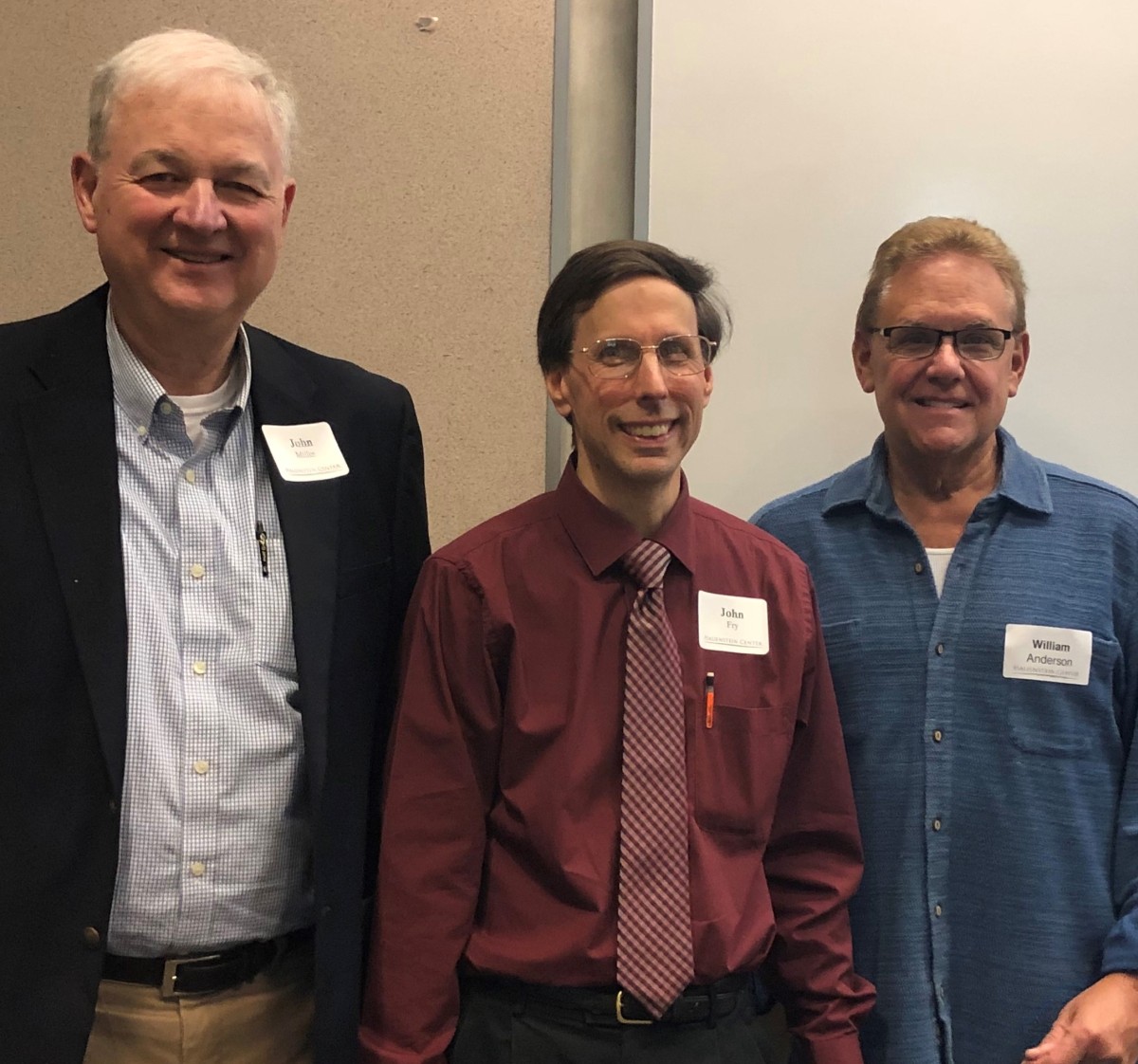
Last Thursday and Friday, I attended the Midwestern History Conference in Grand Rapids, Michigan. I had a great time.
The conference was sponsored by the Midwestern History Association and hosted by the Hauenstein Center for Presidential Studies at Grand Valley State University (GVSU). It was held at GVSU’s Pew Campus in downtown Grand Rapids.
I presented on a panel on Thursday morning titled “‘Everyone Has a Wilder Story:’ Laura Ingalls Wilder, the Midwest, and Historical Research.” It was a privilege to join Bill Anderson and John Miller. We each told the story of how we came to research and write about Laura Ingalls Wilder. Bill has been writing about Laura since the 1960s and has published over twenty-five books. I have previously mentioned four on this blog (links are at the end). John has written three books about Wilder and De Smet, South Dakota, including the most scholarly biography to date, Becoming Laura Ingalls Wilder. They included me, even though I did not read the Little House books when I was a child and I did not grow up in the Midwest. There were around fifteen attendees at our session, which was respectable, given the fact that there were nine other sessions going on at the same time. (I attended other sessions with only five people in the audience.) Discussion during the Q&A was also robust.
I used some of my presentation to reflect on “Everyone has a Wilder Story” in a second way. I think that many people today have a story that they tell about Wilder – about who she really was, and about how we should understand her life and respond to it today. This “Wilder story” guides how they read the Little House books and Wilder’s other writings, and it guides how they view her legacy. So I used my presentation to roll out some possible “Wilder stories,” some tentative ways of understanding Laura’s faith. I don’t think that any of these will come as a surprise to regular readers of this blog
– First, Laura was a committed Christian, attended Christian worship services, read the Bible, and prayed her entire life. She engaged in Christian practices that built her relationship with God and Jesus Christ.
– On the other hand, she never publicly identified with an individual body of believers – she never officially joined any church.
– On a third (?) hand, the original, handwritten manuscripts of the Little House books have more straightforward and positive descriptions of God, Christianity, and the church than appear in the published Little House books. These accounts were changed—most likely by her daughter Rose, who was agnostic when they were written—into the more negative depictions that appear in the published books.
– On a fourth (!) hand, Laura can probably not be understood as an Evangelical Christian. Her descriptions of God, Christianity, and church emphasize God’s power, His laws, and individual moral choices. Her writings almost never mention Christ, forgiveness of sins, or salvation.
It’s complicated. The more I engage the faith of Laura Ingalls Wilder, the more I despair of having just one ‘Wilder story,’ or a simple way of describing her faith. But if I was to have to give an overarching narrative for Laura’s life, I might say that she believed that people do not live by bread alone. Bread is necessary, but faith, community, and family relationships are more important. There are ironies here, too. Her relationship to the church she attended and the community she lived in was often ambivalent. Her own relationship with her own daughter was marked by misunderstandings and, at times, open conflict. Yet in the midst of these difficulties, Laura and Rose together created, in the Little House books, an immensely attractive vision of human flourishing that influenced millions of Americans during the middle to late twentieth century.
Other highlights of the conference included Anna Lisa Cox’s plenary talk on Thursday night and a session I chaired on Friday about music in the Midwest. Many thanks to Trinity Christian College for a travel grant to go to the conference. Thanks also to David Zwart, who teaches at GVSU, for letting me crash at his place on Wednesday and Thursday night.
As always, thanks for following along.
Links:
2019 Midwestern History Conference
Post on Bill Anderson’s Laura Ingalls Wilder: A Biography
Post on Bill Anderson’s The Selected Letters of Laura Ingalls Wilder
Post on Bill Anderson’s Little House Sampler and Little House Reader
Post on John Miller’s Becoming Laura Ingalls Wilder
 The Faith of Laura Ingalls Wilder