
It has again been two weeks since I posted. Last week I went to a conference for work from Thursday to Saturday, and that took out the days I usually have to read and write. But I was able to read Little Town on the Prairie yesterday morning.
There are a lot of things going on in Little Town on the Prairie. A number of plot threads that were introduced in By the Shores of Silver Lake begin to come together in this book, though they won’t get completely resolved until the last book in the series, These Happy Golden Years. In Little Town, Mary leaves to attend the college for the blind in Iowa, and Laura continues her studies knowing that she will have to teach school in order to keep Mary there. Nellie Oleson returns (we met her in On the Banks of Plum Creek) and again serves as foil and antagonist to Laura. Almanzo Wilder also first shows interest in Laura in this book. Through it all, Pa remains Laura’s hero. I hope that my teenage daughter comes to regard me with the love and respect that Laura did her father…
Mentions of God, the church, and religious observance are frequent in Little Town. Laura’s observations about morality and God begin in the second chapter. Laura tells Mary as they walk on the prairie that she (Mary) is truly good. Mary disagrees: “‘We are all desperately wicked and inclined to evil as the sparks fly upwards,’ said Mary, using the Bible words.” (376) The words are from Jeremiah 17:9 and Job 5:7. We then read this part of their conversation about goodness and God:
“I don’t believe we ought to think so much about ourselves, whether we are bad or good,” Mary explained.
“But, my goodness! How can anybody be good without thinking about it?” Laura demanded.
“I don’t know, I guess we couldn’t,” Mary admitted, “I don’t know how to say what I mean very well. But—it isn’t so much thinking as—as just knowing. Just being sure of the goodness of God.”…
Everyone knows that God is good. But it seemed to Laura that Mary must be sure of it in some special way.
“You are sure, aren’t you!” Laura said.
“Yes, I am sure of it now all the time,” Mary answered. “The Lord is my shepherd [here Mary recites the first two verses of Psalm 23]. I think that’s the loveliest Psalm of all.” (376-377)
Laura and Mary appear to be expressing two different understandings of God, one that concentrates on morality and one that is more oriented towards relationship. It also appears that Laura believes that Mary’s relationship with God led her to be morally good, but that Laura herself could never be like Mary. This is the first of three longer passages about the church and religion in the book.
Interestingly, like in By the Shores of Silver Lake, a hymn is used early in the book in a profane way. Laura describes watching two drunken men walk down the sidewalk in DeSmet, singing “Pull for the Shore.” As they walk, one puts his foot through the screen door of each business on the main street. This fits the early chapters’ descriptions of the wild things that sometimes happen in town, as opposed to the serenity of life on the Ingalls’s homestead. But it is mentioned again later.
The second longer passage that includes a reflection about God describes an epiphany that Laura has on the Fourth of July. She and Pa and Carrie have gone to town for the celebration. They hear a man read the Declaration of Independence, and then the crowd sings “America” (“My Country ‘Tis of Thee”). The song ends “Long may our land be bright / with freedom’s holy light. / Protect us by Thy might / Great God our King.” (412)
Suddenly she had a completely new thought. The Declaration and the song came together in her mind, and she thought: God is America’s King.
She thought: Americans won’t obey any king on earth. Americans are free. That means they have to obey their own consciences. No king bosses Pa; he has to boss himself. Why (she thought), when I am a little older, Pa and Ma will stop telling me what to do, and there isn’t anyone else who has a right to give me orders. I will have to make myself be good.
Her whole mind seemed to be lighted up by that thought. This is what it means to be free. It means, you have to be good. “Our father’s God, author of liberty—” The laws of Nature and of Nature’s God endow you with a right to life and liberty. Then you have to keep the laws of God, for God’s law is the only thing that gives you a right to be free.
At this point, Laura’s thoughts are interrupted by Carrie and Pa calling her to get lemonade. Although the content is mainly political, the tone of this description sounds like it is a religious experience.
The institutional church looms larger in this book than any of the previous books. In Chapter 4, we are told that a church was organized and the foundation laid for a building. Laura befriends Ida Brown, the adopted daughter of Reverend Brown, the Congregational minister, in Chapter 11. Rev. Brown is described in detail in Chapter 17, where we learn that he talks a lot, has a rumbling voice, and dresses untidily. He claimed to be the cousin of the John Brown who “killed so many men in Kansas and finally succeeded in starting the Civil War.” (487) We also learn that:
Ma and Pa were sadly disappointed that dear Rev. Alden from Plum Creek was not the preacher. He had wanted to be, and the church had sent him. But when he arrived, he found that Rev. Brown had established himself there. So dear Rev. Alden had gone on as a missionary to the unsettled west.
Pa and Ma could not lose interest in the church, of course, and Ma would work in the Ladies Aid. Still, they could not feel as they would have felt had Rev. Alden been the preacher.
Later in the book, we are told that “Laura even enjoyed Rev. Brown’s preaching. What he said did not make sense to her, but he looked like the picture of John Brown in her history book come alive.” (496-497) She enjoys “changing his sentences in her mind, to improve their grammar.” (497) And we read that Laura “need not remember the sermon, for at home Pa required her and Carrie only to repeat the text correctly.” (497) These are not the most stellar of endorsements for the church or for Christianity. While it is clear that Brown himself is the object of the comments, the church also does not come off very well.
The church comes off even worse in the third lengthy description of Laura’s feelings about religion: her description of the church’s revival services in chapter 23. We are told initially that if “a revival meeting could be nothing but singing, Laura would have loved it.” (527) During the “long prayer,” Rev. Brown’s “harsh voice singsonged on and on.” (527) Then the sermon gives Laura chills, but not in a good way:
She seemed to feel something rising from all those people, something dark and frightening that grew and grew under that thrashing voice. The words no longer made sense, they were not sentences, they were only dreadful words. For one horrible instant Laura imagined that Reverend Brown was the Devil. His eyes had fire in them. (528)
Brown calls people to come forward to be saved from damnation. When he begins to sing “Pull for the Shore,” however, Laura remembers the drunks singing the same song, and that dissolves her anxiety. “Now she felt all the noise and excitement was not touching her.” (528) The revival service is also a key moment in plot development, as Almanzo Wilder first asks Laura if he can walk her home from church that very night. When she gets home, in answer to Pa’s question of what she thought of the revival service, she merely answers “It isn’t much like Reverend Alden’s quiet sermons. I like his better.” (530) The next night, “she did not mind the sermon at all, she only wished she need not be there, when so many people, all together, grew so excited.” (530)
I believe that it was this volume that initially got me thinking about the nature of Wilder’s faith the last time that I read the Little House books. These negative characterizations of religious practice seem to clash with simple descriptions of Wilder as a devout, lifelong Christian. They got me thinking about whether her daughter Rose Wilder Lane, who was an agnostic if not an atheist when she was helping Wilder write the books, influenced these sections. Lord-willing I can find out; I hope to look at the original manuscripts during a research trip this summer.
However, since I am now reading these descriptions in the context of all of the Little House books and looking specifically about how the church and Christianity are described, I can more clearly see that Wilder may have been describing the particular phenomenon of revival services negatively, not the church or Christianity more broadly. As a result, this could be reconciled with the more positive depictions of Christian practice in The Long Winter and sporadically in other books.
A couple last thoughts: the name of Jesus has yet to appear in any of the books, and I’ve read seven of eight. If one is counting how many chapters have references to the church, Christianity, or religious practice, this book ties The Long Winter with 13, but that is out of 25 chapters while Winter has 33.
Thanks for reading. As always, I welcome comment.
(All page number references are from Volume 2 of the two volume set of the Little House books published by the Library of America in 2012.)
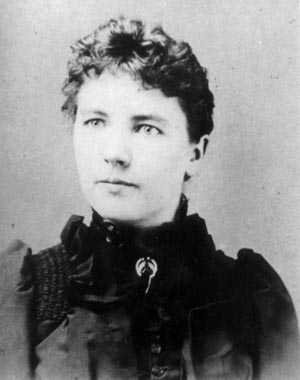
 The Faith of Laura Ingalls Wilder