Midsummer 2025

Summer is in full swing in Chicago. Last week it was in the 90s all week, and this week it’s been in the upper 80s and hasn’t rained. The grass at my house is getting brown; I’ve been watering my tomatoes every night.

In June I had the privilege of doing a radio interview to talk about A Prairie Faith on Ozarks radio station KHOZ (FM 94.9, AM 900) in Harrison, Arkansas. Dan Reynolds had stopped by my book table when I was at the Missouri Cherry Blossom Festival at the end of April. He and Ann Lemley host a show called “Around the Table” on KHOZ every mid-morning. We worked out that he would call me on the morning of June 10. I had a great time talking with Dan and Ann; I really appreciated their invitation.

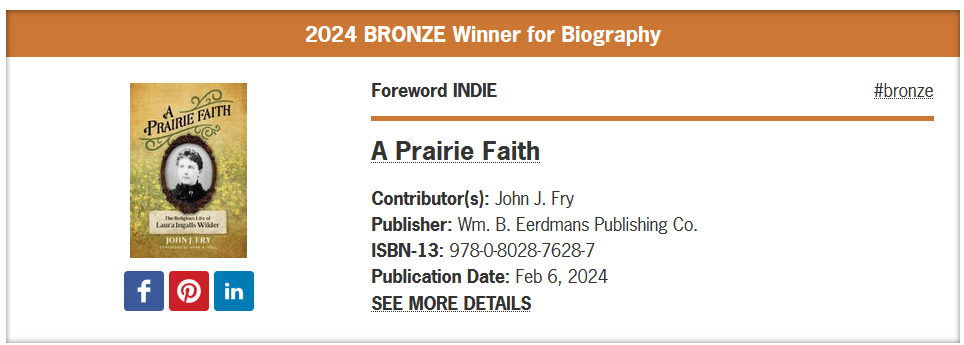
Early in June I also learned that A Prairie Faith had been named a Bronze Award winner in the 2024 INDIES Book of the Year Awards for Biography from Foreword Reviews. Eerdmans had three books win awards from the Foreword website, which reviews and promotes books from small publishers and self-published authors. Here is their description of the INDIES Awards:

Whether you’re a librarian, a bookseller, or just a general lover of books, you know that independent presses and authors are publishing some of the most innovative, creative, and beautiful books. To honor the very best of indie publishing each year, we’re pleased to host the Foreword INDIES Book of the Year Awards!

Thousands of books are entered each year, and over 100 librarians and booksellers take part in the judging process, narrowing down a group of finalists in 55 categories to Gold, Silver, and Bronze winners that truly represent the best in independent publishing.

My deepest thanks to the folks at Eerdmans who nominated the book and the judges at Forward who named it a finalist and then gave it the award!

Later this month, on July 18, I will be recording a podcast for the website Mere Orthodoxy about the 90th anniversary of the publication of Little House on the Prairie. Many thanks to Nadya Williams for that invitation.

Finally, I am very sad to not be able to attend LauraPalooza 2025 in Sioux Falls, South Dakota, next week. I will be traveling east for a family reunion in New Jersey at the end of this week and could not figure out how to make the trip west at the same time. I hope that all who are heading to Sioux Falls and De Smet have safe travels and a great time of gathering and sharing. Thanks to Rachel Luther and everyone at the Laura Ingalls Wilder Legacy and Research Association (LIWLRA) for their work putting that event together.

As always, if you’re interested in having me speak, please let me know (john.fry@trnty.edu). Thanks for reading!

Links

Around the Table with Dan and Ann

2024 Foreword INDIES Awards for Biography

Foreword INDIES Awards

Foreword’s Listing for my book

Mere Orthodoxy

LauraPalooza 2025

The Laura Ingalls Wilder Legacy and Research Association (LIWLRA)

LauraPalooza Paper

important but not central…

Greetings. The fall semester has started here at Trinity Christian College, and I have started a new position: Dean of Faculty. That has meant that I have been busier than usual with meetings and emails. I am also teaching a course this semester – the Senior Seminar for History Majors, which has been going well. The seven students have begun working on their major research projects and are narrowing down their topics, asking questions about them, and thinking about their significance.

I was very glad to send in the manuscript of my book to my editor at Eerdmans Publishers on August 12, the last day of my sabbatical. The editors of the series The Library of Religious Biography are reading it and will be getting me their comments by the end of this month.

For those of you who were not able to attend LauraPalooza, I thought that I would share the paper that I presented. It gives some of my conclusions and some of my evidence.

“‘On the Pilgrim Way:’ The Faith of Laura Ingalls Wilder”

John J. Fry

LauraPalooza 2022: The Wilder Side

Burlington, Vermont, 14 July 2022

I’d like to start by thanking the LIWLRA Board for accepting this paper, and Kimberly Endicott for chairing this session. I should also say thanks the school where I teach history, Trinity Christian College in Palos Heights, Illinois, for supporting my research. Finally, thanks to all of you for coming and making LauraPalooza 2022 possible.

For the last five years, I have been working on a book about Laura Ingalls Wilder that pays particular attention to her Christian faith. The nature of Laura’s Christianity has not always received extended attention. I think that some biographers have ignored or downplayed her religious beliefs, others have taken them for granted, and still others have addressed them but not fully considered their complexity or significance. For instance, the 2020 PBS American Masters documentary, Laura Ingalls Wilder: Prairie to Page, does not mention Christianity beyond the use of the word “churches” two times by Marta McDowell and several images of churches in towns where Laura lived. My book will provide a comprehensive look at Wilder’s faith. I examine what she believed, how Christianity shaped her identity, and how it influenced her behavior.

The Challenge. Some here know the challenge that faces a researcher hoping to describe the nature of Laura’s faith: she didn’t talk or write about it very often. In fact, Pioneer Girl gives one reason why in this description of a young man in Walnut Grove:

Howard Ensign had joined the Congregational church after their revival and would testify at prayer meeting every Wednesday night. It someway offended my sense of privacy. It seemed to me that the things between one and God should be between him and God like loving ones [sic] mother. One didn’t go around saying ‘I love my mother, she has been so good to me.’ One just loved her and did things that she liked one to do. (Pioneer Girl, 136)

But accepting that Wilder was generally private about expressing her religious beliefs does not mean that one cannot piece together a description of her faith. I am very glad to be sharing some of my conclusions with you today. They fall under three headings: “Laura’s Faith,” “Laura and her daughter Rose,” and “So What?”.

Laura’s Faith

Committed Christian. It seems clear that Laura Ingalls Wilder was a committed Christian, for several reasons. First, this conclusion is supported by her life-long Christian practices and her patterns of church belonging. Her family began attending Sunday School and Sunday morning worship services in Walnut Grove, Minnesota, and she attended for the rest of her life. While she lived in the upper Midwest, she attended Congregational Churches with her family. When she and Almanzo moved to the Ozarks, she attended Sunday School and Sunday morning worship at the Mansfield Methodist Church. She also read the Bible, probably daily. She had memorized large numbers of scripture verses when she was a child, and she knew the Bible very well as an adult.  Thousands of visitors to one of the historic sites have taken home a reproduction of the handwritten guide to Bible verses for specific occasions that she kept in her personal Bible. Finally, there is evidence from across her life—from childhood to old age—that she prayed every day before she went to bed.

In addition, Laura included Christianity, the church, and faith in her writing. Her columns in the Missouri Ruralist did not mention Christianity explicitly very often, but when they did, Laura presented traditional Protestant views of God, God’s laws, and God’s goodness. Prayer, Bible reading and memorization, and Sunday School and Sunday worship appear in Pioneer Girl and later in the Little House books. And she did describe a personal experience with God’s presence in Pioneer Girl.  It was in the context of difficult times for the Ingalls family while they were living in Walnut Grove. Her father was doing odd jobs to support the family. At one point, Laura was paid to stay with a woman whose husband was frequently traveling. This meant that Laura, as a pre-teen, often spent the night away from her own home. On one occasion, she was particularly troubled:

The rest of the days were lonely and I was homesick. I knew things were not going well at home, because Pa could not get much work and we needed more money to live on.

One night while saying my prayers, as I always did before going to bed, this feeling of homesickness and worry was worse than usual, but gradually I had a feeling of a hovering, encompassing Presence of a Power, comforting and sustaining and thought in surprise ‘That is what men call God!’ (Pioneer Girl, 137)

As many Christians in times of distress and need have found, in this moment she felt peace and strength that seemed supernatural. It was real enough that she remembered it over fifty years later when she sat down to write the first draft of Pioneer Girl, despite what she thought about those who talked publicly about their relationship with God. This experience is transformed in By the Shores of Silver Lake in a chapter titled “On the Pilgrim Way,” which is where I got the title for my book and my talk today.

Important but not Central. Having said this much about the importance of Wilder’s faith to her worldview and to her life choices, I also believe that the distinction can be made that Christianity was important but not central to her life. There were limits to the commitment she showed to the church and Christian beliefs and practices. Here is some evidence:

First, it seems clear that she attended Sunday School and morning worship services in Mansfield, but not the evening worship service. It also appears that this was her family’s pattern in Walnut Grove and in De Smet. For several stretches while her daughter Rose was living at Rocky Ridge, Rose kept a detailed diary about what she did. It provides evidence that Laura and Almanzo went to Sunday School and morning worship, but that they did not go to the evening service.

Second, there is also no mention, in any of Laura’s writings about her cross-country travels, that she ever attended worship services on Sunday while away from home. This is the case in the diary she wrote on the trip from De Smet to Mansfield in 1894. She records that they rested on Sunday, but they did not go to church. Here is an example: “August 26, Sunday, Monotonous, writing, reading, & sleeping. Saw a girl with fire red hair & a fire red dress.” (Diary, 26 August 1894) In the letters she wrote to Almanzo from San Francisco in 1915, and in diaries she kept on trips to De Smet in 1931 and 1938, there is ample evidence that travel, sight-seeing, and other activities were pursued on Sunday rather than worship.

Third, there is the fact that she and Almanzo never officially became members of the Methodist Church in Mansfield. Various answers may be given for why they never joined, and it is unclear what to make of this fact, but it is true. At the same time, we do know that Laura became a member of the Order of the Eastern Star in Mansfield, and she was very active in the leadership of that organization for over twenty-five years.

Neta Seal. If I am correct that Laura’s faith was important but not central to her life, her younger friend Neta Seal serves as an illustrative contrast. The Baptist Church, both locally and in its broader regional and national contexts, was central to Neta’s life. While Laura attended meetings of the Methodist Ladies Aid Society occasionally, Neta attended meetings of the Baptist Ladies Aid Society and the Baptist Women’s Missionary Union every month. She frequently hosted meetings of one of the two groups. For many years, Neta taught a children’s Sunday School class at the Baptist church and held parties for them at her home. She also attended ordination services at Baptist churches in other areas of Wright County. In 1953, she accompanied the pastor of Mansfield’s Baptist Church and his wife to the Southern Baptist Convention in Houston, Texas. In August of 1956, she both took young people to a local Baptist camp and hosted the Business Circle of the First Baptist Church in her home. Neta Seal’s Baptist Christianity were absolutely central to her life. This was not the case for Laura Ingalls Wilder.

Laura and Rose

These are some of my conclusions about Laura’s faith in the book. But one of the reasons that I first wanted to research Laura’s faith is that when you read the Little House books, at times the description of the church is not positive. Because the books were the product of a collaboration between Laura and Rose, I wondered if there might be differences between what Laura wrote in her handwritten drafts and what appeared in the published books.

Collaboration. I was able to look at all the original manuscripts and compare them to what ultimately was published. A couple initial notes:

I think that the best way of describing the creation of the books is as a collaboration between Laura and Rose. Rose was not just an editor. She reorganized material, changed descriptions into dialogue, and sometimes added entire scenes. Both Laura and Rose contributed to make the series as excellent as it is.

When Rose made changes to the books, she ran those changes past Laura. As the first three books were written, the two women were living on the same property and this process was conducted in person. For the next three books, Rose was living in another city (or another state), so the process took place in letters, and we can follow it. For the last two books, we do not have correspondence. We can’t really draw a sharp line between what Laura wanted in the books and what Rose wanted, since Laura in some way always accepted the changes that Rose made.

But I think that we can identify in many cases where ideas about faith, Christianity, and the church originated—Laura or Rose—and what their content and tone was.

With those caveats, I think that we can see that in fact the collaboration between the two women points in multiple directions when it comes to God, Christianity, and faith.

Negative edge. First, at times, straightforward and positive descriptions of Christianity in an original manuscript are more negative when they appear in the published book. In general, that would mean that Laura was positive, and Rose was less so. Because Rose was a deist who was had some cultural attractions to Islam, I was expecting this. The last time that I spoke at LauraPalooza in 2017, I gave several longer examples of this from Farmer Boy and On the Banks of Plum Creek. This time I thought I would just give two quick examples from These Happy Golden Years. Both involve the pastor of the Congregational Church in De Smet, Rev. Brown. The first time that Sunday School and worship are mentioned in the manuscript, we are told that “Laura knew the sermon would be long but after she made sure she would remember the text when Pa asked her to repeat it, she let her thoughts wander to other things.” (These Happy Golden Years manuscript, Tablet 1, 39) This becomes in the published book: “Reverend Brown preached one of his long, stupid sermons… Laura made sure that she remembered the text, to repeat at home when Pa asked her; then she need not listen any more.” (These Happy Golden Years, 575) In a later account, the manuscript reads “Reverend Brown was preaching earnestly and everyone was quiet and attentive when Laura saw a stray kitten walking up the aisle.” (These Happy Golden Years manuscript, Tablet 5, 279) The published book has: “Reverend Brown was preaching earnestly and Laura was wishing that with so much sincerity he could say something interesting, when she saw a small plump kitten straying up the aisle.” (These Happy Golden Years, 712-713) These changes can be seen as Rose making feelings more intense. Rose’s editing often did this. In this case what was made more intense was a negative view of Brown. There are other examples of changes making the resulting text less positive, and I can share some of them if you are interested.

Deeper Engagement. The surprise I encountered was that there are places where references to prayer, to Bible passages, and to other Christian concepts do not appear in the original manuscript, but they do in the published book. That would mean that Rose was adding material that addressed faith, the church, and Christianity, in effect providing a deeper engagement with faith than Laura originally had. This is particularly the case in The Long Winter.

The Long Winter is the Little House book that engages with faith the most, I believe because the extreme difficulties encountered by the Ingalls Family cause them to turn to God for help, encouragement, and comfort. In the first chapter, Pa explains to Laura that God is the one who tells muskrats when to build houses with thicker walls. This explanation is not in Laura’s handwritten        manuscript. Later in the book, Laura thinks “Oh, that I had the wings of a bird” to flee the coming winter. This is a reference to Psalm 55:6. This does not appear in the manuscript either. On Laura and Carrie’s first day of school in town, the teacher opens by reading Psalm 23. This is not mentioned in the manuscript. After a harrowing walk home from school through a blizzard, Laura thinks [quote] “It was so wonderful to be there, safe at home, sheltered from the winds and the cold… this must be a little bit like Heaven, where the weary are at rest. She could not imagine that Heaven was better than being where she was, slowly growing warm and comfortable.” (The Long Winter, 227) This observation is not in the manuscript. Mr. Foster is jokingly called “A mighty hunter before the Lord,” a reference to Genesis 10:9. Ma comments on a man’s actions by saying “Pride goes before a fall,” a slight misquoting of Proverbs 16:18. Late in the book, Carrie wonders whether they could possibly eat grass, and Pa says, “No, Nebuchadnezzar,” a reference to the Babylonian king eating grass in Daniel 4:32-33. None of these Biblical notes appears in the original manuscript. (The Long Winter, 288, 298, 354) Finally, the published book mentions Laura and Mary saying their prayers four times, but the original manuscript only mentions prayer once. There are engagements with faith in the manuscript that are left pretty much unchanged in the book. But it seems that Rose knew many scripture passages, and she worked intentionally to use them to contribute to the overall effect of the book. The original manuscript had envisioned Christianity as an important part of the fictional Ingalls family’s navigation of the hard winter, and Rose added additional material to confirm, enhance, and deepen that vision. There are other examples of this deepened engagement, and I can share some of them if you are interested.

So What?

So what? Clearly, my research suggests that Laura was a committed Christian. And I think it is clear that for Laura, Christianity was important but not central to her life. This can help us understand her life and her writings.

Laura’s Life. As far as her life goes, I think that this understanding helps to locate her on the spectrum of Christian commitment, identity, and practice. Some people are more devout than others. If I want to love my neighbor the way I love myself, including my neighbor who lived in the past, I should recognize that people in the past were the people that they were, not who we might want them to be.

The Little House Books. The idea that Christianity was important but not central to Laura also provides a way of understanding the treatment of faith in the Little House books. It appears that Christianity was important but not central to the fictional Ingalls family. In only The Long Winter can faith be seen as close to the center of the narrative and the characters’ lives. Christianity is mainly addressed in one chapter each of Little House in the Big Woods and Farmer Boy, and it is almost completely absent from Little House on the Prairie. The church appears more in On the Banks of Plum Creek, but not until its twenty-fourth chapter. By the Shores of Silver Lake again confines consideration of Christian ideas to one chapter. In the last two books, the church is one of the two institutions (the other is the school) which organizes the Ingalls family’s life. But the depiction of the church in those books is soured by the depiction of Rev. Brown, which is distinctly unfavorable.

Enduring popularity. Finally, the idea that faith is important in the Little House books, but it is not central, may also have contributed to the books’ enduring popularity. Christians who read the books encounter families who are committed to God, faith, and the church. For those who are not Christians, faith is not central enough to interfere with the enjoyment of the books for other reasons.  (Including the wonderfully direct prose, the deeply moving descriptions of family togetherness, and Laura’s passion for nature and wilderness.)

Laura Ingalls Wilder was a Christian. Her faith was important to her life, and she nurtured that faith by reading the Bible, praying, and attending worship. Unlike others in Mansfield like Neta Seal, while Christianity was important to her, it was not central to her life.

Thanks for listening. I’d be glad to take questions.

Works Cited:

All works are by Laura Ingalls Wilder.

Diary, in Wilder, Laura Ingalls Papers, Microfilm Collection available at The State Historical Society of Missouri, folder 33, (unpaginated).

The Long Winter, in The Little House Books. Volume Two. Edited by Caroline Fraser. New York: Library of America, 2012.

Pioneer Girl: The Annotated Autobiography. Edited by Pamela Smith Hill. Pierre: South Dakota State Historical Society, 2014.

These Happy Golden Years manuscript, Burton Historical Collection, Detroit Public Library, Detroit, Michigan.

These Happy Golden Years, in The Little House Books. Volume Two. Edited by Caroline Fraser. New York: Library of America, 2012.

Thanks for reading!

Links:

Trinity Christian College

Eerdmans Publishing

Library of Religious Biography

LauraPalooza 2022

The Laura Ingalls Wilder Legacy and Research Association (LIWLRA)

American Masters Biography

LauraPalooza 2022

a group that loves to learn new things

Last week I attended LauraPalooza 2022: The Wilder Side. The conference was sponsored by the Laura Ingalls Wilder Legacy and Research Association (LIWLRA). It is (obviously) the only conference of its kind, half academic conference and half fan gathering. I had attended the first LauraPalooza in 2010 in Mankato, Minnesota, and the fourth in Springfield, Missouri, in 2017. This year’s was the seventh, and it was held in Burlington, Vermont.

It was great to be back with a group of people who are interested in pretty much everything about Laura Ingalls Wilder. There are multiple worlds associated with Wilder:

1) The world of the historical Laura, who lived from 1867 to 1957, her husband Almanzo, who lived from 1857 (maybe 1859) to 1949, and their daughter Rose Wilder Lane, who lived from 1886 to 1968.

2) The fictional world of the Little House books, published between 1932 and 1943. The books were the product of a collaboration between Laura and Rose.

3) The world of the television series, “Little House on the Prairie.” Nine seasons aired between 1974 and 1983, and it has never been off the air (it immediately went into syndication and is still on cable stations and streaming services).

4) The world of the historical sites that one can visit to see the landscapes where she lived and walk in her footsteps, in Wisconsin, Kansas, Minnesota, Iowa, South Dakota, Missouri, and New York.

This year, there were presentations about all these worlds, and the last day of the conference was a bus trip to the Wilder Homestead in Burke, New York. The Wilder Homestead is where Almanzo Wilder, Laura’s husband, grew up in the late 1850s, 1860s, and 1870s.

There were almost one hundred in attendance. The community that gathers at LauraPalooza is striking for several reasons:

  • It is a group that loves to learn new things. This year, they invited Robert Goodby, an anthropologist who studies Native Americans in New England, to talk about the world of Indigenous peoples in upstate New York and how they are addressed in Farmer Boy, the Little House book about a year in Almanzo Wilder’s childhood.
  • It is also a group that loves to read. One of the keynote speakers was Mitali Perkins, whose book Steeped in Stories argues for the benefits of children reading a lot of different stories. In addition, since I was presenting a paper, I was included in the Authors’ and Artists’ reception. I took copies of my second book, Almost Pioneers, which is not about Laura Ingalls Wilder. I still sold all the copies that I took. Dr. Goodby also sold some copies of his book.
  • Finally, it is a group that understands the nuance involved in understanding people who lived in the past, and therefore didn’t think the way we do today. Wilder’s attitude toward—and her writing about—people of other cultures was at times negative, dismissive, and lacking in understanding. But it is possible to condemn that and still appreciate the positive aspects of her life and written work. IT’s like applying the Biblical instruction to love your neighbor as yourself to our neighbors who lived in the past.

At one point, attendees were asked to put up our hands to indicate how many conferences we had attended. It appeared that the two biggest groups were those who were first time attendees (one of the advantages of having the conference in different locations) and those who had attended all six conferences. Fascinating.

Seven highlights:

  • Robert Goodby, “The Wilder Homestead in An Indigenous Landscape: Native American History and Farmer Boy.”
  • Barb Bousted’s update of her research on the Hard Winter of 1880-1881.
  • Mitali Perkins, “Steeped in Stories: The Power of a Multi-Storied Child.”
  • Melissa Stoller’s reflection on the Laura and Almanzo’s age difference when they got married, in the context of late nineteenth century marriage statistics.
  • Michelle McClellan’s overview of the development of the Wilder Homestead as a historic site.
  • Patty Dowd Schmitz’s presentation about the location of the hill in the “Grandpa’s Sled and the Pig” story from Little House in the Big Woods.
  • Chris Czajka and Caroline Curvan’s backstage tour of the making of the PBS American Master’s Documentary, “Laura Ingalls Wilder: From Prairie to Page.”

I was somewhat reluctant to make such a list because such lists inevitably leave some people out. I think that I probably learned something from every presentation.

I presented some of the conclusions from my book about Wilder’s faith and got some excellent feedback, both during the question and answer period, and later on that day. It was also a blessing to talk at length with Bill Anderson, who has been an incredible help throughout my project. I will refrain from listing the many old friends I saw and new friends I made because I would certainly forget someone. I had some new Facebook friend requests when I got home.

I was not able to go to the Wilder Homestead on Friday because I had to get back to the Midwest. My first grandchild was born early Saturday morning.

Many thanks to those in the LIWLRA who made everything possible. Particular thanks are due to Lauri Goforth and Sue Poremba, the conference Co-Chairs, to Carole Nebhut and her son Adam for taking care of everyone’s audio-visual needs, and to Sarah Manley for her calm and steady leadership of the organization. I hope that everyone has been able to rest this week after all of their work. Many thanks also to my institution, Trinity Christian College, for paying for my trip to Burlington.

Stay tuned for more updates.

Links:

LauraPalooza 2022

The Laura Ingalls Wilder Legacy and Research Association (LIWLRA)

The Wilder Homestead

Robert Goodby

Mitali Perkins

Almost Pioneers

PBS American Masters documentary on Laura Ingalls Wilder

Bill Anderson

Trinity Christian College

Francis Schaeffer and the Shaping of Evangelical America

(Photo credit: Pete Unseth, Wikimedia Commons)

I know that I have not posted much this fall. My time has been taken up with Academic Dean duties here at Trinity Christian College. I had hoped to get some writing done on chapter four of my book, but that hasn’t happened. In other research project news, however, I did propose a paper for LauraPalooza 2019. John Miller, Bill Anderson, and I are also looking at doing a session proposal for the Midwestern History Conference. And last week, a group of professors at Trinity read the first chapter of my book and give me comments on it. I got some great critiques and words of encouragement.

Over Thanksgiving break I read a biography in the series from Eerdmans publishers that I’m writing for: Francis Schaeffer and the Shaping of Evangelical America by Barry Hankins. It’s a very good book. I met Hankins at a meeting of the Conference on Faith and History (CFH) a while ago. He is the Chair of the History Department at Baylor University in Texas. The book came out in 2008. Since then, he has written books on the 1920s, American Baptists, and Woodrow Wilson.

Francis Schaeffer was a Presbyterian pastor during the twentieth century. He became a missionary to Europe and ran a Christian study center called L’Abri in Switzerland from the 1950s to the 1970s. It became a place where young Europeans who were questioning the meaning of life could come and hear Christian answers to their questions. Francis talked with them, Edith made them meals, and they could stay as long as they wanted. The theme of his teaching was that only Christianity provided philosophically supportable answers to the most important questions of life. He spoke cogently about art, culture, philosophy, politics, and many other topics. Eventually, L’Abri employed a large staff and thousands of young people from the United States and Europe visited. InterVarsity Press turned some of his talks into books, and during the 1960s he spoke at many Christian colleges in the United States. A number of the students who heard him became Christian scholars and college professors as a result of his inspiration. In the 1970s his son Frank Schaeffer and he made two movie series: How Should We Then Live and Whatever Happened to the Human Race? The first gave a history of western thought and culture, described where it had gone wrong, and gave instructions for how Christians should respond. The second was about the dangers of abortion, infanticide, and euthanasia.

Hankins’s biography was a trip down memory lane for me. I grew up in a home and a church where people read Schaeffer’s books and talked about them. My Mom read books by Edith. I remember reading Schaeffer’s books—I can only remember Escape from Reason and A Christian Manifesto specifically, but I know that I read more—when I was in high school and college. Both movie series were shown at my church. I think that I would give Schaeffer some of the credit for why my best friend in high school and I both became academics (he’s now a Professor of Political Science). For us, Schaeffer made the idea of studying culture and history from a Christian perspective cool.

Once I became a historian, I went back and re-read several of Schaeffer’s books. I found that they have a number of historical arguments and assertions that I just don’t think are correct. Schaeffer wasn’t a trained historian. He was a pastor, and he tended to use stories about the past to make the points he wanted to make about the world, God, and Christian answers to life’s questions. Other Christian historians have also found his historical narratives wanting, even those who were launched on their path to becoming academic historians by hearing Schaeffer speak or reading his works. Hankins notes this. It’s a fascinating story.

As I read Hankins’s biography, I also thought a bit about its structure in relation to what I am planning for my book on Laura Ingalls Wilder’s life. In many ways, Hankins’s biography is very different than what I think mine will be. Only one small section of one chapter is about Schaeffer’s childhood, mainly because there are few sources about it. I am projecting that three of the eleven chapters in my book will be on Laura’s childhood. Also, three of the main chapters of Hankins’s work are thematic: they’re about Schaeffer’s works on 1) philosophy, 2) culture, and 3) the Bible. The chapters are not chronological; the time periods covered overlap. I think that my book will mainly be chronological, and the chapters will be pretty self-contained.

This is likely the last post that I’m doing during 2018. I hope that everyone has a blessed Christmas and a good start to 2019.

Links:

Trinity Christian College

LauraPalooza 2019 Call for Papers

Midwest History Conference Call for papers

Francis Schaeffer and the Shaping of Evangelical America

End of Summer

Thanks very much to everyone who reached out to me (via email, in person, via Facebook) after I announced two weeks ago that I had received a book contract. You all are the best.

Today all first year students will be moving into the dorms here at Trinity Christian College. There have been some students on campus for the last week or two, including fall athletes, student leaders, and some others. It’s been great to see more students around; they bring life back to a college campus. All the new freshman will be here by this evening. Returning resident students and new transfers arrive by the middle of next week to complete the student body. My daughter moves back to Trinity (she’s a sophomore) this Sunday. Regular courses begin next Wednesday. My three sons start school (two in high school and one in homeschool eighth grade) next Thursday morning. All of this means that the summer is just about over.

It’s been a productive summer:

– I finished my book review of Christine Woodside’s Libertarians on the Prairie for Fides et Historia (the journal of the Conference on Faith and History) in April. (I guess this wasn’t really summer, but I hadn’t mentioned it’s completion on the blog before.)

– I finalized my book proposal and sent it off to Eerdmans in May.

– I presented a paper at the Midwest History Conference in Grand Rapids in June.

– I spoke at LauraPalooza in July.

– I received a book contract from Eerdmans and signed it in July.

– Last week I completed a book review of Pioneer Girl Perspectives for The Annals of Iowa.

– This morning I wrote three and a half pages of a possible introduction to the book.

I hope to keep reading for the book project once school starts at least once a week. I got a list of books to read from Mark Noll, one of the editors of the Eerdmans series I’m writing for, about American religious history. I also hope to do more thinking and writing. I will try to keep up the blog as much as I can.

Thanks for following. Best wishes to all who has someone in their home who returns to school during the next several weeks.

Links:

Trinity Christian College

Fides et Historia and the Conference on Faith and History

My Libertarians on the Prairie blog post

My LauraPalooza post

My book contract post

My Pioneer Girl Perspectives post

The Annals of Iowa

LauraPalooza 2017

Last week I traveled to the Ozark Mountains of Missouri. I attended LauraPalooza 2017, and I visited Mansfield, the town where Laura and Almanzo Wilder spent most of their adult lives.

LauraPalooza is a conference sponsored every other year by the Laura Ingalls Wilder Legacy and Research Association.* The conference brings together scholars, authors, teachers, librarians, and other who love the Little House books in one location for several days of presentations, networking, and fun. In 2010 and 2012, the conference was held at Minnesota State University in Mankato. In 2015, it was held at South Dakota State University in Brookings. This year, it was held at a hotel in Springfield, Missouri. I met attendees from the Netherlands, the United Kingdom, Denmark, and across the United States. I believe that there were somewhere around 130 people in attendance. Some women attended sessions in period clothing, including sunbonnets, calico dresses, and one on Friday in full hoopskirts.

I drove down last Tuesday morning. My plan was to stop in Mansfield to see the Laura Ingalls Wilder Historic Home and Museum on my way to Springfield. Unfortunately, the rental car’s one front wheel started making a terrible screeching sound outside of St. Louis. I had to go to the St. Louis airport to return the car and get a different one. This put me several hours behind schedule, so when I reached Mansfield, everything was closed. I ate dinner at Ma and Pa’s Family Style Restaurant and then continued on to Springfield.

The top three presentations on Wednesday:

– Eddie Higgins and Sanne Jakobsen spoke about their research into the Ingalls’s family’s ancestors, including a trip they took to the parish in Skirbeck in eastern England from which Francis and Edmond Ingalls left for America in the late 1620s and early 1630s.

– Emily Anderson engaged the use of the Little House books by individuals from different ethnic groups to make sense of their experiences, including the Hmong who currently make up about a third of the population of Walnut Grove, Minnesota.

– Caroline Fraser addressed the U. S.-Dakota War of 1862, referred to as the “Minnesota Massacre” in Little House on the Prairie.

The top three presentations on Thursday:

– Bill Anderson described the individuals who interacted with Pioneer Girl before it was published and those who helped preserve the stories of Wilder’s life.

– Robynne Miller reported on the lives of the three individuals—Nellie Owens, Genevieve Masters, and Stella Gilbert—who inspired the character of Nellie Oleson in the Little House books.

– Pamela Smith Hill spoke about Wilder’s experiences in and relationship with the Ozarks, where she (Hill) grew up.

Fry at LauraPalooza 1My presentation was on Friday morning. I was followed by an excellent talk by Kipton and Ethan Smilie about the ways that the Little House books show the formation of social capital in their depictions of late nineteenth century education, and by a fascinating demonstration by Rich Kurz about how he created a scale three-dimensional model of the Ingalls store in DeSmet, South Dakota, from extant pictures.

All in all, it was an eclectic conference. My talk was well-received, I enjoyed talking with many new contacts, and it was good to see a number of old friends, including Bill Anderson, Barb Bousted, Caroline Fraser, Sandra Hume, and Michelle McClellan.

Wilder Home for BlogI left a little early on Friday morning so that I could stop in Mansfield to see the Historic Home and Museum on my way home. I was able to tour both the farmhouse that Laura and Almanzo built between 1894 and the 1910s and the “rock house” that was built by their daughter Rose Wilder Lane for them during the late 1920s. Laura wrote Pioneer Girl and the first several Little House books while living in the rock house between 1828 and 1936. Both of the houses are amazingly well built and well kept. They are also quite small. I guess that’s appropriate for someone famous for writing about Little Houses. I had forgotten that Laura was only four feet, eleven inches tall. Since Wilder was famous when she died in 1957, the farmhouse immediately became a historic home, and almost everything inside it belonged to her and Almanzo. The rock house had been sold and was not reacquired until the late 1900s, but it has been restored. I was hoping to walk the path between the two houses that was used by Wilder and Lane to see each other when they were writing. Unfortunately, I was told that it was flooded.

Rock houseI also looked through the new Museum at the site, which was just finished last year. There is an 8-minute orientation film and a lot of artifacts from Laura and Almanzo’s lives on display. Several are related to my work on Wilder’s faith:

– Laura’s Bible, which she kept “on the table next to her favorite locker.”

– The Ingalls Family Bible

Persuasives to Early Piety by J. G. Pike, a book published by the American Tract Society –this was a gift from Charlotte Holbrook Quiner to her daughter Caroline Quiner Ingalls, or Ma. Ma passed it on to Laura.

– “Laura’s Sunday School Cards” – these are about 1 ½ by 2 inch cards with Bible memory verses from one of the churches in Walnut Grove, Minnesota, in 1878. I’m guessing it was the Congregational Church. There are eight pasted on the first page of what looks like a book for them; verses are from First Corinthians, Hosea, Psalms (3), Isaiah (2), and Deuteronomy. There may be more on the following pages; there was no one to open the display case for me to take a look.

– A bread plate that says “Give us this day our daily bread” that was saved from the fire that destroyed Laura and Almanzo’s home in the late 1880s. This was described in The First Four Years.

I am very thankful to my family for allowing be to be gone four days. I was very happy to see them all when I got back Friday night.

Thanks for reading.

Links:

Laura Ingalls Wilder Legacy and Research Association

Laura Ingalls Wilder Historic Home and Museum

Ma and Pa’s Family Style Restaurant

Emily Anderson’s Little on Amazon

Walnut Grove Mural Bridges Cultures – about the Hmong in Walnut Grove

Caroline Fraser’s website

Bill Anderson’s website

Robynne Miller’s books on Amazon

Pamela Smith Hill’s website

My blog entry on The First Four Years

*(I recently finished reading Nicholas Carr’s The Shallows: What the Internet is Doing to Our Brains. I now believe that having hyperlinks in the text of my blog entries encourages people to read poorly. From here on out, all links will appear at the bottom of the post.)

State of the Project

It’s time to take stock of where my project on the faith of Laura Ingalls Wilder has led me so far and where it is heading.

In January of 2016, I began this blog. The plan was to investigate Wilder’s faith and write an article for a history journal about it. I also had the idea that the article could be the core of one chapter in a book on how Wilder’s work engages topics of interest to readers in the twenty-first century. Many readers of this blog walked with me as I read through the Little House books, the best biographies of Wilder, and other books in the spring and summer of 2016. Last fall, I presented a paper on Wilder’s faith to the Conference on Faith and History. It was there that several individuals suggested that consider writing a book-length biography of Wilder with particular attention to her faith.

The idea of writing a spiritual biography of Wilder was confirmed by students when I taught an Honors Seminar on the Little House books during the spring 2017 semester. There also seemed to be enthusiasm for the project when I gave an invited lecture at Calvin College in Grand Rapids, Michigan, in February. And it received general support from many old friends and Wilder scholars I saw at the Laura Ingalls Wilder: A 150-Year Legacy conference in Sioux Falls at the end of last month. So writing this book is currently my intention.

Last week, I sent a book proposal to Eerdmans Publishers in Grand Rapids, Michigan. The book would be part of their series titled The Library of Religious Biography. I projected that there will be ten chapters. If I can write two chapters each summer, the manuscript will be complete in five years. Both the series editor and an in-house editor at Eerdmans are receptive to the idea. So we will see what happens next.

This summer, I will be speaking on Wilder’s faith two times. At the beginning of June, I will be on a panel at the Third Annual Midwestern History Conference in Grand Rapids. The panel is titled “The Uses of Public Memory in the Rural American Midwest.” My paper title is “Little House and Little Church: Memory and the Church in the Published Works of Laura Ingalls Wilder.” My paper will suggest that the Midwestern upbringing of both Wilder and her daughter Rose Wilder Lane influenced the depiction of the church in Wilder’s works. However, because Wilder and Lane had strikingly different experiences in the church—and therefore strikingly different memories of the church—those differences also influenced how the church is described, especially in the Little House books.

In July I will be speaking at LauraPalooza. This year the conference is titled LauraPalooza 2017: Little Houses, Mighty Legacy: 150 Years of Laura Ingalls Wilder. I am on their agenda first thing on Friday morning. The conference is sponsored by the Laura Ingalls Wilder Legacy and Research Association and held in Springfield, Missouri. Many of the attendees at this conference will be people who just love Wilder and the Little House books, not academics. Probably a large percentage of them will be women. My talk is just titled “‘On the Pilgrim Way’: The Faith of Laura Ingalls Wilder.” The title is taken from Chapter 23 of By the Shores of Silver Lake, which describes the first prayer meeting and worship service in DeSmet, SD, in 1880. I am hoping to roll out some of my observations about Wilder’s faith for this broader audience. It is also my hope to stop at the Laura Ingalls Wilder Historic Home and Museum in Mansfield, Missouri, on my way to the conference.

Meanwhile, this summer I hope to continue to read and post about what I read. Thanks for being part of my work.

The Ingalls Wilder Family Songbook

In 2011, the Ingalls Wilder Family Songbook was published.  This should not be confused with the Laura Ingalls Wilder Songbook. The latter was edited by Eugenia Garson and published by HarperCollins in 1968. It is 160 pages long and contains 62 songs. It is out of stock on Amazon, though you can get used copies from used booksellers.

The Ingalls Wilder Family Songbook, by contrast, is an exhaustive and scholarly book edited by musicologist (music historian) Dale Cockrell. I heard Cockrell speak at the first LauraPalooza conference in 2010. He made a convincing argument—one that is given in the introduction of this book—that one of the ways that Wilder was able to include as many details in her books is that she used her memories of music to help her remember her childhood. The bulk of the book, however, is sheet music for the 127 songs that are mentioned in the eight Little House books. After each song, the book and chapter that the song is referenced in is provided, along with a brief description of the context.  As a result, the book is a whopping 425 oversize pages. It was a volume in two different series from the American Musicological Society: “Recent Researches in American Music” and “Music of the United States of America.” It also appears to be out of print on Amazon; the list price was $240, so few individuals would probably be in a position to buy it. I was fortunate to get the library at Trinity Christian College, where I work, to purchase one.

In his introduction, Cockrell describes the different roles that music played in the Little House books. Pa played his fiddle and the family sang both for entertainment and for community-building. The family was the primary community that music fostered, although the local, church, and national communities were also maintained by songs. Cockrell notes that the first time a formal church service is mentioned in the books (in On the Banks of Plum Creek), Wilder describes the congregation’s terrible rendition of the hymn “Jerusalem, the Golden.” Laura’s assessment of the church service is brief:

Pa turned on the seat and asked, “How do you girls like the first time you ever went to church?”

“They can’t sing,” said Laura. (xxxiv)

Cockrell classifies twenty-three of the 127 songs in the book as “Hymns or Sunday School songs.” So almost a fifth of the songs mentioned in the Little House books were used in Christian worship or educational settings. As I read through these songs, I divided them into eight different categories based on the content of the lyrics:

Song about being good and enjoying nature: “Gentle Words and Loving Smiles”

Songs about Christmas: “Merry, Merry Christmas,” “The Star of Bethlehem”

Songs for church services, Sunday School – “Doxology,” “My Sabbath Home”

Song about death: “When Jesus Holds My Hand”

Song about God’s protection: “A Shelter in the Time of Storm”

Songs about heaven: “Canaan,” “The Evergreen Shore,” “The Happy Land,” “The Home of the Soul,” “Jerusalem the Golden,” “The Mountain of the Lord,” “On Jordan’s Stormy Banks,” “Pull for the Shore,” “Sweet By and By,” “When I Can Read my Title Clear”

Songs about Jesus and Salvation: “The Ninety and Nine,” “Rock of Ages”

Songs about working for what is right: “Am I a Soldier of the Cross?” “The Good Old Way,” “Lend a Helping Hand,” “What Shall the Harvest Be”

I was surprised by how this division came out. Given my previous observations in this blog about Wilder’s faith tending towards right behavior, I had assumed at the outset that most of the hymns would be about working for what is right. This is the second-largest category. However, the largest single category – ten out of the twenty-three songs – contains songs about heaven. I didn’t expect this.

I think that there are several possible reasons for this over-representation of songs about heaven. It may be that I should revise my ideas of Wilder’s faith to recognize a larger role for heaven in her thinking. On the other hand, seven of these ten songs are referenced in The Long Winter, which I have already noted as having many connections to Christianity. Many of the songs are sung while blizzards bear down on the family as a way of defying the storm. For instance, “The Evergreen Shore” has the chorus, “Then let the hurricane roar, / It will the sooner be o’er, / We will weather the blast, and will land at last, / Safe on the evergreen shore.” (187) So the songs about heaven are used for a particular reason in that particular book. Finally, it may just be that these songs have the most memorable lyrics for Wilder. In other words, the content of the entire hymn may be less important than how particular lyrics functioned in her upbringing and in her memory.

It is not surprising to me that only two of the twenty-three songs are specifically about salvation or Jesus’ sacrifice.

Clearly, Christian music had a great influence on Wilder’s life and upbringing. The type of Christianity that she experienced as a child—and later pursued and described as an adult—may have emphasized doing good works to please God (as opposed to a message of sin and salvation by Jesus’ blood). But it also emphasized singing.

Thanks for reading.

Page number references are from Dale Cockrell, ed. The Ingalls Wilder Family Songbook (Middleton, WI: Published for the American Musicological Society by A-R Editions, Inc., 2011).

Laura Ingalls Wilder: A Writer’s Life

This week I re-read Pamela Smith Hill’s Laura Ingalls Wilder: A Writer’s Life. I was glad to read this book when it came out in 2007, and I was glad when John Miller introduced me to Hill at LauraPalooza in 2010.

Hill brings the knowledge and sensibility of a published writer to her task. While the book is a full biography of Wilder, it focuses on how the Little House books were written. Thus, the chapters that focus on Wilder’s early life compare accounts in the Little House books to Pioneer Girl and other extant records for the Ingalls family. The chapters about her adult life describe how the Little House books were written. Hill is particularly interested in understanding the collaboration between Wilder and her daughter Rose Wilder Lane.

To the question of “how should we understand Wilder’s and Lane’s contributions to the Little House books?”, Hill answers that Wilder should be considered the author of the books, and Lane should be seen as an editor. Hill describes several letters that Lane wrote to Wilder about her writing as editorial letters, examples of a type of letter written by an editor to a writer in response to a manuscript. The aim of such a letter is to improve the resulting book. Hill also notes that the editors at Harper and Brothers who received Wilder’s books rarely had to make many changes to the manuscript; this was because Lane had already edited them—in some cases heavily—as she typed them. In general, Hill argues that each woman brought her own strengths to the series. For Wilder this included vivid descriptions and a deep understanding of her characters. Lane contributed in the areas of large scale structure, sentence editing, and the creation of drama.

Laura Ingalls Wilder: A Writer’s Life does not say much about Wilder’s faith. It mentions the Ingalls family’s interactions with Congregational Churches in both Walnut Grove and DeSmet (21, 45). It also notes that Laura was disappointed that there wasn’t a Congregational church in Mansfield, Missouri. (85) Finally, it states that “The Wilders joined the Mansfield Methodist church, where they worshiped for the rest of their lives.” (89) The second half of the statement is true, but the first is not. John Miller in Becoming Laura Ingalls Wilder more reliably notes that while they attended the Methodist church, they never joined. (John E. Miller, Becoming Laura Ingalls Wilder: The Woman Behind the Legend [Columbia: University of Missouri, 1998], 86, 102.)

Hill does make some observations about choices Wilder made concerning audience in relation to The First Four Years. Hill asserts that Wilder had a particular approach to an adult audience, that “Wilder’s perception that a novel for adults should appeal to a mature, perhaps even jaded, audience; the book’s characterizations, plot, and theme had to reflect adult readers’ more careworn vision of reality.” (75-76) Interestingly, Hill argues that Wilder modeled her writing in that book on Lane’s work, especially her book Let the Hurricane Roar, which was based on Wilder’s parents’ story. I believe this supports some of my impressions about The First Four Years. Specifically, when considering the possible reasons that faith is nowhere mentioned in the book, I wrote in my blog entry, “Perhaps she thought that religion should be kept out of an adult novel.”

Thus I think that the contribution that Laura Ingalls Wilder: A Writer’s Life makes directly to a project on the Wilder’s faith is small. However, Hill’s insights about the relationship between Wilder and Lane will be helpful as I approach the Little House manuscripts at the Herbert Hoover Presidential Library this summer. I’m hoping to specifically examine the places where the church or Christianity is mentioned in the Little House books and determine if the particular form it takes is primarily because of Wilder or Lane’s influence.

As always, your comments are welcome.

Page number references are from Pamela Smith Hill, Laura Ingalls Wilder: A Writer’s Life (Pierre: South Dakota State Historical Society, 2007).