Back to School 2025

returning to Western Pennsylvania in October

Back to school time is upon us. Gas prices in my neighborhood have spiked to nearly $4 a gallon ahead of the Labor Day weekend. And classes at Trinity Christian College began on Monday. This semester I am teaching the first half of the United States history survey—U. S. History to 1860—for the first time since 2021. Back then it was a Monday-Wednesday-Friday course. Now it is a Monday-Thursday course, since Trinity reworked the weekly schedule to make room for Wellbeing Wednesdays as part of our Transformative Colleges Initiative. I have also flipped the classroom; I made 25 videos this summer and no longer lecture in class; we do activities and discuss primary sources. So far my students are doing great.

In July I recorded a podcast episode for the website Mere Orthodoxy. They have a new podcast titled “Christians Reading Classics.” The host is Dr. Nadya Williams, who is a classicist and has a book about the Greek and Roman Classics coming out late this year. The podcast has a little broader definition of “classic,” and she asked me to join her to talk about Little House on the Prairie, which was published 90 years ago in 1935. I had a great time discussing the book and Laura Ingalls Wilder’s life and faith with Nadya and Dr. LuElla D’Amico, a Professor of English and Gender Studies at the University of the Incarnate Word in San Antonio. The episode dropped several weeks ago and I have a link to the podcast at the end of this post.

This month I also found out that A Prairie Faith was reviewed in the academic journal Church History: Studies in Christianity and Culture. The review came out in the September 2024 issue, which was published online in February 2025. The reviewer, Dr. Melinda Marchand, teaches history at Clark University in Worcester, Massachusetts. The review provides an excellent summary of the book and my argument. The author was generous even as she pointed out particular contexts that readers of that journal would have been interested in the book addressing in more detail. The journal is behind a paywall, so I think the best way to find it online is to see if your local public or university library has access.

I will be returning to Western Pennsylvania in October to sign books at Geneva College’s Homecoming. The event will be in the West Reading Room of McCartney Library on Saturday, October 25, from 11:00 am to 1:00 pm. I graduated from Geneva thirty-four years ago, and I was a student worker in the library all four of the years I attended. Many thanks to Beckie Cottage and the Alumni and Advancement team at Geneva for making this possible.

I also just picked up a copy of Pamela Smith Hill’s Too Good to Be Altogether Lost: Rediscovering Laura Ingalls Wilder’s Little House Books. It came out this year from the University of Nebraska Press. It looks pretty fascinating. I will have to carve out some time in my schedule to read it this semester.

As always, if you’re interested in having me speak, please let me know (john.fry@trnty.edu). Thanks for reading!

Links

Trinity Christian College

Wellbeing Wednesdays

Transformative Colleges Initiative

Mere Orthodoxy

Christians Reading Classics

Nadya Williams

LuElla D’Amico

Church History, September 2024 issue at Cambridge Journals

Melinda Marchand

Geneva CollegeHomecoming 2025

Book Tour – Spring 24

a number of opportunities

Photo by Eric Schiemer, Geneva College

The spring semester at Trinity Christian College has sped by. Today is the last day of regular classes, and finals week is next week. During the last couple of months, I have also had a number of opportunities to talk about my research.

February was online appearance month. Right after the book appeared, I got an email from the publisher saying that Shaun Tabatt wanted to interview me for The Shaun Tabatt Show. We spoke via zoom on February 15 and the interview was published online two days later. Later that month, Fred Zaspel reached out about doing an interview for Books at a Glance. We spoke on February 28 and the interview was published on March 5. Many thanks to both Shaun and Fred for their time and interest.

March was email month. I traded many emails with staff and friends at (in alphabetical order): the Ann Arbor Public Library, the Blue Island Public Library, the College of the Ozarks, Geneva College, Grove City College, the Ingalls Homestead outside of De Smet, the Laura Ingalls Wilder Museums in Pepin and Walnut Grove, the Laura Ingalls Wilder Historic Home and Museum in Mansfield, the Laura Ingalls Wilder Historic Homes in De Smet, the Midwestern History Conference, and Schuler Books in Grand Rapids. Some of these contacts have become upcoming appearances, some are still in process.

April has been in-person appearance month. On April 4, I spoke at the Blue Island Public Library. About ten people attended and we had a great talk. Many thanks to Dennis Raleigh for making that event happen. I also taught a SALT course at Trinity Christian College from April 2 to 16. SALT (Seasoned Adults Learning at Trinity) courses are for residents aged 50 and older from communities surrounding the college. There were eight students, and over the three weeks we read and discussed the book. I also shared some photos from my research trips and visits to the Ingalls and Wilder historical sites. Many thanks to Dewoun Hayes for her enthusiasm and faithful support.

On Monday of this week, I flew to Pittsburgh and drove to Grove City, PA. There I got to have lunch with my longtime friend Michael Coulter, who teaches Political Science at Grove City College, and dinner with Jan and Katie Dudt, old friends from when we lived in western PA. I spoke to about forty people that evening, about half students (all women – not entirely surprising) and half people from the community. Several were high school classmates from Grove City Christian High School and Portersville Christian school. One I had not seen for probably 30 years. It was a great time. It was also a great blessing to stay with the Dudts on their beautiful farm outside Grove City, close to where I grew up. Many thanks to Mike for his work and to Grove City’s Institute for Faith and Freedom and Departments of English and History for sponsoring the talk.

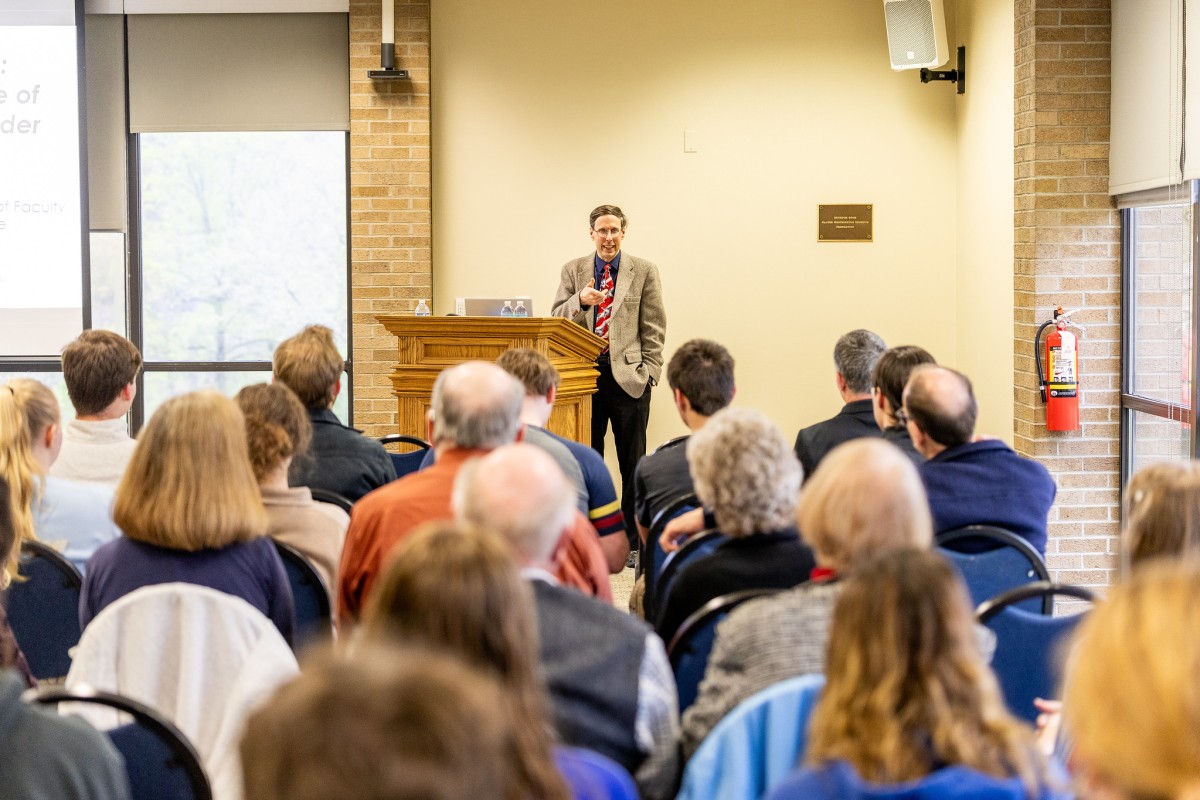
Then on Tuesday, I drove from Grove City to Geneva College in Beaver Falls, PA. It was a nostalgic trip, especially the stretch down the hilly and twisty back roads between Portersville and Eastvale. It is still pretty early spring, so it wasn’t always beautiful, but it was home. At Geneva I got to spend some time with Jeff Cole and Eric Miller, members of the History Department, and Kae Kirkwood in the Archives. Geneva is my alma mater, so I knew Kae from when I attended in the late 80s and early 90s. And two of my sons, Ben and Daniel, currently go to Geneva, so we were able to get together for dinner (and ice cream after my talk). There were probably sixty people at the talk; most were students, but some were from the community, including several from Grace OPC in Sewickley, the church I attended when I was in college. The talk was part of Geneva’s Visiting Artist and Lecture Series (GVALS). Many thanks to Jeff and Eric, Provost Melinda Stephens, and Marlene Luciano-Kerr for the invitation and their hospitality.

I now have a page on the website dedicated to Book Talks, both upcoming ones and previous ones.

If you are interested in having me speak at your local bookstore, church, public library, or other community group, please contact me at john.fry@trnty.edu.

Thanks again for your support!

Links:

Trinity Christian College

Eerdmans Publishers

Midwestern History Conference

Blue Island Public Library

SALT at Trinity (click on Classes and then Session 3A to see the information about my course)

Geneva College

Grace OPC

Update 2022

There is much to report

It has again been a long time since I have posted. There is much to report.

My sabbatical from teaching and administrative responsibilities at Trinity Christian College began in January and continues to the middle of August. I have taught at Trinity for eighteen and a half years, but this was the first time I have ever taken a sabbatical. I never thought that I would want to be away from teaching for eight months. My wife will tell you that I get antsy at the end of the summer when I haven’t been teaching for just a couple of months. But it was absolutely necessary for me to have the time to finish the book. When I got the book contract from Eerdmans in 2017, they gave me five years; my deadline is the end of August, 2022.

The sabbatical has been an incredible blessing. Between January and May, I was able to work almost exclusively on the book. In January and February, I worked through the available manuscripts of all eight Little House Books, microfilm copies of the Mansfield Mirror from 1923 to 1957, and all of Rose Wilder Lane’s diaries and journals. I also wrote drafts of the final three chapters of the book. In the middle of March, I did my last research trip to Missouri. I visited Ellis Library at the University of Missouri in Columbia, the Missouri United Methodist Archives (MUMA) at Central Methodist University in Fayette, and the State Historical Society of Missouri in Columbia (SHSMO). By the end of March, I had finished a draft of the entire book. I then attended the Conference on Faith and History Biennial Meeting at Baylor University in Waco, Texas. It was supposed to be held in fall 2020, but it was postponed twice because of covid. I did not present, but I connected with many old friends, and I made some new ones.

In April and early May, I revised the book. My initial draft was around 107,000 words, and my contract says the book should be around 80,000. So I worked through the manuscript several times, scrapped almost all of one chapter, examined every single quotation, and read the entire book out loud. The word count is now much closer to the target number. I never would have been able to complete the book without the sabbatical. Bill Anderson has graciously agreed to read it and give me his comments.

In the middle of June, I will travel to Burlington, Vermont, to present at LauraPalooza 2022: The Wilder Side. LauraPalooza is held only once every three years, and it is my hope that the book will be out next year, so I thought it would be good to give a preview to those who are most likely to be interested in it. Many thanks to the Laura Ingalls Wilder Legacy and Research Association (LIWLRA) for their work on the conference, particularly Lauri Goforth and her attention to the many, many details. Lauri offered to let me sell copies of my second book, Almost Pioneers, and hand out materials about “On the Pilgrim Way”: The Faith of Laura Ingalls Wilder. To provide a better experience for those interested in my research, I have completely overhauled the website.

My year has also been full of family milestones. My son Stephen graduated from Geneva College in Western Pennsylvania in May, started a new job in Pittsburgh last week, and moved to a new apartment two days ago. His wife Amanda is due in July. My youngest son Daniel graduated from Chicago Christian High School in June. And my only daughter Deborah is getting married in August. My wife Paula and I have traveled to Pennsylvania twice already, and we will be going back after the baby comes. (Paula will be going back again to take Daniel and my son Benjamin to Geneva at the end of August.) In September, it will just be Paula and me in the house.

At any rate, the book is coming. Thanks to everyone who continues to follow my work and give me encouragement.

Links:

Trinity Christian College

Eerdmans Publishers

Missouri United Methodist Archives

State Historical Society of Missouri

LauraPalooza 2022

Almost Pioneers: One Couple’s Homesteading Adventure in the West

Geneva College

The Big Woods and COVID-19

“She was glad that the cozy house, and Pa and Ma and the firelight and the music, were now. They could not be forgotten, she thought, because now is now. It can never be a long time ago.” (95)

It was just over a month ago when the administration of Trinity Christian College, where I work, announced that due to COVID-19, courses for the rest of the spring semester would be conducted online, all of the resident students had to move home, and all spring events on campus (athletic, theater, music, art, etc.) were canceled. It was Thursday, March 12. The announcement came at noon, and the Chaplain’s office quickly organized a final worship service that afternoon as a way for students, faculty members, and staff members to communally grieve the losses that confronted us and express our trust in God and our Lord Jesus Christ. I found my daughter, who is a senior at Trinity, and she put her head on my shoulder and we cried together. That event now seems like a long time ago.

The next week, the Governor of Illinois issued a stay-at-home order. I moved enough out of my office to teach and do my work as an Academic Dean from home. My oldest son was sent home from his college in Pennsylvania to finish the semester online, and plans were underway for my two sons who are in high school to begin online classes. So my four children and I are now all doing online education. So far the bandwidth has held out. My wife is also at home because her work as a nanny and a volunteer at a thrift store both were suspended. Everyday life at my home during the last month has been transformed completely. Now is now.

I would not want to put my losses up against others who have lost a lot more. I am able to work from home and receive a paycheck. Although they have lost paying jobs at their schools, several of my children work at a local greenhouse which is still open, so they can still make some money for college. And there have been compensations. There are six people at the table every day for dinner. My wife has been baking large loaves of delicious homemade bread that we’ve been toasting and covering with the apple butter she made and canned last fall. There is more time for board games in the evening. We have popped corn and watched movies together. There are livestream services on Sunday morning and evening, and Sunday School, Youth Group, and mid-week Bible studies online.

Several weeks into the online, stay-at-home version of life and work, Bill Anderson (William Anderson, author and probably the greatest living authority on Laura Ingalls Wilder) emailed me a link for a New Yorker article that mentions Little House in the Big Woods in relation to the author and her family’s entry into quarantine in London. Margaret Mead, a long-time author for the New Yorker, she speaks of how her husband, her son, and her three stepsons, had all loved the book when they were children. Mead read the book out loud to her son again, and they decided to grow some vegetables in their window boxes. She ends by describing her stepson who lives in rural upstate New York with his partner and their son.

Last week, I got an email from a librarian at the Christian college I attended in Pennsylvania (and where two of our sons will be attending this fall). It included a link to a blog entry from a young Christian woman reflecting on the importance of stories when confronting new realities, like COVID-19. She specifically mentions the Little House books and the Lord of the Rings trilogy by J. R. R. Tolkien.

In between these emails, I was contacted by Jared Burkholder, a historian at a Christian college in Indiana. He is teaching an online course on the History of the American West and wondered if we could record an interview about Laura Ingalls Wilder and the Little House books that he could have his students watch. I said I’d be glad to do so. We recorded the interview this past Monday, using Zoom. It was a lot of fun.

One of the questions he asked me about concerned reasons for the persistent popularity of the Little House books. I thought about the New Yorker author and the Christian blogger and said that I thought that the books combine two features that are often seen as appealing to either the cultural right or the cultural left: an incredibly attractive vision of family life and loving depictions of wilderness and the natural world. Cultural conservatives are often drawn to the Little House books’ depictions of the nuclear family. Pa represents the male head of household and the provider; Ma is the civilizer of the home. Together they support their children, and the books describe how real girls and young women feel when confronted with real challenges in growing up. Cultural liberals and environmentalists are drawn to the books’ detailed and evocative descriptions of wilderness, wild animals, and the landscape of the American west. And in fact, both of these things transcend cultural (and political) categories. Mead, who I would think leans to the left, appreciates Big Woods’s description of a happy home. I lean to the right and love the Little House books’ description of the physical environment, animals, and nature. The result is that the books continue to speak to tens of thousands of people.

So I decided to read Little House in the Big Woods yesterday and think about what it might say to the world in which I live today, the world shaped by COVID-19. It was especially appropriate for me to do it yesterday morning, because an April storm had caused several inches of snow to fall in Chicagoland. I immediately identified with the events in Chapter 7, “The Sugar Snow,” except we don’t have any real maple syrup in the house. I was again amazed at the book’s detailed descriptions of how food was prepared and preserved, its depictions of how young children feel and act, and its vision of how a family could feel they had everything they need, even as they have so much less than we do today. This is the accomplishment of the collaboration between Laura Ingalls Wilder and her daughter Rose Wilder Lane: many people today, 150 years after the events depicted and almost 100 years after the words were written, can identify with the stories. When I’ve been surprised by the usefulness of an online tool during the last several weeks, I’ve found myself thinking—like Pa did of the mechanical thresher in Chapter 12, “That machine’s a great invention!” (91) The very next chapter (the last of the book) depicts Pa’s love for natural beauty and wildlife as being so great that he is unable to shoot the deer or bear that walked into the clearing where he was hunting to bring home meat for his family. When he tells Ma and the girls, Laura says “I’m glad you didn’t shoot them!” and Mary adds “We can eat bread and butter.” (94) I agreed.

As a historian, I know that the world that is created in Little House in the Big Woods was not exactly how it was for Laura Ingalls Wilder during the years that she and her family lived in the log cabin outside of Pepin, Wisconsin. They had relatives and neighbors much nearer than the book suggests.  But ultimately, Little House in the Big Woods is a book of stories, and stories can teach even when they are not historically accurate.

I may try to read The Long Winter next week as a different way into the COVID-19 quarantine experience.

I realize that this entry has been mostly about me. Thanks for reading anyway.

(Quotes and page numbers are from Laura Ingalls Wilder, The Little House Books, edited by Caroline Fraser, Volume I (New York: Library of America, 2012).

Links:

Trinity Christian College, where I work.

Geneva College, where two of my sons will attend next fall, Lord-willing

Margaret Mead, “Returning Once More to a Little House in the Big Woods,” New Yorker, March 4, 2020.

Venia “On Stories and Facing a Quarantine,” Sola Gratia, April 3,