Iowa and Missouri

two book events in April

Photo by Michelle Underwood

Summer has arrived in Chicagoland. Finals week at Trinity was the last week of April and Commencement was May 2. May 15 was the last day for faculty members on nine-month contracts. As June approaches, I’m in fewer meetings. I’ve begun thinking about the two history courses I will be teaching in the fall: History 204, the first half of the American History survey, and History 401, the Senior Seminar.

I enjoyed two book events in April. The first was an online Iowa History 101 event sponsored by the State Historical Society of Iowa (SHSI) on April 10 at noon. The zoom session was attended by about a dozen people. My talk addressed what we know about Laura’s faith and about Laura and Rose’s contributions to the Little House books, particularly as they address Christianity and the church. I also discussed the Ingalls’s family’s one-year stay in Burr Oak, Iowa, in 1876 and 1877. There were some great questions at the end. The session was recorded and a link is at the end of this post.

Then I was able to travel to the Missouri Cherry Blossom Festival in Marshfield, Missouri. I was there on Friday, April 25 and Saturday, April 26. The mornings and early afternoons of both days I was able to sell and sign books (I took copies of both A Prairie Faith and my second book, Almost Pioneers) in Marshfield’s Community Center, along with a number of movie and television stars from the mid to late twentieth century. Nine actors were there from “Little House on the Prairie,” including Dean Butler, who played Almanzo, and Alison Arngrim, who played Nellie Oleson. There were also three actors from “The Waltons,” and others from “Leave it to Beaver,” “Dallas,” “Barney Miller,” It’s a Wonderful Life, and a variety of other shows and movies. Michelle Underwood, a southwest Missouri author who also works at the Laura Ingalls Wilder Home in Mansfield, had a table next to mine. She has written a book giving a “behind the scenes” look at the Wilder Home. We enjoyed talking while we worked to attract the crowds who waited in line to get autographs from the “Little House on the Prairie” stars. I ultimately sold about twenty books.

On Friday afternoon I went to the Marshfield Assembly of God church to receive the Ella Dickey Literacy Award. Bill Anderson presented me with the award. The other awardees were the Rev. John Marshall, a retired Baptist Pastor who has written a book on the faith of Abraham Lincoln, and Paul Landis, a Secret Service Agent for John F. Kennedy who has written a memoir about his experiences. I was honored to receive the award, which is named after a beloved, long-time librarian in Marshfield.
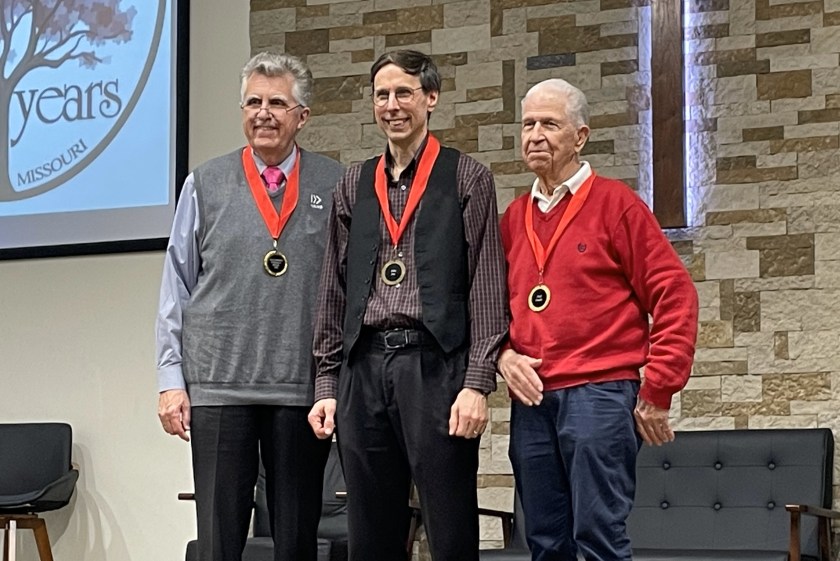
John Marshall, me, and Paul Landis. Photo by Sarah Manley

Later Friday afternoon, I attended the Dred Scott Reconcilation Forum, hosted by Lynne Jackson, a descendant of Dred and Harriet Scott. She interviewed Dr. Bryan Moore, the pastor of Jubilee Community Church in north St. Louis and a distant relative of Nat Turner. I also got to judge a cherry pie contest. On Saturday morning, I attended Rev. Marshall’s session about Lincoln; his comments were very insightful. It was great to catch up with Bill Anderson and Sarah Manley. Many thanks to Sarah for taking the pictures during the ceremony. Many thanks also to Rev. Nicholas Inman, Director of the Laura Ingalls Wilder Home in Mansfield and the driving force behind the Festival, for his gracious invitation.

Now I’m just waiting to hear the announcement of the Book of the Year for Biography from the website Foreword. A Prairie Faith is one of eight finalists. Lord-willing that will be announced in June.

If you’re interested in having me speak, please let me know (john.fry@trnty.edu). Thanks for reading!

Links:

Trinity Christian College

Iowa History 101 Recording

STL listing of events at Missouri Cherry Blossom Festival

My second book: Almost Pioneers: One Couple’s Homesteading Adventure in the West

Michelle Underwood’s website

Michelle’s Laura Ingalls Wilder’s Rocky Ridge Farm: A Detailed Look Behind the Scenes

Bill Anderson’s website

Paul Landis’s The Final Witness: A Kennedy Secret Service Agent Breaks His Silence After 60 Years

John Marshall’s Lincoln and Christianity: Essays on Lincoln’s Religious Life

The Laura Ingalls Wilder Home and Museum in Mansfield

Foreword Book of the Year Finalist Announcement

List of Foreword Book of the Year (INDIES) Finalists for Biography

Foreword’s Listing for my book
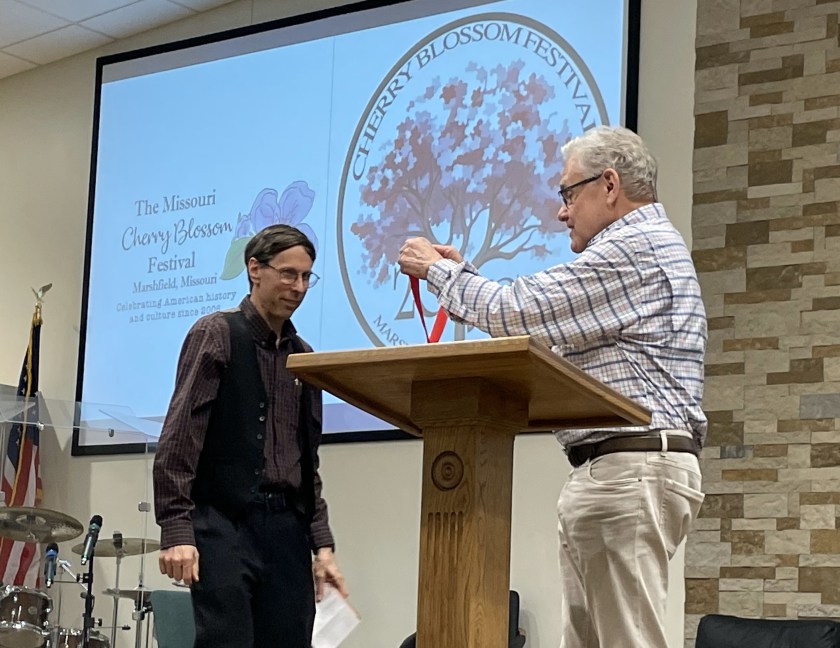
Picture of Bill Anderson giving John Fry the Ella Dickey Literacy award.

Bill Anderson presenting me with the Ella Dickey Literacy Award. Photo by Sarah Manley

Articles and Anticipation

It has now been almost a month since I last posted here. My attention and time have been taken in several directions, including teaching, grading papers and exams, committee meetings, and my work as an Academic Dean. In addition, I have been asked to speak about my last book, Almost Pioneers, at a 25th Anniversary celebration for the Iowa Women’s Archives in Iowa City next weekend. Almost Pioneers is the memoir of Laura Gibson Smith, a woman from Iowa who homesteaded in Wyoming during the 1910s; I edited it and got it published in 2013. I’m glad to be part of the celebration, but it has taken me out of my pattern of reading for the Faith of Laura Ingalls Wilder project.

However, I have spent some time each week with Laura Ingalls Wilder materials. I’ve been able to read four articles that concern Wilder, the Little House books, and history. I also stand in anticipation of the next book-length biography of Wilder which is due to be released this month.

Articles: “Little House, Big Lessons” is actually a conference paper presented by historian Pamela Riney-Kehrberg at an agricultural history conference this fall in Belgium. Pam and I have known each other since I was a graduate student at the University of Iowa in the late 1990s and she was teaching at Illinois State University. She now teaches at Iowa State, one of the flagship schools for the study of rural and agricultural history. We see each other every couple of years at a conference. She reached out to me last summer for help with how Europeans responded to the Little House books; I was able to connect her with several Wilder scholars who provided a lot of leads. The paper is both about European reception of the Little House books and what they teach about everyday life in late-nineteenth century American rural areas. She concludes that the books are useful in enabling students to better understand “the environment of the American Great Plains, and the complexities of gender ideals versus gender realities.” Fascinating stuff.

The second article was “Re-examining the American Pioneer Spirit: The Extended Family of Laura Ingalls Wilder.” It was published in the Wisconsin Magazine of History last March and uses materials at the Wisconsin Historical Society to fill in some information about the families of Charles Ingalls and Caroline Quiner, Laura’s parents. It’s pretty interesting. I fed some biographical information from this article into the timeline of Laura Ingalls Wilder’s life that I am constructing for the book project.

I also read “American Indians in the Fiction of Laura Ingalls Wilder” by John Miller. I had previously read the three books that Miller has written about Wilder (Laura Ingalls Wilder’s Little Town, Becoming Laura Ingalls Wilder, and Laura Ingalls Wilder and Rose Wilder Lane), but I had never read this article, published in South Dakota History in 2000. Miller provides a nuanced consideration of the depiction of Native Peoples in the Little House books and Wilder’s other published work. Clearly there are multiple voices in the books: Ma and others are very anti-Indian, but Pa and Laura are not unremittingly so. Pa respects the Native Americans that he encounters, but assumes that they will be moving on so that whites can have their land. Laura is more like Pa than Ma, and Laura identifies with Indians at times. Miller argues that Americans in 2000 might see the depictions of Native Peoples in the books as problematic, but that Wilder’s views were probably more open than those of most others who lived in the Ozarks during the 1920s and 1930s. I know that I will have to engage this issue in some way in my biography of Wilder.

Finally, I was able to read “Homesteading Remembered: A Sesquicentennial Perspective” by Brian Cannon, published in Agricultural History in 2013. 2012 marked the 150th anniversary of the passage of the Homestead Act in 1862, and Cannon investigates how homesteading was depicted in popular culture—both books and movies—during the twentieth century. Major literary works examined include the last three Little House books, Rose Wilder Lane’s Free Land, Elinore Stewart’s Letters of a Woman Homesteader, and O. E. Rolvaag’s Giants in the Earth. The article engages movies from The Homesteader in 1919 to Shane in 1953, Heartland in 1979, and Far and Away in 1992. Cannon points out that “The most pointed criticism of the government’s administration of homesteading in these works is actually the writing of Laura Ingalls Wilder. Without exception these works valorize the homesteaders’ tenacity, work ethic, and family values. Only one, Giants in the Earth, seriously questions the prudence of homestaders’ decisions although many show the travails of homesteading.” He concludes that scholars’ assessment of homesteading have rarely been taken up in popular culture, and that some works reveal more about the time that they were produced than the time that they depict.

Anticipation: Caroline Fraser’s Prairie Fires: The American Dreams of Laura Ingalls Wilder is set to be released on November 21. Advance copies have been reviewed by major library outlets, and there are already 10 customer reviews on Amazon.com. At 640 pages, it promises to be a nearly comprehensive biography setting Wilder’s life and writings in historical context. I hope to get a copy as soon as it’s released.

Thanks for reading.

Links:

My Almost Pioneers blog

Almost Pioneers at Globe-Pequot Press

Iowa Women’s Archives 25th Anniversary Celebration

Pamela Riney Kehrberg at Iowa State University

John Miller’s books at Amazon

Caroline Fraser’s website