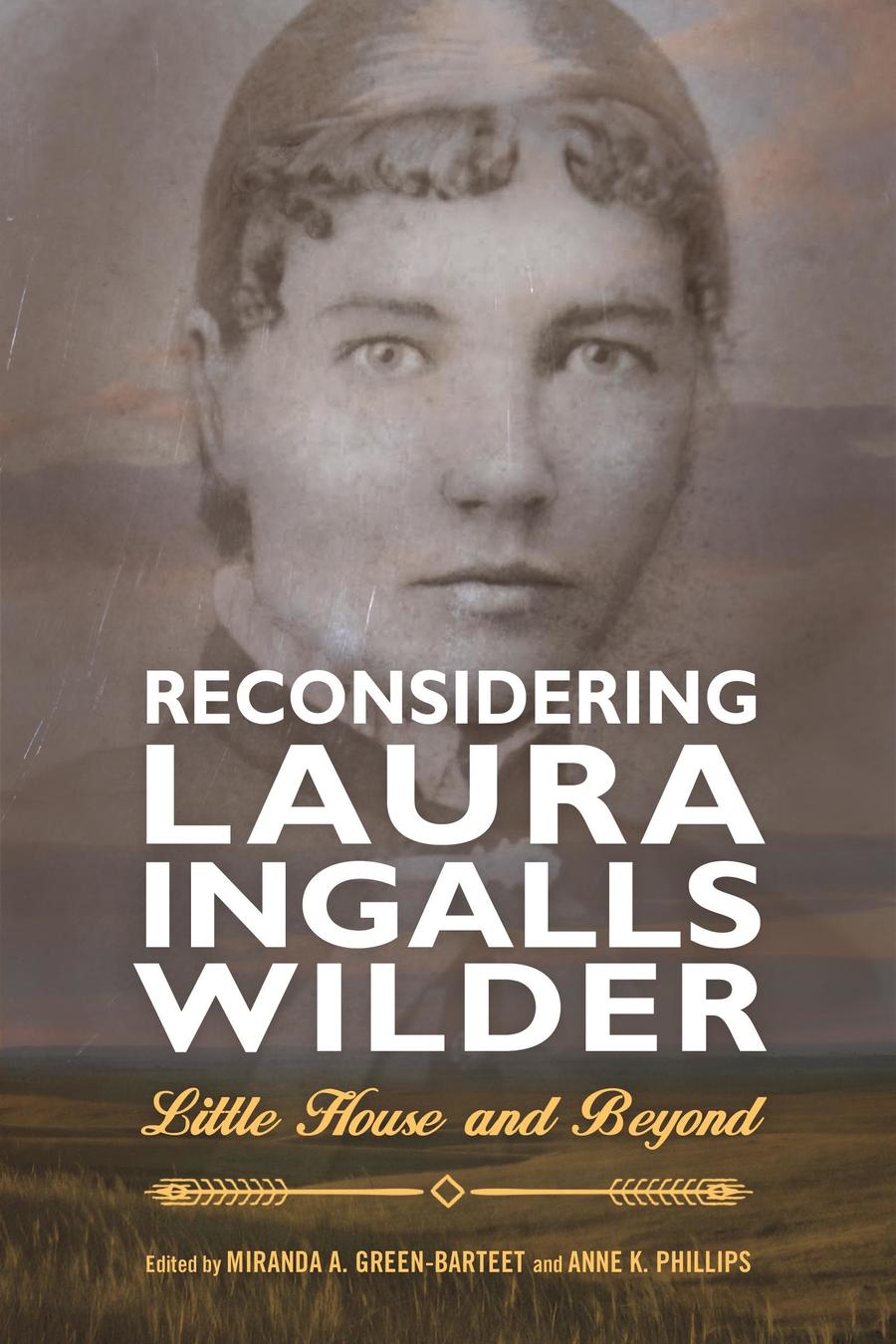
Reconsidering Laura Ingalls Wilder

When I sat down to write this entry, I was shocked to realize that it has been five months since I have contributed anything to The Faith of Laura Ingalls Wilder. Actually, I wasn’t shocked. I knew that it has been a long time. But I have tried to keep doing some reading about Laura Ingalls Wilder. During this semester, that has meant reading a couple of essays in Reconsidering Laura Ingalls Wilder: Little House and Beyond each week. I finished the book yesterday.

Published by the University of Mississippi Press earlier this year, Reconsidering Laura Ingalls Wilder contains fifteen essays by scholars, and it presents some of the most recent academic scholarship on Wilder and the Little House books. Most of the authors are literature scholars; several have degrees in creative writing, American studies, women’s studies, and gender studies. There are no historians. Like most books of essays, I found some of the pieces to be stronger than others. Five stood out to me as providing particularly helpful examinations of Wilder’s writing:

  • Keri Holt and Christine Cooper-Rompato, “The Complicated Politics of Disability: Reading the Little House Books and Helen Keller.” The authors examine the Little House books’ depiction of Mary’s blindness, which is central to the later novels. They point out that the ways that the books depict Mary’s contributions to family life show her “individualism, self-sufficiency, and independence,” (35) which was a contrast to most other children’s books’ depictions of people with disabilities. These traits were also stressed by Helen Keller in her writing during the early twentieth century. Ironically, however, both Wilder and Keller stressed independence and distanced themselves from outside support; the Little House books do not mention that Dakota Territory paid for Mary’s tuition at the Iowa School for the Blind, and Keller often publicly refused monetary gifts and quietly accepted them later. I greatly appreciated Holt and Cooper-Rompato’s nuanced description of the complicated nature of these individuals’ lives and works.
  • Vera R. Foley, “Naked Horses on the Prairie: Laura Ingalls Wilder’s Imagined Anglo-Indian Womanhood.” This essay provided a close reading of Laura’s interactions with horses in the Little House books and The First Four Years. Foley describes Laura as “a young girl caught between the influence of a genteel mother and an unstable frontier.” (51) The result, Foley argues, was that Laura embraced an outdoor, active femininity, not Ma’s domesticity. (49-50) A key part of how the books describe this process involves horses: from the Indians riding away on ponies at the end of Little House on the Prairie, to her racing with Lena across the plains in By The Shores of Silver Lake, to her courtship which is conducted almost exclusively on buggy and sleigh rides, to her riding of Trixy in the First Four Years. Fascinating.
  • Jenna Brack, “Her Own Baby: Dolls and Family in ‘Indians Ride Away.’” This essay presents the most multidimensional explanation of Laura’s shocking demand for a Native American baby at the end of Little House on the Prairie that I have read. You may not agree with her interpretation; I don’t agree with it completely. Unfortunately, it is impossible to describe in a short space.
  • Jericho Williams, “Breathing Literary Lives from the Prairie: Laura Ingalls Wilder and the Promises of Rural Women’s Education in the Little House Series.” This essay compares the description of Laura’s career as a teacher to depictions of teachers in Hamlin Garland’s Rose of Dutcher’s Coolly and Willa Cather’s The Song of the Lark. While the female protagonists in Garland and Cather’s books leave their small towns for success in urban areas, Wilder’s works reject the idea that “rural women lead inferior lives.” (134) Williams continues: “In Wilder’s view, rather than just a means for talented women to leave their hometowns, education is a multifaceted process that consists of learning rural arts and skills, living within one’s means, adapting to one’s environment, and assisting one’s family members and community.” (134) I think that this is an insightful statement about key aspects of Laura’s overall worldview, not just her view of education.
  • Christiane E. Farnan, “The Undergraduate American Studies Classroom: Teaching American Myths and Memories with Laura Ingalls Wilder.” Farnan has her college students read Little House in the Big Woods, Farmer Boy, and Little House on the Prairie in conversation with other classic books about farming and the frontier by Mary Rowlandson, Thomas Jefferson, Hector St. John Crevecoeur, Horace Greeley, Frederick Jackson Turner, James Agee and Walker Evans, and Henry Nash Smith. The essay asserts that her current students easily understand Big Woods and Farmer Boy as depictions of the agrarian ideal, but they often interpret Little House on the Prairie as a critique of Native American removal and agrarian occupation. Pa uproots his family, takes them into danger in many forms (the frozen lake, the high river, fire, wolves, hostile Native Americans), then abandons all of their work because of a rumor. Nobody is better off at the end of the book. It was a reading that I hadn’t thought about before, and not one that I especially share, but I can see how her students come to it.

Unfortunately for my particular project, most of the authors ignore religion and faith. The one significant consideration is in Anna Thompson Hajdik’s “The Wilder Mystique: Antimodernism, Tourism, and Authenticity in Laura Ingalls Wilder Country,” a review of the development of some of the Wilder historic homesites and an examination of some of the sources of their appeal during the late twentieth and early twenty-first centuries. Hajdik notes the importance of the books to Christian homeschooling families and the Amish. The homeschooling connection has been mentioned by other authors (and I have numerous personal examples), but this is the first time I’ve read about the Amish. The citation for this observation was a personal conversation from 2006.

Reconsidering Laura Ingalls Wilder provides a number of fresh looks at the Little House books. I was pleasantly surprised that the authors are willing to consider the works on their own terms, not just condemn them for not living up to how people today would deal with the subject matter. It does not provide any new biographical or historical information about Wilder, but it does provide some new and interesting ways to approach Wilder’s work.

As always, thanks much for reading.

(All citations are from: Reconsidering Laura Ingalls Wilder: Little House and Beyond. Edited by Miranda A. Green-Barteet and Anne K. Phillips. Jackson: University of Mississippi Press, 2019.)

Publisher’s site and picture credit: https://www.upress.state.ms.us/Books/R/Reconsidering-Laura-Ingalls-Wilder

Laura Ingalls Wilder: A 150-Year Legacy

Well, it’s May. It’s somewhat embarrassing that I haven’t posted anything since the middle of March. I could give some excuses. I could describe how in the last two months I’ve traveled to Pennsylvania (twice), Wisconsin, and South Dakota. But instead, I will try to make up for my lack of action by posting to the blog several times this week and next. (It’s finals week here at Trinity Christian College, so I have high hopes.) This post will report on the conference I attended in South Dakota at the end of last week. Lord-willing I will next put up a final report on the Honors Seminar I taught this term, and then an update on where the project is.

Last Friday and Saturday, the South Dakota State Historical Society (SDSHS) hosted the Laura Ingalls Wilder: A 150-Year Legacy conference in Sioux Falls. It was an incredibly good event. I think that there were over 200 people in attendance. The SDSHS Press published Wilder’s previously unpublished memoir Pioneer Girl: The Annotated Autobiography several years ago. It was a beautiful book, and as I mentioned in my blog entry on the book, it became a surprise best-seller.  The Press has followed up that volume with a book of essays released this year titled Pioneer Girl Perspectives: Exploring Laura Ingalls Wilder. The conference speakers had all written an essay in that book. Nancy Tystad Koupal, the director of the Press and editor of the book presided over the conference. Pioneer Girl Perspectives will not be available to the public until the end of May, but it was for sale at the conference. I sold two copies of my last book, Almost Pioneers, so I was able to buy a copy.

As far as the presentations went, there were several that were especially insightful. One was by Caroline Fraser, who edited the two-volume Library of America edition of the Little House books and who has a new biography of Wilder coming out in November: Prairie Fires: The Life and Times of Laura Ingalls Wilder. Fraser placed Wilder’s daughter Rose Wilder Lane’s career in context of Yellow Journalism during the early 20th century, where “fake news” was used to attract readers. Fraser uses that context to explain why Lane included the story of the “bloody Benders” in some of the manuscripts of Pioneer Girl, and why Wilder mentioned them in her Detroit Book Fair Speech. Bill Anderson’s talk about what happened to the Pioneer Girl manuscripts between 1957 and the 1970s had some great stories and filled in many gaps in my knowledge of the manuscripts. And Sallie Ketcham described some ways that the Little House books, and especially Little House in the Big Woods, have characteristics of fairy tales.

Several historians presented, and they were excellent. Paula Nelson mined Wilder’s Missouri Ruralist articles to describe Wilder’s relationship to her time, especially Wilder’s ideas about women’s suffrage. Wilder’s pioneering was physical and geographical; she was not a pathbreaking feminist. Her ideas were shaped by the nineteenth century, and she believed in family, church, authority, self-control, and tradition. John Miller uncovered ways that Wilder was a Midwestern girl. Finally, Elizabeth Jameson outlined some of the reasons why the Little House books may be excellent literature, but they’re not representative of childhood on the late nineteenth century frontier. Wilder’s actual experiences, as outlined in Pioneer Girl, were in many ways not happy. She worked for wages to support the family, often had to live away from home, and was nearly sexually assaulted. But Wilder transformed her experiences into the happy childhood presented in the Little House books, and that may mislead people as they think about families in the past. I believe that it is important to have novels like the Little House books that put forth ideals of love and support for families to emulate. But I do understand Jameson’s critique. I would also feel better if Wilder and Lane had not told many people that the books described exactly what happened.

In addition to presentations, there were also panels of authors who discussed major controversies concerning Pioneer Girl and the Little House books. These included the roles of Wilder and Lane in their composition, and the political ideas presented in them. The panelists agreed that Lane acted as an editor and an agent for the books, but not as a ghostwriter. There was disagreement over whether Lane should be called a collaborator. Fraser and Miller argued that she was a collaborator, Koupal and Michael Patrick Hearn (a children’s literature scholar) asserted that she was not. The consensus about political ideas is that while there are some libertarian ideas in the Little House books (watch for a blog post about Christine Woodside’s Libertarians on the Prairie in a week or two), some arguments about the books’ political nature are overblown.

The conference was also great for networking. I was fortunate to meet Jameson (I had read two books she edited on women in the west when I was in graduate school at the University of Iowa), Fraser, and Koupal for the first time. I also really enjoyed catching up with friends who attended, including Anderson, Miller, Nelson (she and I both had Malcolm Rohrbough as our dissertation advisor at Iowa), and Michelle McClellan, who teaches at the University of Michigan and is working on a book about the Little House historical sites. I also saw Sarah Uthoff from Trundlebed Tales, who live tweeted the conference (see her day 1 and day 2 compilations), and Sandra Hume from Little House Travel and the Laura Ingalls Wilder Legacy and Research Association (organizers of LauraPalooza – more on this in later blog entries). I also spoke briefly with Jon Lauck, who started the Midwestern History Association several years ago. It was also neat to talk to some women who just love the Little House books, especially Kasey and Alice, who bought the copies of Almost Pioneers.

All in all, this conference has given me new energy for getting back to work on the Faith of Laura Ingalls Wilder. So Lord-willing there will be more material on the blog in the near future. Thanks for reading.

Presentations and Meditations

Well, it’s March. It’s incredible how fast time is moving this semester.

On Wednesday of last week I spoke at Calvin College in Grand Rapids, Michigan. The talk was sponsored by the History Department and the Mellema Program in Western American Studies. It was a great time. Over fifty people turned out to hear me speak—at least I took fifty handouts and they were all gone. My presentation gave a report of what I’ve come to understand so far about Laura Ingalls Wilder’s faith: 1) that the descriptions of God, Christianity, and the church in the Little House books were shaped by her daughter Rose Wilder Lane, and 2) that Wilder’s faith was deep and genuine, but it emphasized God the Father and His laws more than Jesus Christ and salvation. These conclusions will be familiar to those who have been reading this blog for any length of time.

The question and answer period was especially rich. The audience had students, faculty members, and members of the community, including a mother with two young children. I took questions from all three groups. It was a fascinating experience. At one point, I had to try to explain to a faculty member why so many Americans for the last eighty years have been drawn to the Little House books. (Briefly: engaging descriptions, emotionally gripping prose, and a vision of human flourishing that provides an attractive alternative to modern life for many.) I also at times had to explain to some members of the community that not everything in the books represents exactly how things happened. I’m still working on how to characterize the complex collaboration of Laura and Rose.

Many thanks to Will Katerberg for inviting me and Jenna Hunt for taking care of so many of the details for the talk. If you’re interested, the audio recording may be made available, and I’ll put up a link when it is.

While I was in Grand Rapids, I also met with David Bratt, an editor for the William B. Eerdmans Publishing Company, which is headquartered there. David would like me to write a proposal for a book-length biography of Wilder with particular attention to her faith. Eerdmans has a series titled the Library of Religious Biography, and the series editors are also very interested in seeing a proposal. Eerdmans publishes books for academics and readers in the church, so they may be a good fit; it is my hope that any book I do write will not only speak to college faculty and students but also to a broader audience of people who are interested in the books. My plan is to write the proposal by the end of this semester.

In addition, on Monday of this week, I spoke at a Faculty Coffee sponsored by the Faculty Development Committee here at Trinity Christian College. It was an abbreviated version of the Calvin talk, because I only had forty-five minutes rather than ninety to speak and take questions. I was very happy that one of the students from my Honors Seminar course came, as well as many faculty and staff.

My conversation with David, my lecture at Calvin, and my talk here at Trinity have led me again to think about audience and reception. As I talk with more people about the project, I’m realizing that my research points in two directions. First, it seems that Laura Ingalls Wilder was a committed Christian, and that at least some of the straightforward and positive descriptions of God, Christianity, and the church in her handwritten original manuscripts were changed by her daughter into the more mixed or even negative depictions that appear in the published Little House books. One might imagine that this would be welcomed by many of those who love the books, especially those who are serious Christians themselves. However, I also think that my research suggests that Wilder was not what we might call a born-again or evangelical Christian. Her descriptions of God, Christianity, and church emphasize God’s power, His laws, and personal morality. Wilder’s writings hardly mention Christ, the gospel, or salvation. I think that this runs against what some readers believe about her. I think that the television series may play a role in this. Although I have never watched an episode (I guess that I need to watch at least some soon), it is my understanding from others that Christianity was pretty central to the series.

I’m not exactly sure how I’m going to navigate this, except to say, as I said in response to a question on Monday morning, that one thing that historians often have to do is to try to get behind how a historical figure is remembered to the historical person himself or herself. I don’t want to do it just for the purpose of cutting down Laura in people’s estimation or telling people that what they believe is wrong. But I do think that loving one’s neighbor who lives in the past includes being honest about who they were, what they believed, and how they lived.

I’m still thoroughly enjoying the Honors Seminar on the Little House books. This week we finished Little Town on the Prairie. Perhaps I can do a post next week (next week is spring break, so I’ll have some more time) where I reflect a little on what has been going on in that class.

Thanks for reading.

“This is What Men Call God”

Greetings. I’ve been working on my paper for the Conference on Faith and History (CFH) Biennial Meeting next week. It is titled “‘This is What Men Call God:’ The Faith of Laura Ingalls Wilder.” I sent it off to the respondent for our panel last week. I thought I’d give an overview of the paper this week and then report about what happened after the CFH Meeting.

The paper opens with a brief description of the problems confronting someone trying to consider Wilder’s faith: conflicting evidence and the role of Rose Wilder Lane. The conflict is mainly that there is evidence that she believed in Christianity, but 1) there are negative depictions of the church and Christianity in the Little House books and 2) Wilder never formally became a member of a church. Then there is the question of what in the Little House books was written by Wilder and what was contributed by Lane.

I then describe what I found when I looked at the manuscripts of the early Little House books. Basically, it appears that Wilder wrote a pretty straightforward and conventional description of the church and Christianity. Rose took what Wilder wrote and made it more direct, engaging, and memorable, but she also complicated the simple descriptions Wilder wrote. For more, see my blog entry on the Manuscripts.

Finally, I consider several things that I believe that we can say about Wilder’s faith from all of the works Wilder wrote. First, she seems to have been a believer in God, His word, and His work in the world. Both Pioneer Girl and By the Shores of Silver Lake describe an experience with God. The title of the paper comes from the Pioneer Girl account. Her Missouri Ruralist articles give much evidence of her Biblical worldview. However, her Christianity emphasized moral action in the world and love for one’s neighbor. She very rarely mentioned sin and salvation, and almost never mentioned Jesus Christ. Second, there is good evidence that she participated in the most important Christian practices: Bible reading, prayer, and Sunday worship. Finally, she was active in the Congregationalist Church as a child and young adult in Minnesota and Dakota. She attended the Methodist Church in Missouri for most of her adult life. But there is no evidence that she ever formally became a member of any church.

I’m hoping that those who come to the session will help me with several questions. First, what historical contexts should I be trying to fit this in? Congregationalism? Women’s history? Rural religion? Second, who should I think about in terms of audience. Academics have not been all that interested in Wilder, but there seems to be a large number of people in the general public who read and love Wilder and her works, and they buy books.

We’ll see what people think. Thanks for reading.

A Little House Traveler

It’s been a while again since I’ve posted. I’ve been working on several things. Two weeks ago, I finished a draft of my article, now titled: “‘This is what Men Call God:’ The Faith of Laura Ingalls Wilder.” I then emailed it to nine of my colleagues from the English, History, Music, Philosophy, and Theology Departments here at Trinity Christian College. Last week, some of those colleagues and I met for our monthly Historical Scholars Workshop. We discussed my article; they asked some really good questions and gave me some really good suggestions for the project going forward.

Since then, I’ve been working on a draft of my conference paper for the Biennial Meeting of the Conference on Faith and History to be held at Regent University. The session I will be presenting in is titled “‘On the Pilgrim Way:’ Writing Religious Biographies of Women.” (The quote in the title is from Chapter 23 of By the Shores of Silver Lake.) The other presenters are Kristen Kobes Du Mez from the History Department at Calvin College and Karen Swallow Prior from the English Department at Liberty University. The respondent for the session will be Timothy Larsen from the Biblical and Theological Studies Department at Wheaton College. I will only get 15-20 minutes for my presentation, so I have to pare my article back from 28 pages to about ten. I’ve already gotten it down to 15. More cuts to come.

However, yesterday I also got the chance to look through the last published volume of primary source materials written by Laura Ingalls Wilder: A Little House Traveler: Writings from Laura Ingalls Wilder’s Journeys Across America, published by HarperCollins in 2006. Like many recent publications of Wilder materials, much of it is material that has already been published. In fact, the first four-fifths of the book reproduce two books that I have already written about on this blog, On the Way Home and West From Home. There are some more photographs in this volume, it is hardcover, and the type is larger, but otherwise it appears that the text is exactly the same as the originals.

That leaves the last 70 pages of the 350 page work. The editors of the volume (who are not identified) call this part of the book “The Road Back: Laura Ingalls Wilder’s Record of the Journey Back to DeSmet, South Dakota, 1931.” It reproduces notes that Wilder wrote to herself on a trip that she and Almanzo took from Mansfield, Missouri to DeSmet, South Dakota in 1931. They function as a diary, with daily entries describing how far they traveled, what they did, and how much they spent. Apparently Wilder wrote on loose sheets, and some of them were sent to her daughter for safe keeping while they were on the road. It may be that Wilder wanted to use them for future publications, or it may just be that she had written so much by this time (including fifteen years of Missouri Ruralist articles and columns and Pioneer Girl) that she found writing a valuable way of recording and making sense of what she saw.

I understand why the publishers decided to put these three sets of Wilder’s writings together. On the Way Home, a diary of the trip the Wilders took from DeSmet to Mansfield in 1894, describes their travels in a covered wagon. West From Home, letters Laura wrote to Almanzo from her trip to San Francisco to visit Rose, describe her travels by train. This third trip was taken in their Buick, which they named Isabelle, with their dog Nero. Once they reached South Dakota, they stayed with her sister Grace and her husband Nate Dow in Manchester, South Dakota, and visited DeSmet several times. Laura and Almanzo then drove to the Black Hills to see her sister Carrie and her husband David Swanzey. While there, they visited Mount Rushmore and the badlands. They then drove home, taking a different route. Wilder’s ability to describe a scene minutely and eloquently is often on display here. She saw much evidence of the depression, including idle factories, abandoned farms, and frustrated townspeople. It was a hot, dry summer, and many times she describes billowing clouds of dust.

It would have been helpful if the publisher had provided some kind of map for these travels for the benefit of readers. Also, the introduction to this portion of the book, by Abigail MacBride, says that this was the first time that Laura had visited DeSmet since leaving in 1894. (288-289) However this is not true; Laura had traveled to DeSmet by train in the summer of 1902 to see her father before he died of heart disease. (John E. Miller, Becoming Laura Ingalls Wilder: The Woman Behind the Legend [Columbia: University of Missouri Press, 1998), 111.)

The new material in this volume adds little to our understanding of Wilder’s faith. It does not mention God, Christianity, or the church. I did use my perpetual calendar to look up what Laura and Almanzo did on Sundays during the trip. It appears that they did not keep the pattern they had kept in 1894 of not traveling on Sundays. On Sunday, June 7, they traveled 277 miles from Shady Side, Missouri to Eureka, Kansas. (292-293) On Sunday, June 14, they were staying with the Dows and they visited their parents old house in DeSmet and Nate’s farm. (310) They drove to Mount Rushmore with the Swanzeys on Sunday, June 21. (321-323) Finally, on June 28, they were on the way back to Mansfield and they drove 233 miles. (341-342) I wrote in my entry on West From Home, “One gets the impression… that Wilder was most interested in church life when she was settled in a community and she knew the people. She was not as interested in attending worship when out of her normal surroundings.” It seems that the information about this additional trip confirms that observation.

Thanks for reading.

(Page number references are from A Little House Traveler: Writings from Laura Ingalls Wilder’s Journeys Across America [New York: HarperCollins, 2006].)

“I Remember Laura”

Last week, when I would normally have tried to read a Laura Ingalls Wilder book and write a blog entry, I was working on the draft of my article “The Faith of Laura Ingalls Wilder.” I actually succeeded in writing an additional seven pages (I now have twenty-one pages written.) I’m hoping to finish the article next week so that I can circulate it to some of my colleagues here at Trinity Christian College. We have a reading group of scholars from several disciplines—history, English, music history, theology—who read each other’s work and share comments and suggestions.

This week, I was able to work through I Remember Laura”: Laura Ingalls Wilder, a book edited by Stephen W. Hines and published in 1994. The book’s dust jacket has this additional subtitle (though the title page does not): “America’s favorite storyteller as remembered by her family, friends, and neighbors.” The book is a collection of a number of different types of materials, including some of Wilder’s columns from the Missouri Ruralist, some articles in other publications about Wilder and her daughter Rose Wilder Lane, and some first-hand reminiscences gathered by Hines from people who knew Wilder at the end of her life.

I used the verb “work through” at the beginning of the previous paragraph because there is much material here that is also published in other books. Almost three entire chapters are Missouri Ruralist pieces that I had already read. Other chapters republish articles from a variety of sources that are available elsewhere. There is also much material here that does not bear on Wilder’s faith. For instance, one chapter reproduces recipes from people who knew Wilder.

The unique material the book provides is in Hines’s interviews with people from Mansfield, Missouri who knew Laura, Almanzo, and Rose. Most knew them during the 1940s and 1950s, when the Wilders were in their eighties. In addition, the interviewees were quite advanced in years when Hines met with them during the early 1990s. Still, there is some new information here.

As far as material that bears on Wilder’s faith, there are several new revelations and several that connect to other bits of information I turned up previously. One thing I did not know was that her parents had given her a family Bible when she got married to Almanzo. She gave that Bible to Nava Austin, a friend, before she died:

She gave me her family Bible, the one her mother and father gave her when she and Almanzo were married. The family Bible had clippings and obituaries in it, including one for their boy. I thought Rose was the only child they ever had because Mrs. Wilder herself never mentioned anything about a son.

It was a huge Bible, and there were obituaries for both her mother and father. I’d never seen a Bible like it before, and she had pictures tucked away in it. If I am not mistaken, there was a paper clipping of when she and Almanzo got married. (117-119)

This Bible was never mentioned in either of the books that describe her wedding: Pioneer Girl or These Happy Golden Years. It is also not mentioned in The First Four Years.

“I Remember Laura” also includes an account from Carleton Knight, the pastor of the Methodist Church in Mansfield from the mid-1940s to the early 1950s. He and his wife visited the Wilders at their home a number of times. Almanzo often was working in his workshop or somewhere outside on the farm. Laura would take graham crackers and put powdered sugar icing on them to serve to her guests. Otherwise, the pastor didn’t remember much about their meetings.  However,

One thing I do remember so much is that when she came to church, even in the summer, she nearly always wore a red velvet dress, a dark maroon red, with a lace collar. Her black shoes had a big old silver buckle on them. That was her Sunday outfit. Her hair was beautiful and white and done up in a knot on the back of her head.

By that time she wasn’t terribly active. I never heard anyone say that she taught Sunday school, though she might have done before we came.” (225)

The one bit of information about Wilder’s faith that connects to another book is provided by Iola Jones. Jones spoke of taking Wilder to the Methodist Church for worship services after Almanzo’s death:

Mrs. Wilder had a good sense of humor and lots of wisdom, really; and she put it across in such an interesting way. She had been quite active in her church. In fact, she went to church with me quite a lot, which was a pickup in her activity because before that she hadn’t been going. You see, I don’t think she ever drove, so I think Almanzo’s death kept her in.

She did talk about spiritual things, and we went together to the Methodist Church where she had always gone. I can remember her telling me one time that she had memorized a book of the Bible, but I don’t remember which one. She just didn’t talk about herself a lot.  (136)

 The idea that Wilder had told someone that she had memorized a book of the Bible is striking. This connects to a letter to a Suzanna that I noted in my blog entry on William Anderson’s book, The Selected Letters of Laura Ingalls Wilder: “The whole book of Psalms is a favorite of mine and I can repeat all. Can you?” (Laura Ingalls Wilder, The Selected Letters of Laura Ingalls Wilder, edited by William Anderson [New York: HarperCollins, 2016], 342). Can it be that she told multiple people that she had memorized all 150 Psalms? Fascinating.

It’s late Friday afternoon and I must post this. Thanks for reading.

(All page numbers are from Stephen W. Hines, ed., “I Remember Laura:” Laura Ingalls Wilder [Nashville: Thomas Nelson, 1994].)

Saving Graces

Hmmm.  It’s been over a month since I’ve posted.  My apologies.  Classes are back in session here at Trinity Christian College, where I teach.  I’ve had many meetings, and I served as a faculty mentor to a group of nineteen incoming freshmen.  But yesterday, I was able to read Saving Graces: The Inspirational Writings of Laura Ingalls Wilder (Nashville: Brodman and Holman, 1997).

Saving Graces is a short book (164 pages) that reproduces forty-eight of Wilder’s articles and columns from the Missouri Ruralist.  It was edited by Stephen Hines, who also edited the complete collection of the Ruralist material, Laura Ingalls Wilder: Farm Journalist.  In the time that I had to dedicate to the task, I was able to find all but ten of the articles from Saving Graces in Farm Journalist.  For Saving Graces, Hines gave a different title to each article.  He also added an italicized Bible passage, right in the middle of each.  The titles and passages connect the content of the articles to Christian virtues, topics, and themes.  The book also reproduces ten of Wilder’s best loved hymns with music.

One might wonder why, when I was embarking on a project about Wilder’s faith, I didn’t begin with this book, rather than reading twenty some other volumes first.  Well, I came to the project with my own questions about the Little House books, and I wanted to read them before anything else.  Then I worked my way around to Wilder’s other writings, including the Missouri Ruralist articles.  When I got to reading them, I wanted to make my own decisions about which of those articles were helpful in understanding Wilder’s faith.  So I read Farm Journalist.

The articles in Saving Graces are on a variety of topics, including nature, success, childrearing, work, Thanksgiving, and service to others.  Once I had read the book, I looked through my notes from Farm Journalist to see if I had noted that the articles Hines had chosen gave information about Laura’s faith.  It turns out that I had only identified about half of the articles Hines does.

Hines has a brief introduction titled “The Christian Faith of Laura Ingalls Wilder.”  There he references interviews with neighbors of the Wilders, Laura’s lifelong church attendance, and her conversion experience related in Pioneer Girl.  (See Laura Ingalls Wilder, Pioneer Girl: The Annotated Autobiography, edited by Pamela Smith Hill [Pierre: South Dakota State Historical Society, 2014], p. 137.) Unfortunately, as he describes the context of that experience, he sets it in Burr Oak, Iowa, when in actuality she was living in Walnut Grove, Minnesota.

Perhaps a key to the difference between Hines’s and my idea of what gives evidence of Wilder’s Christianity lies in the book’s subtitle:  The Inspirational Writings of Laura Ingalls Wilder.  There is certainly a difference between something that mentions the church, Christianity, or Christian ideas (what I was looking for) and what might be termed inspirational.  As a result, there are a number of articles reproduced in Saving Graces that display Wilder’s wisdom, insight, and traditional values.  But I don’t think that they are particularly Christian.  They do sound more Christian when juxtaposed with the Bible verses added by Hines.

I appreciate what Hines was trying to do with the book, and it will encourage readers to consider Wilder’s ideas about life, relationships, and what really matters.  But since there is not really any new material in Saving Graces that I had not already read, I don’t think that my understanding of Wilder’s faith was changed much by it.

Correspondence at the Hoover Library

Earlier this week I posted the first of two entries about the research I did last week at the Herbert Hoover Presidential Library in West Branch, Iowa. This is the second. (I’m feeling pretty good about two posts in the same week; I haven’t done that since January…)

The Rose Wilder Lane Papers at the Hoover Library include six boxes that are categorized the “Laura Ingalls Wilder Series.” These boxes contain correspondence, some typescript drafts of several of the Little House books, the original manuscript of The First Four Years, some clippings, and hardcover copies of the books. I was able to look through all of these materials. What I found most enlightening, however, were the letters in the collection from Laura to Rose. Many of these are reproduced in The Selected Letters of Laura Ingalls Wilder, edited by William Anderson. However, some are not included. I found three that shed light on Wilder’s faith.

The first is from Wilder to her daughter, Rose Wilder Lane, on August 19, 1937. Actually, it is a series of “character sketches” that Wilder had written roughly twenty years earlier, “when Wilson was president.” Laura had meant to give these notes to her daughter so that Rose could use them in a short story. The letter is reproduced in Selected Letters, but the character sketches are not. Thankfully, the Hoover Library houses them.

The sketches are of Christians who were part of the Mount Zion church in rural Wright County. Uncle Alf Mingus and Brother Frank Ellis were pastors there, and the pillars of the church were Aunt Julie Mingus, Eppie Mingus, Aunt Anne Bradshaw, and “Aunty Pickle” (yes, really). All the families in the church were farmers, including the pastors. They were all good farmers. The women of the church got together to spin and sew and gossip, but the gossip was edifying, not negative. The church community cared for those who were less fortunate, supported formal education and music instruction for their children, and inculcated good morals: “In all the hunt for illicit liquor no still has ever been found in the neighborhood.” The church building was the center of community entertainment. At the end of her descriptions, Wilder draws this contrast: “Not all communities are like the ones I have described. There are three not far away where the churches declined, were allowed to go into decay, and the wholesome life of the community and the value of its property declined with them.” (Rose Wilder Lane Papers, Laura Ingalls Wilder Series, Herbert Hoover Presidential Library, Box 13, Folder 193)

Wilder’s depictions are of a church that served as the social center of its community, which was a popular idea among many mainline churches in the early twentieth century, because Social Gospel pastors argued that the church should be just that. Wilder’s descriptions are heartfelt. She argues forcefully that an active church community can make a great difference in the life of a rural neighborhood. It’s interesting that she wrote these for Rose, who had rejected the church. Perhaps this was a way to introduce the topic of Christianity into their correspondence.

The second letter is from Laura to Rose on February 20, 1939. Much of this letter is also reproduced in Selected Letters (192-193). About a page and a half is not reproduced. The excised material is the revelation that several of Laura and Rose’s acquaintances had begun attending the Roman Catholic Church. Wilder is incredulous; she could not understand why they would have done so.  Their decision caused troubles for one of the families, and in fact one member had decided to move to a different part of town. This kind of genteel anti-Catholic sentiment was also widespread among Protestants during the nineteenth and early twentieth centuries, and it’s not surprising that Wilder was susceptible to it. I don’t believe that this is a breakthrough discovery, but it is another reference point for constructing Wilder’s adult religious beliefs.

The final letter is one Laura wrote a month after the previous one. It was written on March 17, 1939, and it appears on pages 193-196 in Selected Letters. However, there is a section of news about women in the Mansfield community that was omitted from the book. It contains this account concerning the Methodist church:

          The leaders in the Methodist Aid have told Mrs. Hoover that they don’t need her help any more when they serve dinners. Mrs. Davis said Mrs. Hoover was heart broken over it because she always had helped. “But you know she is 74 years old and not much help any more.”

          A picture of me two years from now! I told the bunch talking about it that Mrs. H. ought to have done as I did – ‘quit while the quitting was good’ and Mrs. Craig said, ‘You and me both.” (Rose Wilder Lane Papers, Laura Ingalls Wilder Series, Herbert Hoover Presidential Library, Box 13, Folder 195)

I’m working to fit all of this in with what I’ve already put together about Wilder’s faith in previous posts. It seems that she was a committed Protestant Congregationalist, but willing to worship in a Methodist church when a Congregationalist church was not available. She was not a Presbyterian, as multiple times she criticized predestination and strict Sabbath-keeping. She worshiped regularly at the church in her community, but it appears not so much when she was out of town. Her faith was important to her, but she also was pretty private about it. Her expression of Christianity in her Missouri Ruralist articles tended towards moral injunctions, not a celebration of God’s forgiveness through Christ. She had good memories of growing up in the church, though those memories as presented in the Little House books are distorted by her daughter’s influence.

I have a couple more books to read through (including A Little House Sampler and A Little House Reader), and then I need to put together an outline and start writing my paper for the Conference on Faith and History this fall. Thanks for reading and commenting.

Page number references are to Laura Ingalls Wilder, The Selected Letters of Laura Ingalls Wilder, edited by William Anderson (New York: HarperCollins, 2016).

Little House Manuscripts

Last week I promised that I would report on the archival research that I did at the archives of the Herbert Hoover Presidential Library. Here is the first installment of that report.

One of the reasons that I went to the Hoover Library was to look at a set of microfilm documents that included original manuscripts of several of the Little House books. The microfilm was made by the Western Historical Manuscript Collection at the University of Missouri and the State Historical Society of Missouri. The actual documents are held by the Laura Ingalls Wilder Home Association in Mansfield, Missouri. The collection includes Wilder’s original handwritten manuscripts of Farmer Boy, On the Banks of Plum Creek, and By the Shores of Silver Lake. It also has later, typescript manuscripts of Pioneer Girl, Little House in the Big Woods, and Little House on the Prairie. I had thought that the collection had some kind of manuscript of all eight of the Little House books, but I was mistaken. However, I was glad to look at what was available.

I’ve worked on two books myself, so I understand how many times a text is revised before it is published. But it still struck me how many different versions there were of each Little House book. This is most clear for On the Banks of Plum Creek and By the Shores of Silver Lake. It appears that for these books at least, Wilder wrote out two different drafts in longhand on yellow lined paper. Her daughter Rose Wilder Lane then typed a draft, changing the order of some stories and adding structure, pacing, action, and dialogue. Then Wilder read over the drafts and made corrections. At times she argued with Lane about changes. We have the letters Wilder and Lane sent to each other about these books because they were living in different parts of the country (and because Lane did not destroy them – see my post on Selected Letters). As a result, the original manuscript is often extremely different from the final, published versions of the stories.

I was also struck by how much of the material for the completed books, how much of the action and dialogue, actually was the work of Lane. It is clear that the books were a collaboration between mother and daughter, with each contributing what each was best at. Wilder excelled at description and she knew her characters and her audience. Lane provided overall structure, pacing, excitement, and dialogue. My apologies to Pamela Smith Hill, who I think has greatly influenced my understanding of this collaboration; she says something close to this in her biography, but I don’t have time to look it up right now.

I was especially interested in whether the depiction of the church and Christianity changed between the original handwritten manuscripts and later versions. It was my hypothesis that Wilder’s original drafts would have more positive descriptions of church people than eventually appeared in the published versions. I was guessing that Lane would have supplied the more negative comments. What I found supported this hypothesis. I can provide two striking examples, one from Farmer Boy and one from On the Banks of Plum Creek.

In my post on Farmer Boy, I related how God comes into the story of the strange dog who guarded Almanzo’s family’s house from thieves when they had been paid $200 cash for two horses and could not get to town to put it in the bank. Here is Wilder’s original manuscript:

          Father took the money to Mother. They didn’t like to keep $200 in the house overnight, but it was too late to take it to the bank at Malone. Mother put it away in the bureau drawer in her room. She said good Christians ought to feel that God would take care of them, but she’d rather the money were in the bank. (Laura Ingalls Wilder Papers, Western Historical Manuscripts Collection C-3633, Folder 11)

This becomes, in the published book, the following exchange:

          “The Lord will take care of us,” Father said.

          “The Lord helps them that help themselves.” Mother replied. “I wish to goodness that money was safe in the bank.” (164)

Then, at the end of the chapter, Mother says the following in Wilder’s original:

          Father shook his head and said, “Well! Well! Well!” But Mother said she would always believe the strange dog had been sent by the Lord to watch over them and that he had kept the robbers away. (Laura Ingalls Wilder Papers, Western Historical Manuscripts Collection C-3633, Folder 11)

The published book says the following:

          Mother said she would always believe that Providence had sent the strange dog to watch over them. Almanzo thought perhaps he stayed because Alice fed him.

          “Maybe he was sent to try us,” Mother said. “Maybe the Lord was merciful to us because we were merciful to him.” (167)

Both of the exchanges in the published version are more interesting and engaging since they are dialogue instead of narrative. This directness is one of the things that makes the Little House books memorable. But I believe that the original manuscript better expresses how Wilder understood God and His actions in the lives of His people. It expresses a more settled faith. Mother and Father agree that God is in control, even when they are anxious. They believe that it was God’s providence that sent the dog to be the means of their protection. The addition of the words from Aesop’s fables (which many believe are in the Bible) and the multiple interpretations given by Mother and Almanzo confuse this depiction of God’s work in the world. Lane must have been the source of these changes, and that confusion reminds me of Lane’s experience of religion. She rejected Christianity until late in her life, was drawn towards Islam when she visited the Middle East, and was a pretty confirmed agnostic if not an atheist during the 1930s.

Even more striking are the changes to the description of church in On the Banks of Plum Creek. In my post on that book, I noted that the treatment of her Sunday School teacher, Mrs. Tower, had a bit of a negative edge. Laura’s original draft is much more positive:

          “The lady told them her name was Mrs. Tower and learned all their names. Then she told a Bible story.

          It was one Ma had told Laura and Mary, so they knew it already, but they liked to hear Mrs. Tower tell it…

          After the story Mrs. Tower repeated a verse from the Bible to each little girl in turn and told her to remember it and tell it to her the next Sunday. That would be her Sunday school lesson.

          When Mrs. Tower came to Laura, she said, “My very littlest girl must have a small lesson. It will be just three words, ‘God is love.’ Can you remember that for a whole week?”

          Laura thought she was not so small as Mrs. Tower imagined. Why! She could remember long verses and whole songs. But she wouldn’t hurt Mrs. Tower’s feelings by telling her that so she answered, “Yes, Mam!” (Laura Ingalls Wilder Papers, Western Historical Manuscripts Collection C-3633, Folder 22)

This becomes the following exchange in the published book:

          “When the others were settled on the square of benches, the lady said her name was Mrs. Tower, and she asked their names. Then she said, “Now, I’m going to tell you a story!”

          Laura was very pleased. But Mrs. Tower began, “It is all about a little baby, born long ago in Egypt. His name was Moses.”

          So Laura did not listen any more. She knew all about Moses in the bulrushes. Even Carrie knew that….

          [Mrs. Tower gives out Bible memory verses:] When it was Laura’s turn… she said, “My very littlest girl must have a very small lesson. It will be the shortest verse in the Bible!”

          Then Laura knew what it was. But Mrs. Tower’s eyes smiled and she said, “It is just three words!” She said them, and asked, “Now do you think you can remember that for a whole week?”

          Laura was surprised at Mrs. Tower. Why, she remembered long Bible verses and whole songs! But she did not want to hurt Mrs. Tower’s feelings. So she said, “Yes, ma’am.”

          “That’s my little girl!” Mrs. Tower said. But Laura was Ma’s little girl. “I’ll tell you again, to help you remember. Just three words,” said Mrs. Tower. “Now can you say them after me?”

          Laura squirmed.

          “Try,” Mrs. Tower urged her. Laura’s head bowed lower and she whispered the verse.

          “That’s right!” Mrs. Tower said. “Now will you do your best to remember, and tell me next Sunday?”

          Laura nodded. (505-506)

Like the alterations to the text of Farmer Boy, the changes to this account make it much more direct. One can feel what Laura felt. It’s much more effective storytelling. However, the tone of the writing and the feelings conveyed to the reader are completely different in the two versions. In Wilder’s original manuscript, Laura enjoys this new person and likes to hear her tell a story, even though she has heard it already. Later, Laura is a little surprised at Mrs. Tower’s notions, but doesn’t want to hurt her feelings. In the published book, which must be Lane’s retelling, Laura is offended that she would be told such a juvenile story and tormented by Mrs. Tower’s assumptions that she can’t memorize anything longer than several words. Add to this the fact that the shortest verse in the King James Bible (which was undoubtedly what was used) is only two words: “Jesus wept.” (John 11:35) “God is love” is actually part of a longer verse (I John 4:8) It appears that Lane did not know this, and it also appears that she deliberately avoided including the words “God is love” in the story.

I believe that these examples, and several others that I’ve not given here, show that it was Lane who changed Wilder’s straightforward and positive depictions of Christianity into the more mixed or even negative descriptions found in the published works. It is good to have some confirmation of something that I’ve long suspected.

However, Wilder did read Lane’s changes before they were finalized. She sometimes argued with Lane about keeping things the way she had written them, and at times she prevailed. But in none of the correspondence that I looked at does the depiction of Christianity come up. So it appears that Wilder accepted Lane’s changes. I think we might explain this acceptance in one of several ways. First, Wilder may have seen this as an acceptable shift in tone. Second, Wilder may not liked the changes, but she may have decided to choose her battles with Lane; she left these changes and concentrated on others. Third, Wilder might have objected to the changes in conversations or correspondence that we do not have, but ultimately lost the argument. I think one of the first two explanations is most likely.

The other reason I went to West Branch was to look at the correspondence the Hoover Library has between Wilder and Lane, which I will address in a separate post. Thanks for reading and I appreciate all comments.

(Page number references are from Volume 1 of the two volume set of the Little House books published by the Library of America in 2012.)