LauraPalooza 2017

Last week I traveled to the Ozark Mountains of Missouri. I attended LauraPalooza 2017, and I visited Mansfield, the town where Laura and Almanzo Wilder spent most of their adult lives.

LauraPalooza is a conference sponsored every other year by the Laura Ingalls Wilder Legacy and Research Association.* The conference brings together scholars, authors, teachers, librarians, and other who love the Little House books in one location for several days of presentations, networking, and fun. In 2010 and 2012, the conference was held at Minnesota State University in Mankato. In 2015, it was held at South Dakota State University in Brookings. This year, it was held at a hotel in Springfield, Missouri. I met attendees from the Netherlands, the United Kingdom, Denmark, and across the United States. I believe that there were somewhere around 130 people in attendance. Some women attended sessions in period clothing, including sunbonnets, calico dresses, and one on Friday in full hoopskirts.

I drove down last Tuesday morning. My plan was to stop in Mansfield to see the Laura Ingalls Wilder Historic Home and Museum on my way to Springfield. Unfortunately, the rental car’s one front wheel started making a terrible screeching sound outside of St. Louis. I had to go to the St. Louis airport to return the car and get a different one. This put me several hours behind schedule, so when I reached Mansfield, everything was closed. I ate dinner at Ma and Pa’s Family Style Restaurant and then continued on to Springfield.

The top three presentations on Wednesday:

– Eddie Higgins and Sanne Jakobsen spoke about their research into the Ingalls’s family’s ancestors, including a trip they took to the parish in Skirbeck in eastern England from which Francis and Edmond Ingalls left for America in the late 1620s and early 1630s.

– Emily Anderson engaged the use of the Little House books by individuals from different ethnic groups to make sense of their experiences, including the Hmong who currently make up about a third of the population of Walnut Grove, Minnesota.

– Caroline Fraser addressed the U. S.-Dakota War of 1862, referred to as the “Minnesota Massacre” in Little House on the Prairie.

The top three presentations on Thursday:

– Bill Anderson described the individuals who interacted with Pioneer Girl before it was published and those who helped preserve the stories of Wilder’s life.

– Robynne Miller reported on the lives of the three individuals—Nellie Owens, Genevieve Masters, and Stella Gilbert—who inspired the character of Nellie Oleson in the Little House books.

– Pamela Smith Hill spoke about Wilder’s experiences in and relationship with the Ozarks, where she (Hill) grew up.
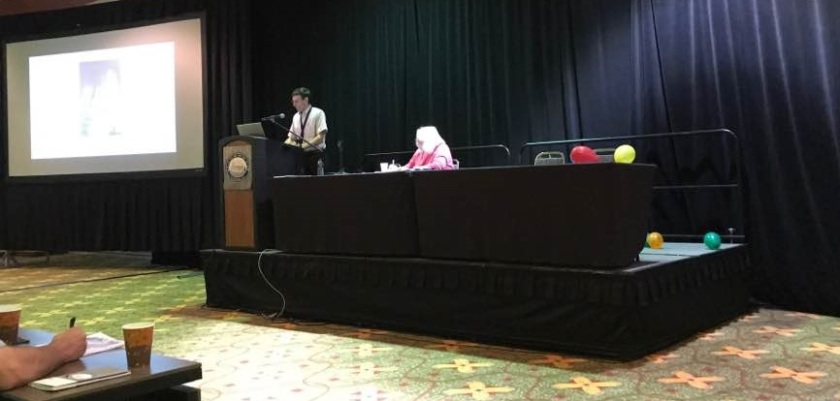
Fry at LauraPalooza 1My presentation was on Friday morning. I was followed by an excellent talk by Kipton and Ethan Smilie about the ways that the Little House books show the formation of social capital in their depictions of late nineteenth century education, and by a fascinating demonstration by Rich Kurz about how he created a scale three-dimensional model of the Ingalls store in DeSmet, South Dakota, from extant pictures.

All in all, it was an eclectic conference. My talk was well-received, I enjoyed talking with many new contacts, and it was good to see a number of old friends, including Bill Anderson, Barb Bousted, Caroline Fraser, Sandra Hume, and Michelle McClellan.
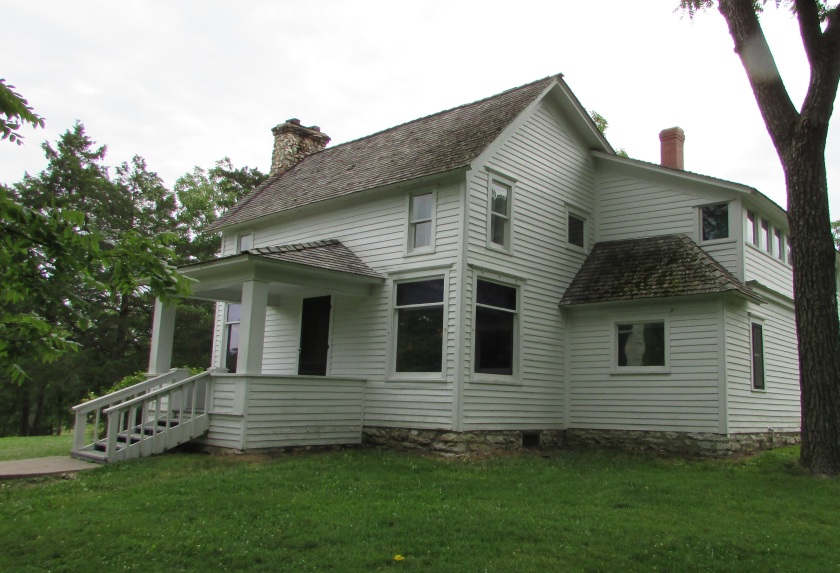
Wilder Home for BlogI left a little early on Friday morning so that I could stop in Mansfield to see the Historic Home and Museum on my way home. I was able to tour both the farmhouse that Laura and Almanzo built between 1894 and the 1910s and the “rock house” that was built by their daughter Rose Wilder Lane for them during the late 1920s. Laura wrote Pioneer Girl and the first several Little House books while living in the rock house between 1828 and 1936. Both of the houses are amazingly well built and well kept. They are also quite small. I guess that’s appropriate for someone famous for writing about Little Houses. I had forgotten that Laura was only four feet, eleven inches tall. Since Wilder was famous when she died in 1957, the farmhouse immediately became a historic home, and almost everything inside it belonged to her and Almanzo. The rock house had been sold and was not reacquired until the late 1900s, but it has been restored. I was hoping to walk the path between the two houses that was used by Wilder and Lane to see each other when they were writing. Unfortunately, I was told that it was flooded.
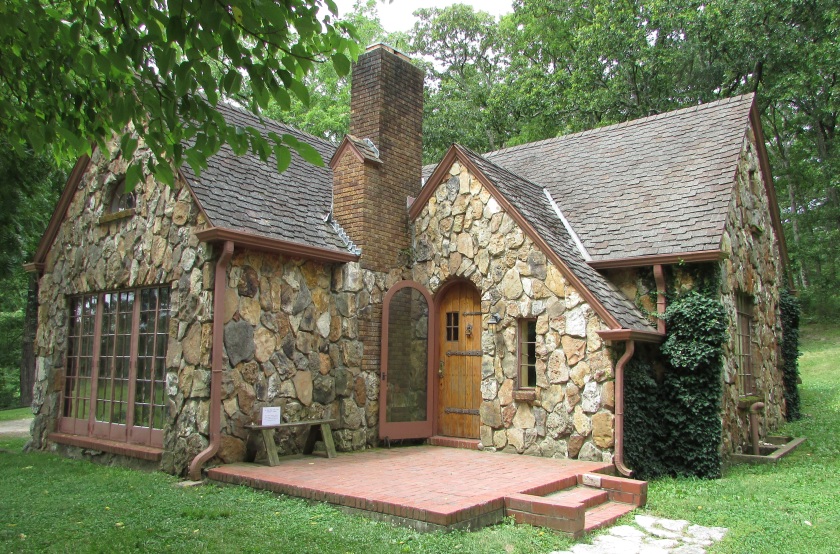
Rock houseI also looked through the new Museum at the site, which was just finished last year. There is an 8-minute orientation film and a lot of artifacts from Laura and Almanzo’s lives on display. Several are related to my work on Wilder’s faith:

– Laura’s Bible, which she kept “on the table next to her favorite locker.”

– The Ingalls Family Bible

Persuasives to Early Piety by J. G. Pike, a book published by the American Tract Society –this was a gift from Charlotte Holbrook Quiner to her daughter Caroline Quiner Ingalls, or Ma. Ma passed it on to Laura.

– “Laura’s Sunday School Cards” – these are about 1 ½ by 2 inch cards with Bible memory verses from one of the churches in Walnut Grove, Minnesota, in 1878. I’m guessing it was the Congregational Church. There are eight pasted on the first page of what looks like a book for them; verses are from First Corinthians, Hosea, Psalms (3), Isaiah (2), and Deuteronomy. There may be more on the following pages; there was no one to open the display case for me to take a look.

– A bread plate that says “Give us this day our daily bread” that was saved from the fire that destroyed Laura and Almanzo’s home in the late 1880s. This was described in The First Four Years.

I am very thankful to my family for allowing be to be gone four days. I was very happy to see them all when I got back Friday night.

Thanks for reading.

Links:

Laura Ingalls Wilder Legacy and Research Association

Laura Ingalls Wilder Historic Home and Museum

Ma and Pa’s Family Style Restaurant

Emily Anderson’s Little on Amazon

Walnut Grove Mural Bridges Cultures – about the Hmong in Walnut Grove

Caroline Fraser’s website

Bill Anderson’s website

Robynne Miller’s books on Amazon

Pamela Smith Hill’s website

My blog entry on The First Four Years

*(I recently finished reading Nicholas Carr’s The Shallows: What the Internet is Doing to Our Brains. I now believe that having hyperlinks in the text of my blog entries encourages people to read poorly. From here on out, all links will appear at the bottom of the post.)

State of the Project

It’s time to take stock of where my project on the faith of Laura Ingalls Wilder has led me so far and where it is heading.

In January of 2016, I began this blog. The plan was to investigate Wilder’s faith and write an article for a history journal about it. I also had the idea that the article could be the core of one chapter in a book on how Wilder’s work engages topics of interest to readers in the twenty-first century. Many readers of this blog walked with me as I read through the Little House books, the best biographies of Wilder, and other books in the spring and summer of 2016. Last fall, I presented a paper on Wilder’s faith to the Conference on Faith and History. It was there that several individuals suggested that consider writing a book-length biography of Wilder with particular attention to her faith.

The idea of writing a spiritual biography of Wilder was confirmed by students when I taught an Honors Seminar on the Little House books during the spring 2017 semester. There also seemed to be enthusiasm for the project when I gave an invited lecture at Calvin College in Grand Rapids, Michigan, in February. And it received general support from many old friends and Wilder scholars I saw at the Laura Ingalls Wilder: A 150-Year Legacy conference in Sioux Falls at the end of last month. So writing this book is currently my intention.

Last week, I sent a book proposal to Eerdmans Publishers in Grand Rapids, Michigan. The book would be part of their series titled The Library of Religious Biography. I projected that there will be ten chapters. If I can write two chapters each summer, the manuscript will be complete in five years. Both the series editor and an in-house editor at Eerdmans are receptive to the idea. So we will see what happens next.

This summer, I will be speaking on Wilder’s faith two times. At the beginning of June, I will be on a panel at the Third Annual Midwestern History Conference in Grand Rapids. The panel is titled “The Uses of Public Memory in the Rural American Midwest.” My paper title is “Little House and Little Church: Memory and the Church in the Published Works of Laura Ingalls Wilder.” My paper will suggest that the Midwestern upbringing of both Wilder and her daughter Rose Wilder Lane influenced the depiction of the church in Wilder’s works. However, because Wilder and Lane had strikingly different experiences in the church—and therefore strikingly different memories of the church—those differences also influenced how the church is described, especially in the Little House books.

In July I will be speaking at LauraPalooza. This year the conference is titled LauraPalooza 2017: Little Houses, Mighty Legacy: 150 Years of Laura Ingalls Wilder. I am on their agenda first thing on Friday morning. The conference is sponsored by the Laura Ingalls Wilder Legacy and Research Association and held in Springfield, Missouri. Many of the attendees at this conference will be people who just love Wilder and the Little House books, not academics. Probably a large percentage of them will be women. My talk is just titled “‘On the Pilgrim Way’: The Faith of Laura Ingalls Wilder.” The title is taken from Chapter 23 of By the Shores of Silver Lake, which describes the first prayer meeting and worship service in DeSmet, SD, in 1880. I am hoping to roll out some of my observations about Wilder’s faith for this broader audience. It is also my hope to stop at the Laura Ingalls Wilder Historic Home and Museum in Mansfield, Missouri, on my way to the conference.

Meanwhile, this summer I hope to continue to read and post about what I read. Thanks for being part of my work.

Presentations and Meditations

Well, it’s March. It’s incredible how fast time is moving this semester.

On Wednesday of last week I spoke at Calvin College in Grand Rapids, Michigan. The talk was sponsored by the History Department and the Mellema Program in Western American Studies. It was a great time. Over fifty people turned out to hear me speak—at least I took fifty handouts and they were all gone. My presentation gave a report of what I’ve come to understand so far about Laura Ingalls Wilder’s faith: 1) that the descriptions of God, Christianity, and the church in the Little House books were shaped by her daughter Rose Wilder Lane, and 2) that Wilder’s faith was deep and genuine, but it emphasized God the Father and His laws more than Jesus Christ and salvation. These conclusions will be familiar to those who have been reading this blog for any length of time.

The question and answer period was especially rich. The audience had students, faculty members, and members of the community, including a mother with two young children. I took questions from all three groups. It was a fascinating experience. At one point, I had to try to explain to a faculty member why so many Americans for the last eighty years have been drawn to the Little House books. (Briefly: engaging descriptions, emotionally gripping prose, and a vision of human flourishing that provides an attractive alternative to modern life for many.) I also at times had to explain to some members of the community that not everything in the books represents exactly how things happened. I’m still working on how to characterize the complex collaboration of Laura and Rose.

Many thanks to Will Katerberg for inviting me and Jenna Hunt for taking care of so many of the details for the talk. If you’re interested, the audio recording may be made available, and I’ll put up a link when it is.

While I was in Grand Rapids, I also met with David Bratt, an editor for the William B. Eerdmans Publishing Company, which is headquartered there. David would like me to write a proposal for a book-length biography of Wilder with particular attention to her faith. Eerdmans has a series titled the Library of Religious Biography, and the series editors are also very interested in seeing a proposal. Eerdmans publishes books for academics and readers in the church, so they may be a good fit; it is my hope that any book I do write will not only speak to college faculty and students but also to a broader audience of people who are interested in the books. My plan is to write the proposal by the end of this semester.

In addition, on Monday of this week, I spoke at a Faculty Coffee sponsored by the Faculty Development Committee here at Trinity Christian College. It was an abbreviated version of the Calvin talk, because I only had forty-five minutes rather than ninety to speak and take questions. I was very happy that one of the students from my Honors Seminar course came, as well as many faculty and staff.

My conversation with David, my lecture at Calvin, and my talk here at Trinity have led me again to think about audience and reception. As I talk with more people about the project, I’m realizing that my research points in two directions. First, it seems that Laura Ingalls Wilder was a committed Christian, and that at least some of the straightforward and positive descriptions of God, Christianity, and the church in her handwritten original manuscripts were changed by her daughter into the more mixed or even negative depictions that appear in the published Little House books. One might imagine that this would be welcomed by many of those who love the books, especially those who are serious Christians themselves. However, I also think that my research suggests that Wilder was not what we might call a born-again or evangelical Christian. Her descriptions of God, Christianity, and church emphasize God’s power, His laws, and personal morality. Wilder’s writings hardly mention Christ, the gospel, or salvation. I think that this runs against what some readers believe about her. I think that the television series may play a role in this. Although I have never watched an episode (I guess that I need to watch at least some soon), it is my understanding from others that Christianity was pretty central to the series.

I’m not exactly sure how I’m going to navigate this, except to say, as I said in response to a question on Monday morning, that one thing that historians often have to do is to try to get behind how a historical figure is remembered to the historical person himself or herself. I don’t want to do it just for the purpose of cutting down Laura in people’s estimation or telling people that what they believe is wrong. But I do think that loving one’s neighbor who lives in the past includes being honest about who they were, what they believed, and how they lived.

I’m still thoroughly enjoying the Honors Seminar on the Little House books. This week we finished Little Town on the Prairie. Perhaps I can do a post next week (next week is spring break, so I’ll have some more time) where I reflect a little on what has been going on in that class.

Thanks for reading.

60 Years

Laura Ingalls Wilder died on February 10, 1957, three days after her 90th birthday, sixty years ago today.

She had lived during the administrations of 17 different presidents, had survived two world wars, and had seen the emergence of the United States as a world power. She rode in a covered wagon in the 1870s and flew in an airplane in the 1950s. She is buried in Mansfield, Missouri.

[Wow, I had the wrong year when I first posted this. Thanks to Connie for setting me straight.]

Happy 150th Birthday

Laura Ingalls Wilder was born one hundred and fifty years ago today, on February 7, 1867, in a cabin outside of Pepin, Wisconsin.

The Washington Post ran a nice article yesterday about Wilder, the Little House books, and her ongoing popularity:  At 150, Laura Ingalls Wilder Still Speaks to Readers Old and New

We will celebrate by having cake at the Honors Seminar.


The End of 2016

It’s almost Christmas, and my family and I will be traveling starting on Friday, Lord-willing. So this, my end-of-the-year post, is going up today.

This blog launched on Monday, January 4, 2016. In that post, I expressed my desire to write an article on Laura Ingalls Wilder’s faith and my plan to read the Little House books and post about them. Since then, I’ve written and posted twenty-nine additional entries.  I read the eight Little House books, twelve additional volumes of material by her, three biographies, and several other books. I got a grant to look at material by Wilder and Lane at the Herbert Hoover Presidential Library. I blogged about early manuscripts of the Little House books and correspondence I read there. I presented an article to a group of faculty here at Trinity Christian College and a paper to the Biennial Meeting of the Conference on Faith and History. I was encouraged to propose a book-length biography of Wilder giving particular attention to her faith by representatives from two different publishers. As a result of my reading and interactions with others, I believe that my understanding of Wilder’s faith is much deeper than it was a year ago.

What’s next? I will be teaching an Honors Seminar here at Trinity titled “The Little House Books in the Twenty-First Century” during the spring semester. We will be reading and discussing the Little House books together as well as some other materials (I haven’t finalized the syllabus yet). I hope to write the book proposal as I teach the class.  It will be good to talk about it with students; as they write their research papers, I’ll be writing my proposal. I’ve also been asked to give a lecture on Wilder’s faith at Calvin College next February. There is a good chance that I will be able to present a paper at the Midwestern History Conference, sponsored by the Midwestern History Association, next June. Finally, I will be writing a book review of the latest book on Laura and Rose, Libertarians on the Prairie by Christine Woodside, for the journal Fides et Historia. So I have been blessed with many opportunities to engage Wilder and her faith.

I hope that everyone who reads this has a truly blessed Christmas and that the new year opens for you with optimism, peace, and trust in the child born in Bethlehem, who is also the King of all creation.

Will be back in 2017.

The Wilder Life

I knew that it had been a while since I posted anything, but I didn’t realize until today that it had been over a month. Many apologies to anyone who’s been waiting. During the last several weeks, I was able to read The Wilder Life: My Adventures in the Lost World of Little House on the Prairie, a memoir by Wendy McClure published in 2011.

McClure grew up in Oak Park, one of the western suburbs of Chicago, during in the late twentieth century. When she read the Little House books as a child, she loved the world that the books created in her mind. When she read them again as an adult, she decided to try to enter that world. She began by reading everything she could about Wilder and the books. She then tried out the recipes in several Wilder cookbooks. She succeeded in buying an authentic, working butter churn and making her own butter. Then she visited all of the major Ingalls and Wilder historic sites in Wisconsin, Minnesota, South Dakota (both the historic homes and the Ingalls Homestead), Kansas, Missouri, Iowa, and New York. The book describes these experiences, her feelings, and her observations about the books, about Wilder, and about life in general.

Christianity and Laura’s faith are mentioned mainly in two chapters of the book. In chapter 6, “The Way Home,” McClure tells the story of her trip to Mansfield, Missouri, where Laura and Almanzo lived most of their adult lives and where Rose grew up. In the museum next to the Laura Ingalls Wilder Historic Home, she met a Christian homeschooling family from Houston. They appreciated the Little House books because of “’the faith that was running throughout.’” (163) Their conversation prompts the following comments from McClure:

I know there are a lot of folks who can easily see Christian messages in the books, lessons about trusting and accepting the will of God in times of hardship and relying on the bedrock of one’s faith to get through. There’s plenty of stuff in the books that can help illustrate these things, I guess. But the Ingalls family in the books didn’t appear to be much the praying types, unless the occasional hymn on Pa’s fiddle counts. Mary becomes a little godly by the later books, but as for the rest of the family, their reasons for attending church seemed to have more to do with partaking in civilized town life than with religious devotion. I suppose I’m inclined to see it that way because that’s how my family did things—went to church (Congregational) sporadically and understatedly. Whenever Ma Ingalls brought out the Bible, it seemed to me to be pretty interchangeable with the other books they turned to for comfort, like the novel Millbank and Pa’s Wonders of the Animal World, only slightly more important.

But in the case of families like Keith and Karen’s, their Laura World includes certain aspects that mine does not; in their Little House scenes the Bible is likely always close by and the Lord near at hand watching over the family through the droughts and blizzards.

I don’t mind that it’s this way for other people, especially if it makes the books more meaningful to them. (163-164)

It’s fascinating to me that the Little House books have appeal for both conservative Christians and agnostic writers. Both groups view the religion of the Ingalls family through the lens of their own commitments. I think that McClure may undersell the importance of Christianity to the books. When I read the books this year specifically looking for mentions of Christianity and the church, I was both surprised about how much they appear in certain books and how little they appear in other books. As I’ve suggested in other blog posts, I also believe that the form Christianity takes in the books is as shaped by Rose’s vision of the church as Laura’s experiences and faith.

Christianity—and a particular type of Christianity—looms larger in the following chapter. Here, McClure and her and her live-in boyfriend Chris attend a “Homesteading Weekend” at a working farm in downstate Illinois. The owners use horse-drawn plows, raise turkeys, and try to live as much as possible like people from 100 years ago. They are joined by several families from a church in Wisconsin who think that the end times are coming and they need to get ready. That’s why they were trying to learn how to live off the grid. These families completely “freak them out,” so they leave early the next morning. This experience prompts her to wonder about how much the Little House books might be contributing to religious fanaticism, and what Wilder would think. McClure concludes that Wilder wouldn’t have liked it, based on comments she makes in Pioneer Girl about not appreciating the anti-Catholic sentiment of the family she sewed for in DeSmet. (205-6) I’m inclined to think that she’s right in this assessment.

Memoir is not something that I’ve ever wanted to write. I tell myself that I’m too humble to write a book completely about me. I tell myself that that I don’t think that I have that much to say that others would be interested in. But I think that it may be less humility and more a desire for privacy. I am amazed by many of the ways that people expose themselves on social media today. I have a Facebook account to catch up on what’s going on with family and friends, but I share almost nothing except when I’ve put up another blog post. I am most comfortable writing when I’m writing about other people, preferably dead people. I’m glad that I am planning to write a biography of Wilder, not a memoir of my experience with the world of the books.

But I’m also glad that I read The Wilder Life. McClure is an engaging writer. Her descriptions – of people, of landscape, of her own feelings – are honest, exquisite, and at times intense. The book also provides insights about Laura, her family, and the Little House books themselves. And at times, it’s just laugh-out-loud funny. It was a good book to read while the semester wound down toward finals.

I hope to post a year in review next week. As always, love to hear your comments.

(References are from Wendy McClure, The Wilder Life: My Adventures in the Lost World of Little House on the Prairie [New York: Riverhead Books, 2011].)

The Conference on Faith and History

Last week a student of mine from Trinity Christian College and I attended the 30th Meeting of the Conference on Faith and History at Regent University in Virginia Beach, Virginia. My student presented at the Undergraduate Research Conference, I presented at the Professional Conference. We had a great time meeting students and faculty from other colleges and universities, listening to other Christian historians present their research, and (for me) meeting old friends and catching up. On the last day of the conference, we went to Jamestown to see the site of the first successful English settlement in America.

My last post was a preview of the paper I was going to present. Here is a report on my panel. The panel was held on Friday, October 21, at 2:45 pm. It opened with a presentation titled “Where are the Women: Writing Religious Biographies of Women” by Kristin Kobes du Mez, a historian from Calvin College. Kristin has written a biography of Catherine Bushnell, and she is currently working on a project tracing the faith of Hillary Clinton. Second, Karen Swallow Prior, who teaches literature at Liberty University, spoke about writing a biography of Hannah More in a presentation titled, “Just a Handmaiden: An English Professor Attempts to Write History.” I then presented my paper on the faith of Laura Ingalls Wilder. Finally, Tim Larsen of Wheaton College responded to the presentations. Then the floor was opened for questions and comments from those assembled. I counted thirty-five people in the audience, of whom around twenty-five were women.

Everyone that I spoke with thinks that looking more closely at Wilder’s faith is a great idea, and I received a lot of encouragement. Unfortunately, I did not get much help from anyone with my questions about historical context. I’ll have to pound on that a little myself. But I did get some interesting ideas about audience in the shape of two suggestions that I write an entire book on Wilder’s faith:

After the session, Tim Larsen spoke to me about whether I was interested in writing a book-length biography of Wilder with particular emphasis on her faith. He edits a series of books for an academic press that examines the faith of a variety of famous figures in history, and he said that he believes that the publisher would be interested in a book on Wilder. I hadn’t thought much about this, because I was thinking that the faith of Wilder would be one chapter in a book that addressed Wilder’s views on a variety of topics (politics, the environment, ethnic diversity, etc.). But I said that I would think about it.

When I got back to where I was staying Friday night, I had an email from another Christian historian who edits a series of religious biographies for a trade publisher. He wanted to set up a time to talk about whether I’d be interested in writing a book on Wilder’s faith for that series. So I spoke with him yesterday. He was downright excited about the project.

So I’m warming up to the idea of writing a biography that highlights Wilder’s faith. I do think that multiple publishers are interested in Wilder because those who read the Little House books buy other books. I believe that I will begin thinking about how I would structure a Wilder biography. I’m not sure who I would rather have publish it.

So overall the conference was a great experience—even though all the meetings on Saturday had to be shifted to another building on Regent’s campus because of a rally for Donald Trump (imagine that). Jamestown is an amazing place. There has been an archaeology project going on there for the last 20 or so years that has uncovered the foundation of the first church in the settlement, a number of graves, and thousands of artifacts. Fascinating.

Many thanks to Trinity for paying for many of our travel expenses.

Thanks for reading.

A Little House Traveler

It’s been a while again since I’ve posted. I’ve been working on several things. Two weeks ago, I finished a draft of my article, now titled: “‘This is what Men Call God:’ The Faith of Laura Ingalls Wilder.” I then emailed it to nine of my colleagues from the English, History, Music, Philosophy, and Theology Departments here at Trinity Christian College. Last week, some of those colleagues and I met for our monthly Historical Scholars Workshop. We discussed my article; they asked some really good questions and gave me some really good suggestions for the project going forward.

Since then, I’ve been working on a draft of my conference paper for the Biennial Meeting of the Conference on Faith and History to be held at Regent University. The session I will be presenting in is titled “‘On the Pilgrim Way:’ Writing Religious Biographies of Women.” (The quote in the title is from Chapter 23 of By the Shores of Silver Lake.) The other presenters are Kristen Kobes Du Mez from the History Department at Calvin College and Karen Swallow Prior from the English Department at Liberty University. The respondent for the session will be Timothy Larsen from the Biblical and Theological Studies Department at Wheaton College. I will only get 15-20 minutes for my presentation, so I have to pare my article back from 28 pages to about ten. I’ve already gotten it down to 15. More cuts to come.

However, yesterday I also got the chance to look through the last published volume of primary source materials written by Laura Ingalls Wilder: A Little House Traveler: Writings from Laura Ingalls Wilder’s Journeys Across America, published by HarperCollins in 2006. Like many recent publications of Wilder materials, much of it is material that has already been published. In fact, the first four-fifths of the book reproduce two books that I have already written about on this blog, On the Way Home and West From Home. There are some more photographs in this volume, it is hardcover, and the type is larger, but otherwise it appears that the text is exactly the same as the originals.

That leaves the last 70 pages of the 350 page work. The editors of the volume (who are not identified) call this part of the book “The Road Back: Laura Ingalls Wilder’s Record of the Journey Back to DeSmet, South Dakota, 1931.” It reproduces notes that Wilder wrote to herself on a trip that she and Almanzo took from Mansfield, Missouri to DeSmet, South Dakota in 1931. They function as a diary, with daily entries describing how far they traveled, what they did, and how much they spent. Apparently Wilder wrote on loose sheets, and some of them were sent to her daughter for safe keeping while they were on the road. It may be that Wilder wanted to use them for future publications, or it may just be that she had written so much by this time (including fifteen years of Missouri Ruralist articles and columns and Pioneer Girl) that she found writing a valuable way of recording and making sense of what she saw.

I understand why the publishers decided to put these three sets of Wilder’s writings together. On the Way Home, a diary of the trip the Wilders took from DeSmet to Mansfield in 1894, describes their travels in a covered wagon. West From Home, letters Laura wrote to Almanzo from her trip to San Francisco to visit Rose, describe her travels by train. This third trip was taken in their Buick, which they named Isabelle, with their dog Nero. Once they reached South Dakota, they stayed with her sister Grace and her husband Nate Dow in Manchester, South Dakota, and visited DeSmet several times. Laura and Almanzo then drove to the Black Hills to see her sister Carrie and her husband David Swanzey. While there, they visited Mount Rushmore and the badlands. They then drove home, taking a different route. Wilder’s ability to describe a scene minutely and eloquently is often on display here. She saw much evidence of the depression, including idle factories, abandoned farms, and frustrated townspeople. It was a hot, dry summer, and many times she describes billowing clouds of dust.

It would have been helpful if the publisher had provided some kind of map for these travels for the benefit of readers. Also, the introduction to this portion of the book, by Abigail MacBride, says that this was the first time that Laura had visited DeSmet since leaving in 1894. (288-289) However this is not true; Laura had traveled to DeSmet by train in the summer of 1902 to see her father before he died of heart disease. (John E. Miller, Becoming Laura Ingalls Wilder: The Woman Behind the Legend [Columbia: University of Missouri Press, 1998), 111.)

The new material in this volume adds little to our understanding of Wilder’s faith. It does not mention God, Christianity, or the church. I did use my perpetual calendar to look up what Laura and Almanzo did on Sundays during the trip. It appears that they did not keep the pattern they had kept in 1894 of not traveling on Sundays. On Sunday, June 7, they traveled 277 miles from Shady Side, Missouri to Eureka, Kansas. (292-293) On Sunday, June 14, they were staying with the Dows and they visited their parents old house in DeSmet and Nate’s farm. (310) They drove to Mount Rushmore with the Swanzeys on Sunday, June 21. (321-323) Finally, on June 28, they were on the way back to Mansfield and they drove 233 miles. (341-342) I wrote in my entry on West From Home, “One gets the impression… that Wilder was most interested in church life when she was settled in a community and she knew the people. She was not as interested in attending worship when out of her normal surroundings.” It seems that the information about this additional trip confirms that observation.

Thanks for reading.

(Page number references are from A Little House Traveler: Writings from Laura Ingalls Wilder’s Journeys Across America [New York: HarperCollins, 2006].)