Iowa and Missouri

two book events in April

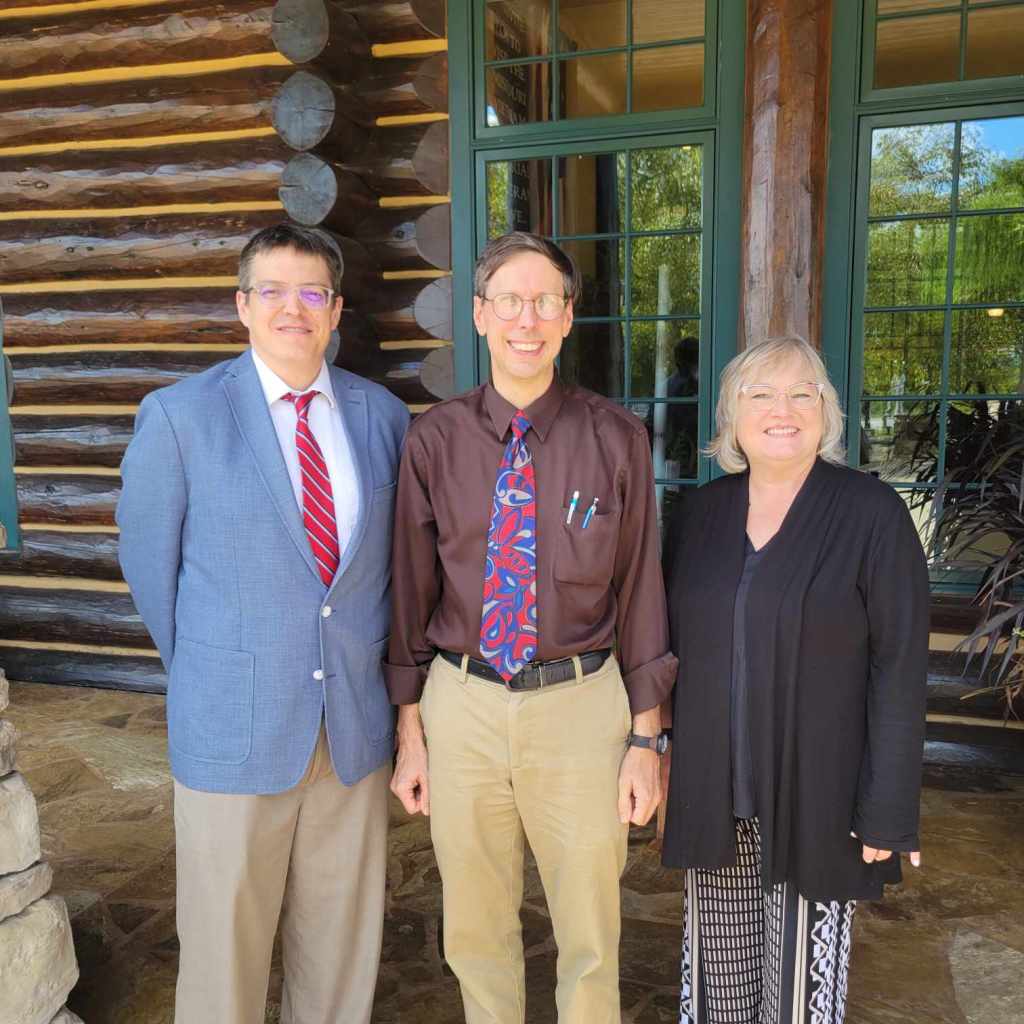
Photo by Michelle Underwood

Summer has arrived in Chicagoland. Finals week at Trinity was the last week of April and Commencement was May 2. May 15 was the last day for faculty members on nine-month contracts. As June approaches, I’m in fewer meetings. I’ve begun thinking about the two history courses I will be teaching in the fall: History 204, the first half of the American History survey, and History 401, the Senior Seminar.

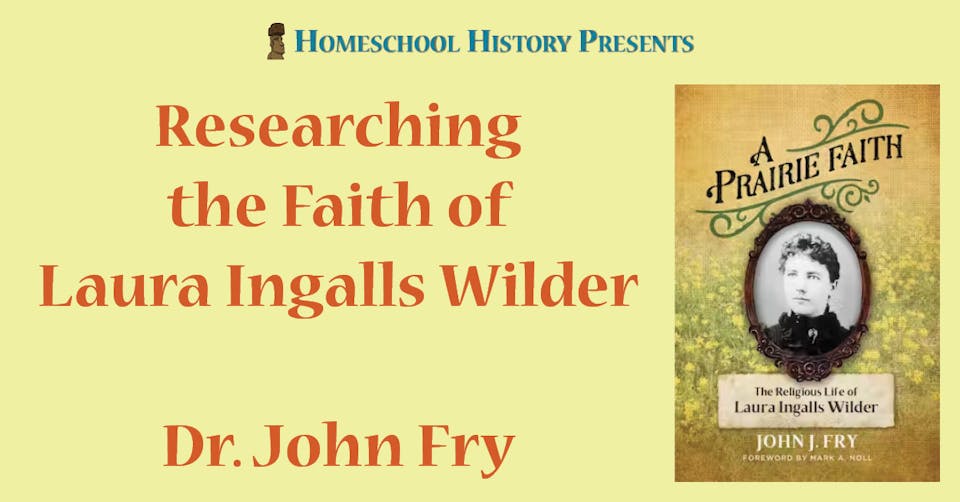
I enjoyed two book events in April. The first was an online Iowa History 101 event sponsored by the State Historical Society of Iowa (SHSI) on April 10 at noon. The zoom session was attended by about a dozen people. My talk addressed what we know about Laura’s faith and about Laura and Rose’s contributions to the Little House books, particularly as they address Christianity and the church. I also discussed the Ingalls’s family’s one-year stay in Burr Oak, Iowa, in 1876 and 1877. There were some great questions at the end. The session was recorded and a link is at the end of this post.

Then I was able to travel to the Missouri Cherry Blossom Festival in Marshfield, Missouri. I was there on Friday, April 25 and Saturday, April 26. The mornings and early afternoons of both days I was able to sell and sign books (I took copies of both A Prairie Faith and my second book, Almost Pioneers) in Marshfield’s Community Center, along with a number of movie and television stars from the mid to late twentieth century. Nine actors were there from “Little House on the Prairie,” including Dean Butler, who played Almanzo, and Alison Arngrim, who played Nellie Oleson. There were also three actors from “The Waltons,” and others from “Leave it to Beaver,” “Dallas,” “Barney Miller,” It’s a Wonderful Life, and a variety of other shows and movies. Michelle Underwood, a southwest Missouri author who also works at the Laura Ingalls Wilder Home in Mansfield, had a table next to mine. She has written a book giving a “behind the scenes” look at the Wilder Home. We enjoyed talking while we worked to attract the crowds who waited in line to get autographs from the “Little House on the Prairie” stars. I ultimately sold about twenty books.

On Friday afternoon I went to the Marshfield Assembly of God church to receive the Ella Dickey Literacy Award. Bill Anderson presented me with the award. The other awardees were the Rev. John Marshall, a retired Baptist Pastor who has written a book on the faith of Abraham Lincoln, and Paul Landis, a Secret Service Agent for John F. Kennedy who has written a memoir about his experiences. I was honored to receive the award, which is named after a beloved, long-time librarian in Marshfield.
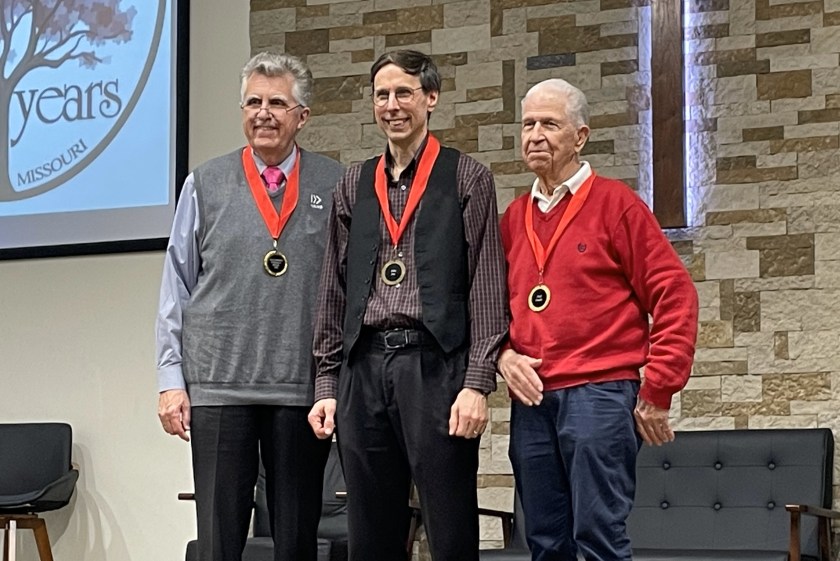
John Marshall, me, and Paul Landis. Photo by Sarah Manley

Later Friday afternoon, I attended the Dred Scott Reconcilation Forum, hosted by Lynne Jackson, a descendant of Dred and Harriet Scott. She interviewed Dr. Bryan Moore, the pastor of Jubilee Community Church in north St. Louis and a distant relative of Nat Turner. I also got to judge a cherry pie contest. On Saturday morning, I attended Rev. Marshall’s session about Lincoln; his comments were very insightful. It was great to catch up with Bill Anderson and Sarah Manley. Many thanks to Sarah for taking the pictures during the ceremony. Many thanks also to Rev. Nicholas Inman, Director of the Laura Ingalls Wilder Home in Mansfield and the driving force behind the Festival, for his gracious invitation.

Now I’m just waiting to hear the announcement of the Book of the Year for Biography from the website Foreword. A Prairie Faith is one of eight finalists. Lord-willing that will be announced in June.

If you’re interested in having me speak, please let me know (john.fry@trnty.edu). Thanks for reading!

Links:

Trinity Christian College

Iowa History 101 Recording

STL listing of events at Missouri Cherry Blossom Festival

My second book: Almost Pioneers: One Couple’s Homesteading Adventure in the West

Michelle Underwood’s website

Michelle’s Laura Ingalls Wilder’s Rocky Ridge Farm: A Detailed Look Behind the Scenes

Bill Anderson’s website

Paul Landis’s The Final Witness: A Kennedy Secret Service Agent Breaks His Silence After 60 Years

John Marshall’s Lincoln and Christianity: Essays on Lincoln’s Religious Life

The Laura Ingalls Wilder Home and Museum in Mansfield

Foreword Book of the Year Finalist Announcement

List of Foreword Book of the Year (INDIES) Finalists for Biography

Foreword’s Listing for my book
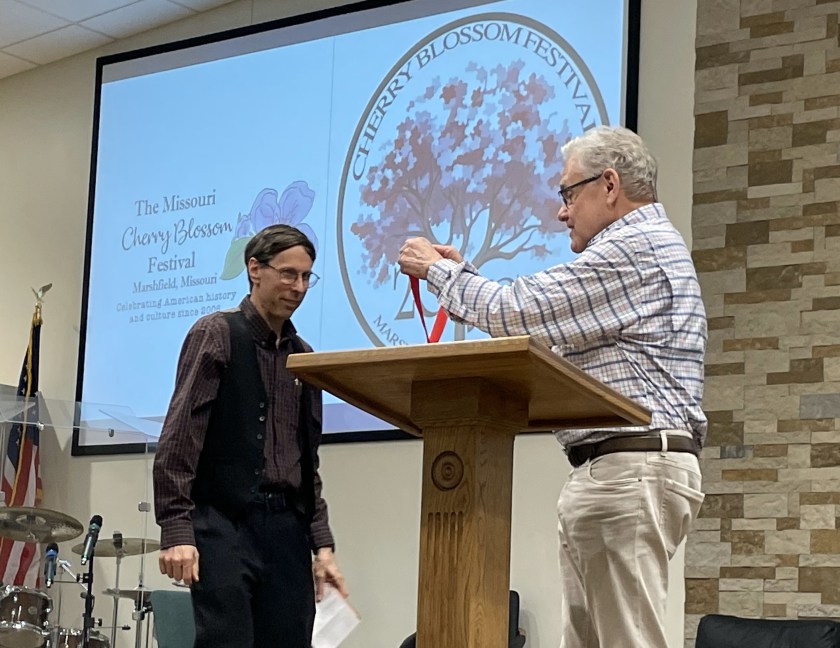
Picture of Bill Anderson giving John Fry the Ella Dickey Literacy award.

Bill Anderson presenting me with the Ella Dickey Literacy Award. Photo by Sarah Manley

Book Tour – Fall 2024

Missouri!

In the gift shop at the Laura Ingalls Wilder Home and Museum, Mansfield

Last week I was able to travel to Missouri for several engagements. On Wednesday, September 25, I from Chicagoland to Branson and stayed overnight there. The next day I drove to the College of the Ozarks (they call it the C of O), which is just south of Branson. There, Dr. Aleshia O’Neal gave me a wonderful tour of the campus before I spoke in her class. Dr. O’Neal is an English Professor at the C of O who grew up on a farm in Missouri. So we enjoyed looking at all the tractors and barbed wire in the college’s tractor museum.  We also went to Patriot’s Park, Williams Memorial Chapel, and the scripture garden that overlooks the White River. The C of O is a work college, meaning there is no tuition, but all students work fifteen hours a week on campus or in the local community. I did not realize how many different on-campus business operations this would require. We visited the stained glass studio and grist mill, and I saw the greenhouses and barns for the cows. We finished at the Ralph Foster Museum, which has artifacts from all periods of Ozarks history. I then spoke about my research on Mrs. Wilder in English 3023, the American Novel, to eight students and several faculty members. The English Department treated me to lunch at the C of O’s Keeter Center, which features an excellent restaurant, as well as a hotel and conference center. Many thanks to Dr. O’Neal and to Dr. Ethan Smilie, Humanities Division Chair, for their invitation and hospitality. I met Dr. Smilie at LauraPalooza in 2017, and we’ve corresponded ever since.

Me with Dr. Ethan Smilie and Dr. Aleshia O’Neal

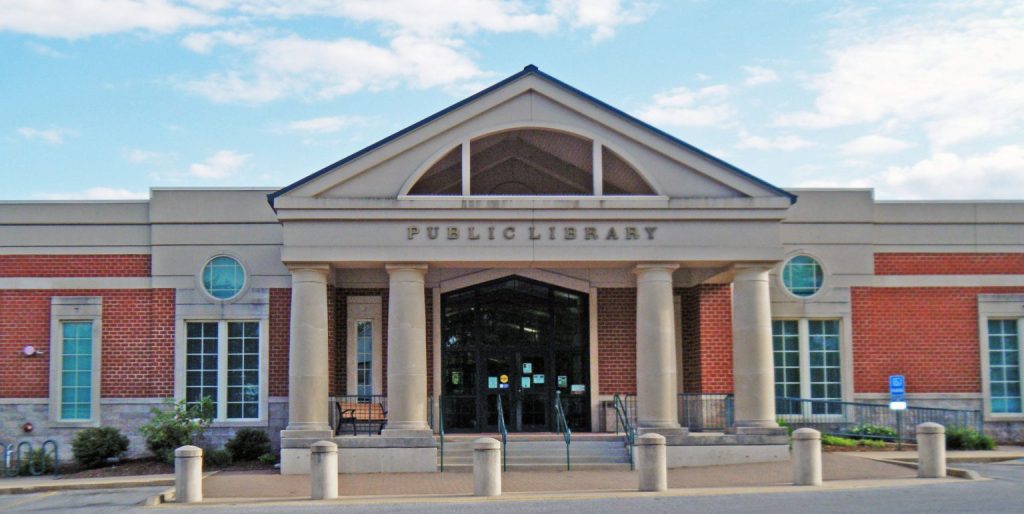
That afternoon I drove from the Keeter Center to West Plains, a town of about 12,000 people in south-central Missouri.  I spoke at the West Plains Public Library at 5:00. There were about thirty people there, including a woman who was originally born in the south suburbs of Chicago. There were also several families from Covenant Reformed Church, which is a congregation in my Presbytery. That night I stayed with a family from that church and really enjoyed my time with them and their daughter and three sons. They reminded me of my family about 20 years ago. Many thanks to Greg Carter and Dianna Locke for hosting me at the Library, and to the Nortons for their hospitality.

West Plains Public Library

On Friday, September 27, I drove from West Plains to Mansfield for the 49th Annual Wilder Days celebration.  I went by way of Ava, which is a town that Laura and Almanzo Wilder often visited on Sunday afternoons, but which I had never been to. This got me off the four-lane highway, which meant I saw some really beautiful views of the Ozarks. Certain areas really reminded me of Western Pennsylvania, where I grew up. Once I got to Mansfield, I went to the Laura Ingalls Wilder Home and Museum outside of town and reacquainted myself with the site.  I walked through the farmhouse, over the path to the rock house, and through the rock house—tours were self-guided because of Wilder Days. I also went through the museum and saw that my book was for sale in the middle of a bookcase of works about Mrs. Wilder.  There now is also a recreation of Almanzo’s garage, just opened this year. I also visited the Mansfield Area Historical Museum in downtown Mansfield.  It is housed in a replica train station and has a variety of artifacts from local history, including materials about Carl Mays, who played major league baseball fifteen years for the Red Sox, Yankees, and Reds. I also got to see the Mansfield public school fourth graders sing in the square. They did great.

Friday evening, I went to the Fifth Annual Wilder Dinner, a fundraising event for the Laura Ingalls Wilder Home and Museum. It was held at the Mansfield High School. Before the prayer, a local musician played two songs on Pa’s Fiddle, the violin that belonged to Charles Ingalls. It gave me chills to hear the instrument that Laura wrote so much about. After dinner, there was a live auction of a variety of pieces of Wilder memorabilia. Dean Butler also spoke; he played Almanzo in the TV series “Little House on the Prairie” from 1979 to 1983. I had previously heard him speak at LauraPalooza in 2022. Friday night, I was able to stay at a house owned by the Wilder Home.

David Wilson playing Pa’s Fiddle

Saturday morning, I was able to hear Pa’s Fiddle again, this time for forty-five minutes, in front of the Wilder Home. I then signed books in the entryway to the museum from 10 am to noon. Dean Butler was signing copies of his new book, Prairie Man in the back of the museum. The line for him wound through the museum, out the front door, down the steps, and along the parking lot. At lunch, I went downtown and bought a pie from the Historical Museum’s fundraiser and a bag of kettle corn. I also got to see the Mansfield Wilder Days Parade. I then went back to the museum and signed books from 2 to 4 pm. I then drove back to Chicagoland. Many thanks to Rev. Nicholas Inman, Director of the Wilder Home and Museum, and to staff members Susie, Vicki, Marie, Tana, Clinton, and everyone else who made my visit there excellent.

Up next for me is a book celebration at Trinity next Wednesday afternoon. There are four faculty members who have published books in the last twelve months. I will also be signing books at the Barnes & Noble in Orland Park, Illinois on Saturday, October 19 from 1 to 3 pm.  Anyone in Chicagoland is invited to attend!  (Put in link)

Thanks again for your support!

Links:

College of the Ozarks

What is a work College?

Gaetz Tractor Museum

Ralph Foster Museum

West Plains Public Library

Covenant Reformed Church

Laura Ingalls Wilder Historic Home and Museum

Mansfield Area Historical Society and Museum

Trinity Christian College

Book Signing at Barnes & Noble Orland Park, Illinois

Interviews and Reviews

I love invitations

Summer has passed quickly. Meetings ahead of the fall semester here at Trinity Christian College begin next week. I hope that everyone whose lives revolve around the academic calendar (professors, teachers, parents, students, etc.) have had a 1) restful and 2) productive summer, in whatever proportion you desired. All best for the new year.

In July I was able to record interviews for two more podcasts. One was for the Conference on Faith and History, an organization I have been a member of for over twenty-five years. I was interviewed by Lucy S. R. Austen, who has written the most recent biography of Elisabeth Elliot. I had a great time. I also recorded a shorter podcast with John Notgrass of Notgrass History, a publishing company for homeschool families. I greatly appreciate their support. Links are at the end of this post.

The book has also been reviewed at a number of online sites this year. I greatly appreciate the kind words from readers. Links are at the end of this page, and I’ve put some on the home page.

My trip to Missouri in September has been finalized. I will be meeting with the American Novel class at the College of the Ozarks on Thursday morning, September 26. I will then be speaking at West Plains Public Library that evening. On Friday and Saturday, September 27 and 28, I will be signing books during the Wilder Days celebration at the Laura Ingalls Wilder Historic Home and Museum in Mansfield.

As always, if you are interested in having me speak at your local bookstore, church, public library, or other community group, please contact me at john.fry@trnty.edu. I love invitations. You can also keep checking my page dedicated to Book Talks, both upcoming ones and previous ones. Thanks again for your support and encouragement!

Links:

Trinity Christian College

Conference on Faith and History Podcast

Notgrass History Podcast

Lucy S. R. Austen

Randi Baltzer, Librarian at Arizona Christian University

Cheryl C. Malandrinos’s Laura’s Little Houses

Dr. John Olds at Life is Story

Midwest Book Review – The Biography Shelf

Annette Whipple’s The Laura Ingalls Wilder Companion (the book giveway is over, unfortunately)

Kingsbury Journal, Kingsbury County, South Dakota (this one is behind a paywall, but in case there are readers who subscribe)

College of the Ozarks

West Plains Public Library

Laura Ingalls Wilder Historic Home and Museum

The Conflicted Ozarks

I did not realize how brutal the Civil War was in Missouri

Again it has been months since I posted to this blog. My apologies to followers.

Quick update on my book: I completed an ugly draft of chapter 8 this last summer, and my research trip to Missouri and Kansas meant I was able to fill in missing pieces of chapters 2, 6, and 7. That means that I have now completed drafts of chapters 1 through 8, so I will need to write chapters 9, 10, and 11 and edit the whole when I am on sabbatical next spring. I have some hopes of accomplishing this. This fall, much of my time has been taken up with teaching a new upper-level history course at Trinity and my administrative duties.

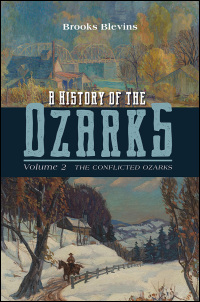
During the last few weeks, however, I have had the opportunity to read the second volume of Brooks Blevins’s A History of the Ozarks: The Conflicted Ozarks. Based on the most recent historical research, the book was mind expanding for my understanding of the region. It is a densely-written book with an incredible amount of detail. The overall contours of the history have expanded my understanding of Wright County, Missouri, where Laura and Almanzo Wilder settled in 1894.

Blevins begins by describing the population of the Ozark Uplift, from eastern Oklahoma to northwestern Arkansas and southern Missouri. The whites of the region were a mixture of westerners, midwesterners, and southerners. The region had fewer slaves per capita than the south, though the existence of slavery colored life everywhere and for everyone. The central chapters of the book describes how society in the Ozark Mountains were destroyed by the Civil War. During the first two years of the war, both Union and Confederate armies marched across the region, living off the land by confiscating foodstuffs and livestock and fighting several major battles. Once the regular armies had moved on, state militias, irregular military units, and what we might call gangs today ranged through the region, attacking opponents, destroying property, and at times displacing entire populations. After the war ended, Reconstruction took different forms in Arkansas, which was occupied by the U. S. army, and Missouri, which was not. In both areas, however, freed slaves worked to find ways to support their families and former slaveowners found new ways of organizing their farms. Bloodshed continued across the region during reconstruction, involving the Ku Klux Klan in Arkansas and vigilantes known as Bald Knobbers in parts of southwestern Missouri. Open violence had largely ended by the middle of the 1870s, but spectacular reports of Bald Knobber lynchings and reprisals were reported in newspapers until 1888.

The last chapter of the book is titled “Reconstructing Society and the Economy in the Ozarks.” It describes how the building of railroads, the development of mining and timbering, and the founding of public schools and educational institutions connected many towns and families to the rest of the country, both economically and culturally. However, areas bypassed by the railroads and further from natural resources remained less prosperous and less “civilized.” In an Epilogue, Blevins argues that these areas and the vigilante action that occurred there became fascinating to Americans in urban areas during the late nineteenth century. Ultimately, the residents of this other world were immortalized by Harold Bell Wright’s The Shepherd of the Hills, published in 1907. The cultural term “Ozarks,” not referring to the town of Ozark or to the Ozark Mountains, appeared in print for the first time in the New York Times in 1887. The term became used for the “backward” portions of the region, much as the term “Appalachia” was used during the same period. These characterizations flattened out the more complex realities of the region for decades to come. In the third volume of the history, which is set to be released in November, Blevins promises to provide a more complex portrait of the region’s past and present.

Reading this book was mind-expanding for me. I did not realize how brutal the Civil War was in Missouri and Northern Arkansas, despite my appreciation of the movie Ride With the Devil (1999) which is set in Missouri during the war. I also learned several things that will be useful for my work on Laura Ingalls Wilder:

  • Wright County and Mansfield, Missouri, are in the Central Plateau of the Ozark uplift. (p. 8)
  • The first railroad that went through Mansfield was the Kansas City, Fort Scott and Memphis, sometimes known as the KC, FC & M. It built east from Springfield to Willow Springs in 1881 and 1882. (196)
  • Railroads made money from selling land along their routes, and they relied on population to use their services. In areas where there was lead, zinc, iron, or large stands of trees, mining and timber paid the freight. This was not the case in the central plateau, so “the KC, FS & M eventually turned to promotion to generate profitable shipping, dubbing the country between Springfield and Thayer the ‘Land of the Big Red Apple’…” (196) This slogan will probably be familiar to Wilder readers familiar with the advertising that brought Almanzo and Laura to Mansfield in 1894. The KC, FS & M was bought out by the St. Louis and San Francisco Railroad in 1901.
  • Laura and Almanzo lived in an area served by a railroad line and therefore more prosperous than many areas, some of them not far from the town of Mansfield. Blevins concludes: “The result of these factors in the decades after the war and Reconstruction was the gradual development of a divergent society in the Ozarks, one of haves and have-nots. While the farms and towns of the Springfield Plain and the river valleys and the rail lines prospered in the late nineteenth and early twentieth centuries, those in other less-advantageous areas stagnated or declined…” (235)

Blevins’s interest is almost completely in the direction of military, economic, and social history. Churches are mentioned only a few times in the book: as a key feature of community for slaves (23-24), when the U. S. War Department allowed Northern Denominations of Christian churches to seize the property of Southern Congregations during the War (148), and when figures were connected with particular churches.

Still, the book is expansive, detailed, and will reward the careful reader. I believe that the observations I outlined above will enrich my chapters about the Wilders’ time in Mansfield, including providing important context for their farm operations, Almanzo’s work in town (which was mostly related to the railroad), and Laura’s work with the Mansfield Farm Loan Association.

Thanks for reading.

Links:

Trinity Christian College – https://www.trnty.edu/

Brooks Blevins, A History of the Ozarks:

Volume 1, The Old Ozarks

Volume 2, The Conflicted Ozarks

Volume 3, The Ozarkers

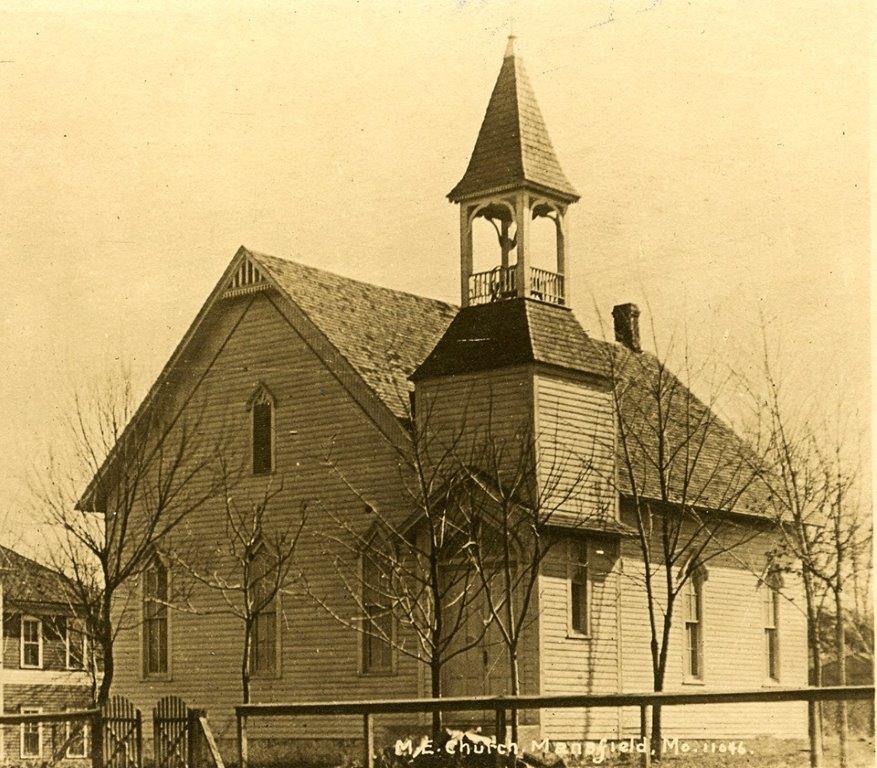
Mansfield Methodist Episcopal Church

Organized Sunday with a Good Membership

Last week, I did my research trip to Missouri and Kansas. This trip generated many insights for my book, and it will provide material for my next several blog posts.

Monday and Tuesday, May 24 and 25, I visited the State Historical Society of Missouri office in Rolla. It is housed in the Wilson Library at the Missouri University of Science and Technology, or Missouri S&T. This school was previously called the University of Missouri at Rolla, and before that it was the Missouri School of Mines and Metallurgy. The State Historical Society of Missouri has collections at universities around the state: Cape Girardeau, Columbia, Kansas City, Rolla, St. Louis, and Springfield. Materials at any location can be sent to any of the others. I requested some reels of microfilm be sent from the University of Missouri at Columbia to Rolla so that I could look at them. They were for the Mansfield Mail from 1895 to 1906 and the Mansfield Mirror from 1923 to 1936. Both were weekly newspapers published in Mansfield.

Katie Seale in the Rolla office kindly obtained the microfilm before I arrived. Once I was there, she taught me to use the microfilm reader, which was a scanner connected to a desktop computer. The technology was incredibly good, especially compared to the microfilm readers and printers used by historians for decades. It was able to make even very dark microfilm images readable. The system also allowed me to scan portions of a page of the newspaper and paste them directly into my notes. After several hours, I was in a groove, and in the two days I had looked at all the issues of the Mansfield Mail and had made some headway in the Mirror.

I was mainly looking for places where the local newspapers mentioned one of the churches in the town, other Christian activities, or the Wilders. I was not disappointed. In fact, it was the first issue I looked at that included a description of the founding of the Mansfield Methodist Episcopal Church, where the Wilders eventually settled. I reproduce that article in full:

The Methodists

Organized Sunday with a Good Membership

The Revival

               The revival held in the C. P. Church by Rev. Worthen resulted in much good in the interest aroused, the crowds that attended and in the enlivening of religious interest in the city, and, especially, in the organization of a Methodist Episcopal Church in our midst. The number of conversions were twenty-three and number of accessions to the M. E. church was twenty-six.

               Organization of the church was effected on Sunday, last, by Rev. E. G. Cattermole officiating, assisted by Revs. Rowden and Worthen. The organization starts out with twenty-six members, while twelve or fifteen more will come in soon. The new church will be in the Rev. Mr. Cattermole’s charge until Conference meets, which will be in March, when its future supervision will be determined.

               Rev. Worthen did a good work here and should have credit, we presume, for the most of the work, as he labored incessantly and without compensation. He is, in fact, an able minister and could do much good if he would learn not to antagonize every interest and every body not directly in conformity with his views, and berate them in language strangely in contrast with the doctrines of the Bible. Nothing can be gained by making enemies in church work; but everything may be gained by making friends and by persuasion. Nevertheless, the work accomplished here was a good work and just credit should be given for it, although enemies were made for the church by the bitterness of the language used by Rev. Worthen; but our people should remember that this was not the fault of our new church or of our home church people, but of an outside individual. (Mansfield Mail, 22 February 1895)

This is a striking article for a couple reasons. First, it sets the origin of the Methodist Episcopal Church in Mansfield in February 1895. The Mansfield United Methodist Church histories that I had read previously say that the church was founded in 1899. The first church building was completed in 1899, but according to this news story, it appears that the congregation was founded four years earlier. However, I’m still wondering about the entry Laura wrote about Mansfield in her diary of her family’s trip from DeSmet, South Dakota to Mansfield on August 30, 1894: “There is a Methodist Church and a Presbyterian.” (On the Way Home: The Diary of a Trip from South Dakota to Mansfield, Missouri, in 1894, with a setting by Rose Wilder Lane [New York: Harper and Row, 1962], p. 74). This suggests that there was already a Methodist church in existence the previous year. Perhaps I will be able to access Methodist Church district records that will shed light on when exactly the Mansfield Methodist Episcopal Church was founded.

In addition, it is fascinating that the author of this article combines straightforward reporting about the revival and its results with what might be seen as editorial comments about the pastors involved. This kind of editorializing was not uncommon during the late nineteenth century. It does indicate that some pastors emphasized their denomination’s doctrines instead of beliefs that all Christians share. It is unclear, obviously, whether the author’s assessment of the pastor’s actions was shared by others who committed to the new church. I think that Laura Ingalls Wilder would probably have resonated with the newspaper reporter’s attitude.

Another item provided regularly in these local newspapers is the schedule for full worship services led by the pastor at each church in Mansfield. There was some shifting over time, but it appears that there were “preaching” services either one or two times a month at the Methodist Church. In some years, it was the first and third Sunday mornings, during others it was the third and fourth, and sometimes it was just the third. This was because the pastor assigned by the Bishop served more than one church.

I believe that I now have an almost complete listing of pastors who served the Mansfield Methodist Church between 1895 and 1935. At least it is more complete than any list I have seen. They were:

E. G. Cattermole, 1895

J. S. Meracle, 1897

T. P. Leckliter, 1898

C. F. Tippen 1899

W. H. Yount or Yaunt, 1899-1900, 1903-1904

John J. Frazier, 1904

B. D. Jones, 1908-1909

B. E. Niblack, 1912-1913

J. J. Wolfe, 1913-1914

J. W. Needham, 1914-1915

Guy Willis Holmes, 1916-1919

Thomas E. Prall, 1919-1920

A. J. Graves, 1920-1921

Clyde E. Little, 1921-1922

W. A. Gray, 1922-1923

M. O. Morris, 1923-1924

George A. Wells, 1924-1926

C. C. Van Zant, 1927-1929

William A. Dahlem, 1929-1931

J. E. Owen, 1930-1931

Andrew C. Runge, 1931-1932

D. S. Frazier, 1932-1933

Holley Day, 1933-1936 (maybe longer)

Pastors normally only served for one year and then were assigned elsewhere. It appears that by the late 1920s and 1930s, however, it was more common for a pastor to serve multiple years.

As far as considering the faith of Laura Ingalls Wilder, I’m gathering answers to basic questions about the Methodist Church in Mansfield—when was it founded? When did they meet for worship? Who was the pastor?—in hopes that they will contribute to answering other questions: What was spiritual formation like for members of a church in a small town like Mansfield, where a pastor came to preach just once or twice a month, and where he served just one year and then moved on? Did the Wilders attend Sunday School, which was held weekly? The newspapers report on events sponsored by the Methodist Church Ladies Aid Society, and they regularly give the program for Epworth League and Christian Endeavor meetings for young people. It doesn’t seem that Laura was very active in the Ladies Aid. When Laura’s name appears in the newspaper, it is usually 1) as an official in the Mansfield chapter of the Order of the Eastern Star or in 2) relation to activities of two women’s clubs, the Justamere Club in Mansfield and the Athenian Club which had members in both Mansfield and Hartville. She also served as the Secretary-Treasurer of the Mansfield chapter of the National Farm Loan Association.

Many thanks to my institution, Trinity Christian College, for funding my travel. More about other things I learned on the research trip in future posts. Thanks for reading.

Links:

State Historical Society of Missouri

Missouri University of Science and Technology

Trinity Christian College

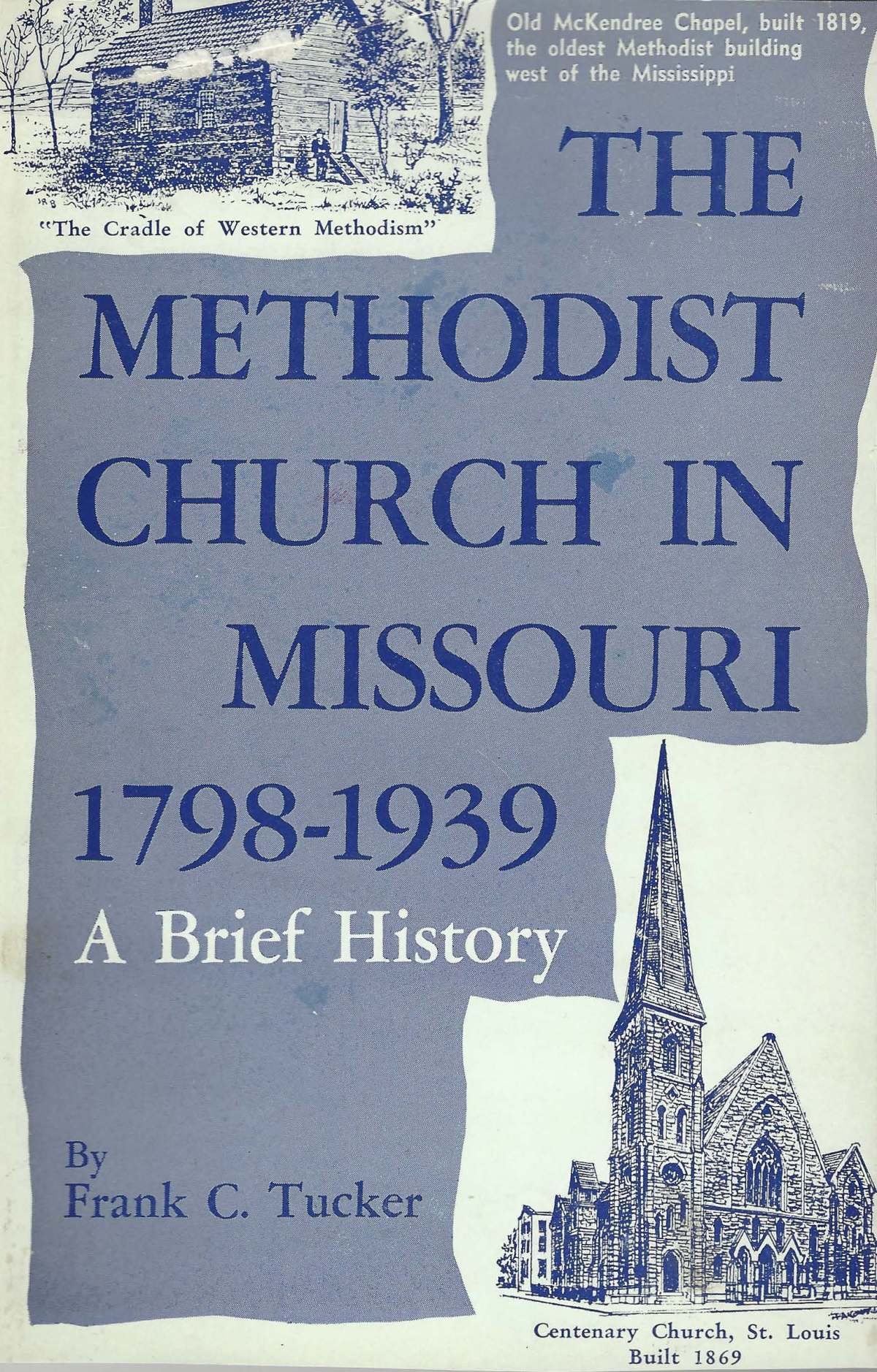
The Methodist Church in Missouri, 1798-1939

Three different Methodist denominations

The spring academic term at Trinity is over. We were able to hold two in-person commencement ceremonies in a local minor-league ballpark for our 2020 and 2021 graduates. Though it was cold, it didn’t rain. My daughter was a 2020 graduate and got to walk across the stage with her friends.

That was two weeks ago. Last week we had a variety of end-of-year meetings. This week my schedule opened up a bit, so I have been able to return to work on the book. Trinity has provided funding for me to travel next week to the State Historical Society of Missouri and look at newspapers from Mansfield, Missouri, where Laura and Almanzo Wilder lived from 1894 to the end of their lives. I will be looking for information about the churches in that town, particularly the Methodist Church, where the Wilders worshipped.

In preparation for the trip, this week I read Frank Tucker’s The Methodist Church in Missouri, 1798-1939: A Brief History. The book was published in 1966. It is an institutional church history, describing the origins and growth of what eventually became the three different Methodist denominations in Missouri during the early twentieth century: The Methodist Episcopal Church (MEC), the Methodist Episcopal Church, South (MECS), and the Methodist Protestant Church (MPC). Tucker places the growth and development of these churches in two contexts: 1) events in Missouri, including early growth of white population in the state, the Civil War, and reforms during the early 20th century, and 2) developments in the denominations nationally. The book ends with the merger of the three denominations to become The Methodist Church in 1939.

Tucker’s book does not mention Mansfield, and it only briefly refers to the spread of Methodism in the Ozarks more generally. But reading the book taught me a lot about Methodism and reminded me of a lot I had previously learned about Missouri’s history. Some particular things:

  • Terminology: Methodist denominations are governed by a General Conference which meets every four years. Smaller geographic areas are governed by an Annual Conference, and still smaller areas have a Quarterly Conference. Ministers are appointed annually to particular churches by the Bishop of the area.
  • Divisions: The MPC left he MEC in the 1830s because of disagreements about governance: how leaders of Quarterly Conferences were chosen and whether lay leaders could be members of Annual and General Conferences. The greater disruption to Missouri Methodism came when the MECS split from the MEC in the 1840s because of disagreements about slavery. Annual Conferences were allowed to choose whether to stay with the MEC or leave with the MECS; the Missouri Annual Conference voted to join the MECS. However, some churches in Missouri then voted to remain in the MEC. As a result, for almost 100 years, churches in Missouri belonged to one of three different Methodist denominations. Since Missouri was a border state, it had much more diversity among the three groups than, say, Minnesota, where most Methodists were MEC, or Alabama, where nearly all Methodists were MECS.
  • The Border War, Bleeding Kansas, and the Civil War: The 1850s and 1860s were terrible years for Missourians. The MEC and MECS both founded churches in Kansas, and there were Methodists among both the Bushwhackers and the Jayhawkers, both before and during the war. Some MECS churches were occupied by pastors from the MEC. The MPC also divided over slavery.
  • Ministries: After the Civil War, as Missouri’s population grew and experienced more prosperity, Methodist churches initiated additional ministries. Sunday Schools became more widespread and organized. Epworth Leagues were started to provide young people in their teens and twenties with leisure activities and opportunities for spiritual growth. Methodist denominations founded colleges, hospitals, and training schools for nurses. Methodists also participated in the late-nineteenth century explosion of world missions.
  • Race: Before the Civil war, there were African-American members in all three denominations. After the war, Black Methodists left the MECS after the Civil War to form the Colored Methodist Episcopal Church, which later was renamed the Christian Methodist Episcopal Church. In the MEC, blacks had their own churches, pastors, districts, and annual conferences.
  • Reunion: During the decades surrounding the Civil War, there was competition and even conflict among churches in the MEC, MECS, and MPC. By the late 1800s, however, animosity had cooled. The three denominations collaborated on a hymnal in 1904, and there were calls from the Annual Conferences in Missouri for the denominations to merge. The merger was finalized in a uniting General Conference in Kansas City, Missouri, in 1939.

The Missouri United Methodist Archives (MUMA) is located in the library at Central Methodist University in Fayette, in north central Missouri. Central Methodist is the sole remaining institution of higher education founded by Methodists in the 1800s. John Finley, the Archivist at MUMA, has been very helpful in sending me information from the Archives about the Methodist Church in Mansfield. Apparently it was part of the MEC. Finley suggests that this would have been more congenial to Laura and Almanzo since the MEC was dominant in the upper Midwest where they were from. So perhaps there were similarities as well as regional and cultural differences between the Methodist Church in Mansfield and the one in Walnut Grove, Minnesota that Laura attended for at least a year as a child.

Tucker’s book provided me with state-level and denominational context for Methodist churches in Missouri. As a work of church history that focuses on church leaders and institutional activities, however, it doesn’t ask or answer questions that a social historian might ask, like: What was it like to be a member or pastor in a church that was part of the MEC in a state that was dominated by the MECS? In a small town like Mansfield during the early 1900s, where a pastor came to preach just once a month, did members feel connected to the Methodist practice of circuit riding in the late 1700s and early 1800s? Or was it just a fact of life, since all churches in Mansfield at the time—Baptist, Christian, Methodist, and Presbyterian—only had preaching once a month? As is often the case, historical work is about struggling with the questions, not finding the answer.

I’m looking forward to being back in Missouri for research next week. Thanks for reading.

Picture credit: I scanned the front of the dust jacket of the book.

Links:

Trinity Christian College

Trinity Christian College Commencement

The State Historical Society of Missouri

The Methodist Church in Missouri, 1798-1939: A Brief History

The Missouri United Methodist Archives

Mansfield Press and Mansfield Mirror

Local newspapers, the Methodist Church, and Faith formation

Greetings. Once upon a time, I did weekly blog posts. Now I’m glad when they are monthly. But these are trying times…

The last several weeks, I’ve been avoiding thinking about preparing for fall by working on my book, “On the Pilgrim Way”: The Faith of Laura Ingalls Wilder. I’ve been writing chapter 7 (of 11). The draft is almost complete. As July begins, I’m going to have to make the pivot to class preparation for the highly uncertain fall and spring of 2020-2021.

Chapter 7 addresses the years 1911 to 1924 in Laura’s life. Laura and Almanzo were living on Rocky Ridge, their farm about a mile outside of Mansfield, Missouri. These were the years that Laura wrote articles and columns for the Missouri Ruralist, a regional farm newspaper. Laura was in her forties and fifties, and even as she first had cultivated an audience for her writing, she was also at the height of her participation in community affairs in Mansfield. She was regularly an officer in the Mansfield chapter of the Order of the Eastern Star, the auxiliary to the Masonic Lodge which allowed female members. She was also a founding member and regular attender of two women’s clubs. One was the Athenians, mostly women from Hartville, the county seat of Wright County and about ten miles north of Mansfield, but with five members from Mansfield. The Justamere club was founded in 1919 by and for women from Mansfield; Laura wrote the club song, “We are All Friends.” During World War I, she volunteered for the local chapter of the Red Cross and she and Almanzo contributed to the Liberty Bond drive. She was active in local Democratic Party politics and helped to found the Mansfield Farm Loan Association, which received funds from the Federal Government and made loans to farmers. She was elected Secretary Treasurer for the Association every year from 1917 to 1928.

How do I know about these activities? Well, most of them are reported in biographies of Laura. But I got to read about all of these things when I looked at the copies of two local newspapers that have been digitized and made available by the Chronicling America program of the Library of Congress. The Mansfield Press is available from 1908 to 1909. The Mansfield Mirror is available from 1912 to 1922.

Authors like John Miller and Caroline Fraser have gone through these papers before me and relate what they say about Laura and Almanzo. I worked through them in order to see what they say about Christian organizations in Mansfield, and especially about the Mansfield Methodist Church, where the Wilders attended most of their adult lives, though they never officially became members. Here are some things that I learned:

  • When Laura and Almanzo moved to Mansfield in 1894, she wrote in her diary that “There is everything here already that one could want though we must do our worshipping without a Congregational church. There is a Methodist church and a Presbyterian.” (On the Way Home, 74) The Methodist church was actually a Methodist Episcopal (or M. E.) Church, and the Presbyterian Church was a Cumberland Presbyterian (or C. P.) Church. In 1909 a Baptist congregation was formed, and a Church of Christ was founded in 1913.
  • The Methodist Church building had been built in 1899, and it was a center of activity in the Mansfield Community. It housed dinners sponsored by the Methodist Ladies Aid Society, graduation services for the local high school, and at times civic events like Memorial Day or July 4 observances, especially if it was rainy—otherwise they were held outside.
  • None of the churches in Mansfield had pastors who served the church there full time—all of them were shared with churches in other small nearby towns. As a result, none of the churches had worship services with a sermon every week. By the middle of the 1910s, the Church of Christ had preaching (this is how the newspaper describes it) the first Sunday of each month, the Baptist church had preaching the second Sunday, the Methodist Church had preaching the third Sunday, and the Presbyterian Church had preaching the fourth Sunday. Sunday school was held in all the churches every Sunday.
  • The Methodist Church in Mansfield was part of the St. Louis Conference of the Methodist Episcopal Church. The M. E. denomination was hierarchical, which meant that the leaders of the conference assigned ministers to the churches every fall for one year terms. At times a pastor might be returned to a church or set of churches for two or even three years, but most of the men that served Mansfield and other churches in small towns were only there for one year before being moved to another pastorate.
  • My far the most colorful pastor of the Mansfield Methodist Church was the Rev. Guy Willis Holmes, who served there from 1916 to 1919. He is described in the newspaper as “an earnest and forceful preacher” and “a live-wire.” He must have been an electrifying speaker and a persuasive organizer. After only six months in the area, he was giving the commencement speech at multiple high schools, had helped to start a boy scout troop, and had conducted revival services that resulted in 22 conversions. But he came into his own during World War I, when he recruited a company for the Missouri National Guard, Chaired the County Council of Defense, and was named the Federal Food Aid Administrator for Wright County. Holmes was an outlier in that he served for three years. Subsequent pastors never quite lived up to his legacy.

I’ve been thinking about how these realities might have formed the Wilders and their faith. What might it have meant that there was only a worship service with preaching at the Methodist Church once a month? I don’t know if Almanzo and Laura went to Sunday School on the other weeks or not. Furthermore, what might it have meant for their church that it often had a pastor who was only there for one year and then moved on? Could a pastor really get to know many people in the church if he was only in town one weekend a month for one year? Finally, what did Laura and Almanzo think of Rev. Holmes and his striking career as pastor and war worker? For most of 1918, in his role as Food Administrator, Holmes published rules for farmers, stores, and individuals in the newspaper. Staples like flour and sugar were rationed and their prices were fixed, farmers had to market their wheat immediately when it was harvested, and threshing machine owners had to provide weekly reports. It is clear that the Wilders opposed what they saw as Federal Government overreach during the New Deal. I don’t know if they resented the U. S. Food Administration’s rules and regulations during the Great War.

As always, I’m working through these things as I write the book. Thanks for reading.

Quote is from Laura Ingalls Wilder, On the Way Home: The Diary of a Trip from South Dakota to Mansfield, Missouri, in 1894, with a setting by Rose Wilder Lane (New York: Harper, 1962).

Links:

Chronicling America at the Library of Congress

For more on Laura and the Eastern Star and other community activities, you can check out Teresa Lynn’s Little Lodges on the Prairie: Freemasonry & Laura Ingalls Wilder (Austin: Tranquility Press, 2014).

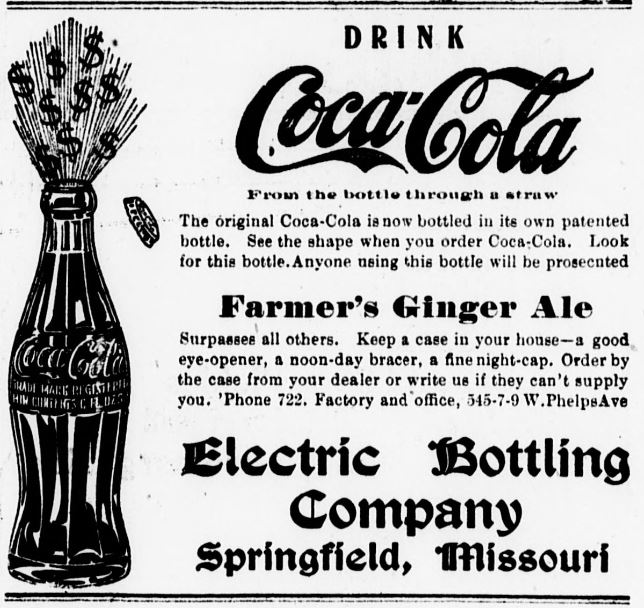
The Coca-Cola ad is from the January 8, 1920 edition of the Mansfield Mirror.