Back to School 2025

returning to Western Pennsylvania in October

Back to school time is upon us. Gas prices in my neighborhood have spiked to nearly $4 a gallon ahead of the Labor Day weekend. And classes at Trinity Christian College began on Monday. This semester I am teaching the first half of the United States history survey—U. S. History to 1860—for the first time since 2021. Back then it was a Monday-Wednesday-Friday course. Now it is a Monday-Thursday course, since Trinity reworked the weekly schedule to make room for Wellbeing Wednesdays as part of our Transformative Colleges Initiative. I have also flipped the classroom; I made 25 videos this summer and no longer lecture in class; we do activities and discuss primary sources. So far my students are doing great.

In July I recorded a podcast episode for the website Mere Orthodoxy. They have a new podcast titled “Christians Reading Classics.” The host is Dr. Nadya Williams, who is a classicist and has a book about the Greek and Roman Classics coming out late this year. The podcast has a little broader definition of “classic,” and she asked me to join her to talk about Little House on the Prairie, which was published 90 years ago in 1935. I had a great time discussing the book and Laura Ingalls Wilder’s life and faith with Nadya and Dr. LuElla D’Amico, a Professor of English and Gender Studies at the University of the Incarnate Word in San Antonio. The episode dropped several weeks ago and I have a link to the podcast at the end of this post.

This month I also found out that A Prairie Faith was reviewed in the academic journal Church History: Studies in Christianity and Culture. The review came out in the September 2024 issue, which was published online in February 2025. The reviewer, Dr. Melinda Marchand, teaches history at Clark University in Worcester, Massachusetts. The review provides an excellent summary of the book and my argument. The author was generous even as she pointed out particular contexts that readers of that journal would have been interested in the book addressing in more detail. The journal is behind a paywall, so I think the best way to find it online is to see if your local public or university library has access.

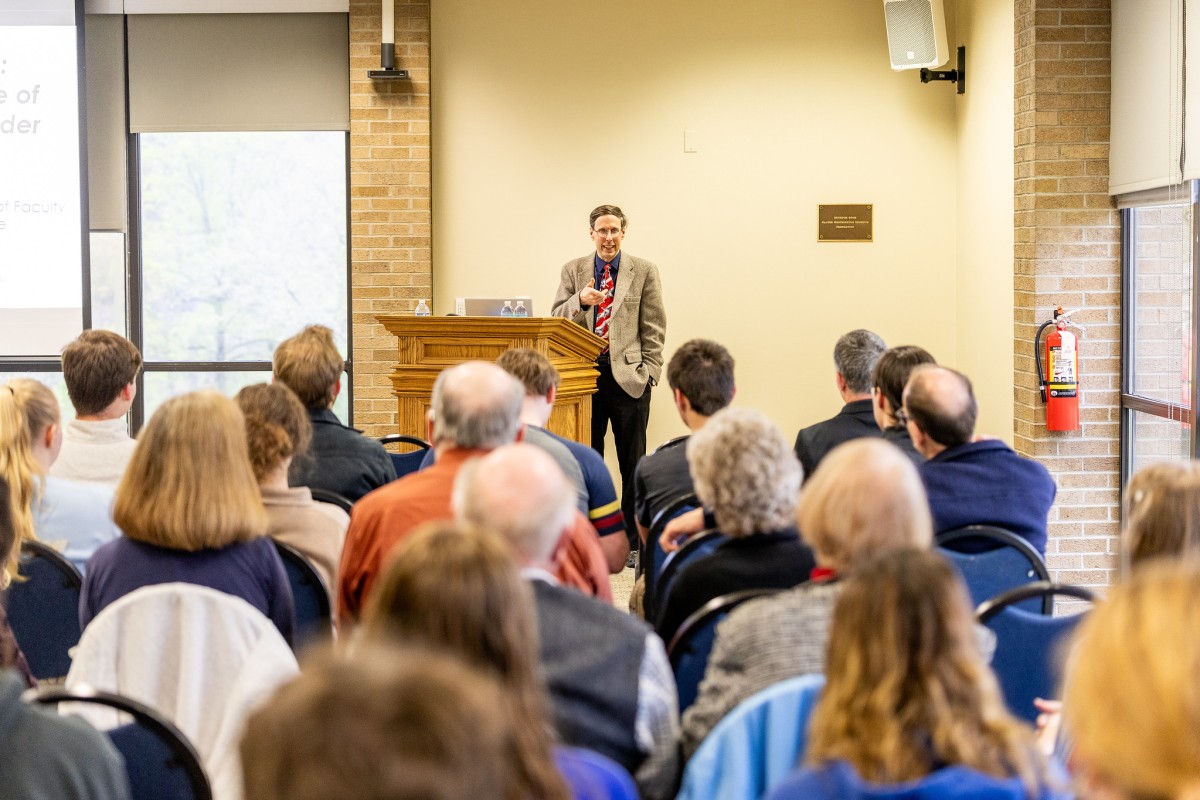
I will be returning to Western Pennsylvania in October to sign books at Geneva College’s Homecoming. The event will be in the West Reading Room of McCartney Library on Saturday, October 25, from 11:00 am to 1:00 pm. I graduated from Geneva thirty-four years ago, and I was a student worker in the library all four of the years I attended. Many thanks to Beckie Cottage and the Alumni and Advancement team at Geneva for making this possible.

I also just picked up a copy of Pamela Smith Hill’s Too Good to Be Altogether Lost: Rediscovering Laura Ingalls Wilder’s Little House Books. It came out this year from the University of Nebraska Press. It looks pretty fascinating. I will have to carve out some time in my schedule to read it this semester.

As always, if you’re interested in having me speak, please let me know (john.fry@trnty.edu). Thanks for reading!

Links

Trinity Christian College

Wellbeing Wednesdays

Transformative Colleges Initiative

Mere Orthodoxy

Christians Reading Classics

Nadya Williams

LuElla D’Amico

Church History, September 2024 issue at Cambridge Journals

Melinda Marchand

Geneva CollegeHomecoming 2025

Iowa and Missouri

two book events in April

Photo by Michelle Underwood

Summer has arrived in Chicagoland. Finals week at Trinity was the last week of April and Commencement was May 2. May 15 was the last day for faculty members on nine-month contracts. As June approaches, I’m in fewer meetings. I’ve begun thinking about the two history courses I will be teaching in the fall: History 204, the first half of the American History survey, and History 401, the Senior Seminar.

I enjoyed two book events in April. The first was an online Iowa History 101 event sponsored by the State Historical Society of Iowa (SHSI) on April 10 at noon. The zoom session was attended by about a dozen people. My talk addressed what we know about Laura’s faith and about Laura and Rose’s contributions to the Little House books, particularly as they address Christianity and the church. I also discussed the Ingalls’s family’s one-year stay in Burr Oak, Iowa, in 1876 and 1877. There were some great questions at the end. The session was recorded and a link is at the end of this post.

Then I was able to travel to the Missouri Cherry Blossom Festival in Marshfield, Missouri. I was there on Friday, April 25 and Saturday, April 26. The mornings and early afternoons of both days I was able to sell and sign books (I took copies of both A Prairie Faith and my second book, Almost Pioneers) in Marshfield’s Community Center, along with a number of movie and television stars from the mid to late twentieth century. Nine actors were there from “Little House on the Prairie,” including Dean Butler, who played Almanzo, and Alison Arngrim, who played Nellie Oleson. There were also three actors from “The Waltons,” and others from “Leave it to Beaver,” “Dallas,” “Barney Miller,” It’s a Wonderful Life, and a variety of other shows and movies. Michelle Underwood, a southwest Missouri author who also works at the Laura Ingalls Wilder Home in Mansfield, had a table next to mine. She has written a book giving a “behind the scenes” look at the Wilder Home. We enjoyed talking while we worked to attract the crowds who waited in line to get autographs from the “Little House on the Prairie” stars. I ultimately sold about twenty books.

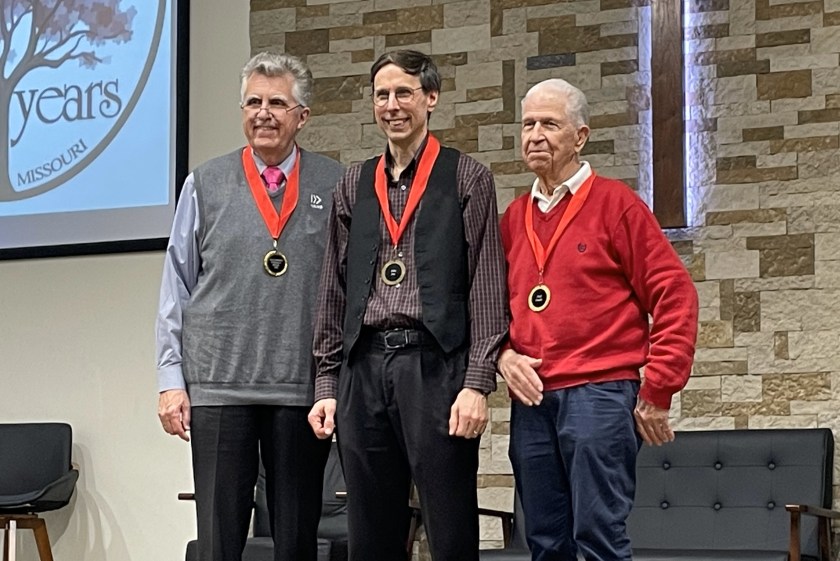
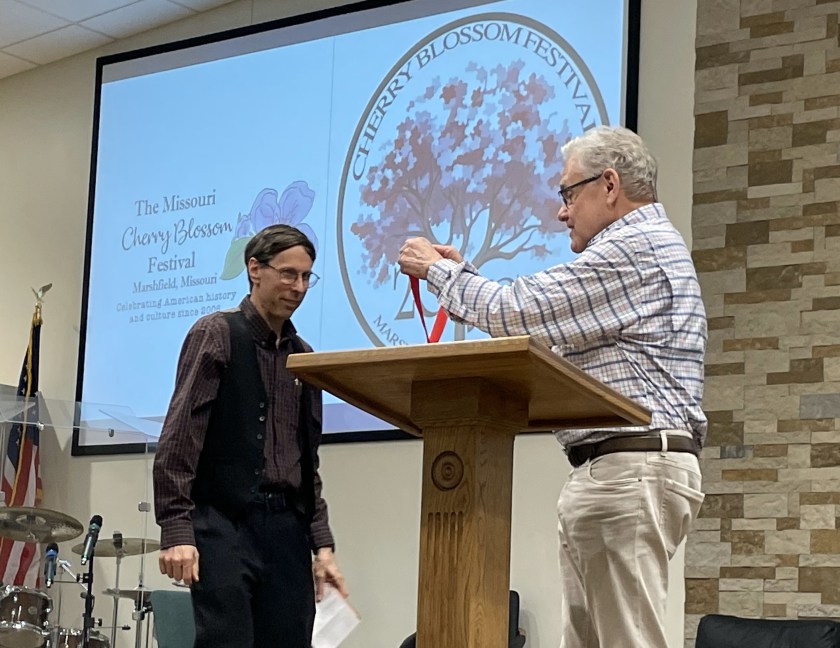
On Friday afternoon I went to the Marshfield Assembly of God church to receive the Ella Dickey Literacy Award. Bill Anderson presented me with the award. The other awardees were the Rev. John Marshall, a retired Baptist Pastor who has written a book on the faith of Abraham Lincoln, and Paul Landis, a Secret Service Agent for John F. Kennedy who has written a memoir about his experiences. I was honored to receive the award, which is named after a beloved, long-time librarian in Marshfield.

John Marshall, me, and Paul Landis. Photo by Sarah Manley

Later Friday afternoon, I attended the Dred Scott Reconcilation Forum, hosted by Lynne Jackson, a descendant of Dred and Harriet Scott. She interviewed Dr. Bryan Moore, the pastor of Jubilee Community Church in north St. Louis and a distant relative of Nat Turner. I also got to judge a cherry pie contest. On Saturday morning, I attended Rev. Marshall’s session about Lincoln; his comments were very insightful. It was great to catch up with Bill Anderson and Sarah Manley. Many thanks to Sarah for taking the pictures during the ceremony. Many thanks also to Rev. Nicholas Inman, Director of the Laura Ingalls Wilder Home in Mansfield and the driving force behind the Festival, for his gracious invitation.

Now I’m just waiting to hear the announcement of the Book of the Year for Biography from the website Foreword. A Prairie Faith is one of eight finalists. Lord-willing that will be announced in June.

If you’re interested in having me speak, please let me know (john.fry@trnty.edu). Thanks for reading!

Links:

Trinity Christian College

Iowa History 101 Recording

STL listing of events at Missouri Cherry Blossom Festival

My second book: Almost Pioneers: One Couple’s Homesteading Adventure in the West

Michelle Underwood’s website

Michelle’s Laura Ingalls Wilder’s Rocky Ridge Farm: A Detailed Look Behind the Scenes

Bill Anderson’s website

Paul Landis’s The Final Witness: A Kennedy Secret Service Agent Breaks His Silence After 60 Years

John Marshall’s Lincoln and Christianity: Essays on Lincoln’s Religious Life

The Laura Ingalls Wilder Home and Museum in Mansfield

Foreword Book of the Year Finalist Announcement

List of Foreword Book of the Year (INDIES) Finalists for Biography

Foreword’s Listing for my book

Picture of Bill Anderson giving John Fry the Ella Dickey Literacy award.

Bill Anderson presenting me with the Ella Dickey Literacy Award. Photo by Sarah Manley

Book Tour – Fall 2024

Missouri!

In the gift shop at the Laura Ingalls Wilder Home and Museum, Mansfield

Last week I was able to travel to Missouri for several engagements. On Wednesday, September 25, I from Chicagoland to Branson and stayed overnight there. The next day I drove to the College of the Ozarks (they call it the C of O), which is just south of Branson. There, Dr. Aleshia O’Neal gave me a wonderful tour of the campus before I spoke in her class. Dr. O’Neal is an English Professor at the C of O who grew up on a farm in Missouri. So we enjoyed looking at all the tractors and barbed wire in the college’s tractor museum.  We also went to Patriot’s Park, Williams Memorial Chapel, and the scripture garden that overlooks the White River. The C of O is a work college, meaning there is no tuition, but all students work fifteen hours a week on campus or in the local community. I did not realize how many different on-campus business operations this would require. We visited the stained glass studio and grist mill, and I saw the greenhouses and barns for the cows. We finished at the Ralph Foster Museum, which has artifacts from all periods of Ozarks history. I then spoke about my research on Mrs. Wilder in English 3023, the American Novel, to eight students and several faculty members. The English Department treated me to lunch at the C of O’s Keeter Center, which features an excellent restaurant, as well as a hotel and conference center. Many thanks to Dr. O’Neal and to Dr. Ethan Smilie, Humanities Division Chair, for their invitation and hospitality. I met Dr. Smilie at LauraPalooza in 2017, and we’ve corresponded ever since.

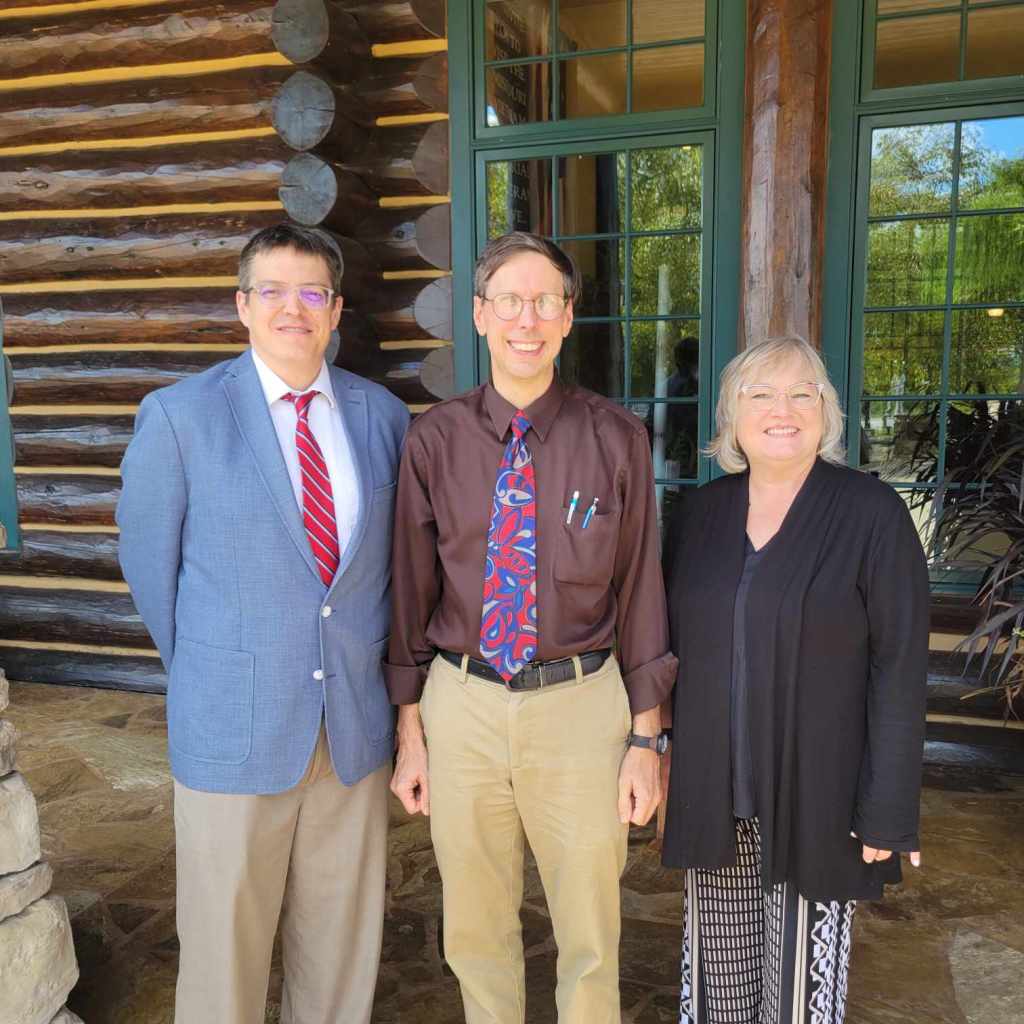
Me with Dr. Ethan Smilie and Dr. Aleshia O’Neal

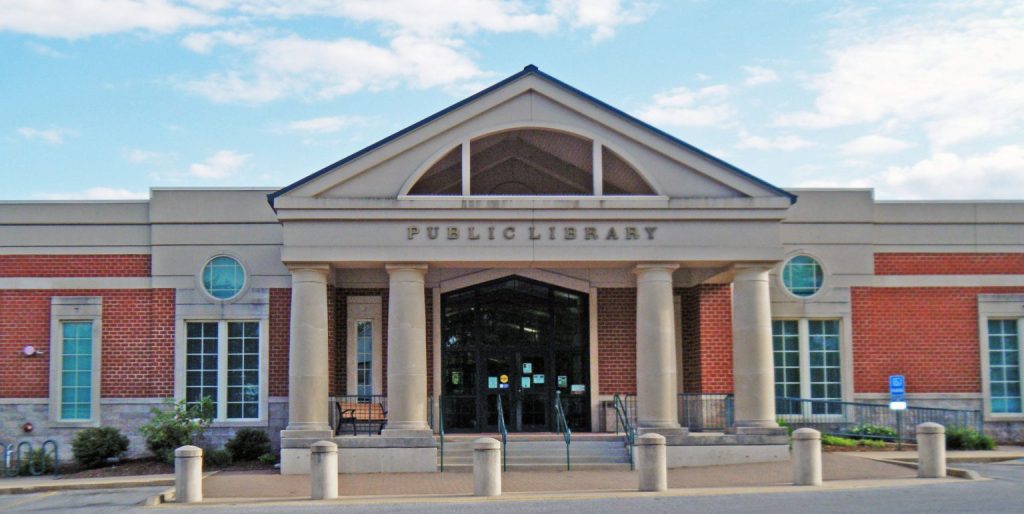
That afternoon I drove from the Keeter Center to West Plains, a town of about 12,000 people in south-central Missouri.  I spoke at the West Plains Public Library at 5:00. There were about thirty people there, including a woman who was originally born in the south suburbs of Chicago. There were also several families from Covenant Reformed Church, which is a congregation in my Presbytery. That night I stayed with a family from that church and really enjoyed my time with them and their daughter and three sons. They reminded me of my family about 20 years ago. Many thanks to Greg Carter and Dianna Locke for hosting me at the Library, and to the Nortons for their hospitality.

West Plains Public Library

On Friday, September 27, I drove from West Plains to Mansfield for the 49th Annual Wilder Days celebration.  I went by way of Ava, which is a town that Laura and Almanzo Wilder often visited on Sunday afternoons, but which I had never been to. This got me off the four-lane highway, which meant I saw some really beautiful views of the Ozarks. Certain areas really reminded me of Western Pennsylvania, where I grew up. Once I got to Mansfield, I went to the Laura Ingalls Wilder Home and Museum outside of town and reacquainted myself with the site.  I walked through the farmhouse, over the path to the rock house, and through the rock house—tours were self-guided because of Wilder Days. I also went through the museum and saw that my book was for sale in the middle of a bookcase of works about Mrs. Wilder.  There now is also a recreation of Almanzo’s garage, just opened this year. I also visited the Mansfield Area Historical Museum in downtown Mansfield.  It is housed in a replica train station and has a variety of artifacts from local history, including materials about Carl Mays, who played major league baseball fifteen years for the Red Sox, Yankees, and Reds. I also got to see the Mansfield public school fourth graders sing in the square. They did great.

Friday evening, I went to the Fifth Annual Wilder Dinner, a fundraising event for the Laura Ingalls Wilder Home and Museum. It was held at the Mansfield High School. Before the prayer, a local musician played two songs on Pa’s Fiddle, the violin that belonged to Charles Ingalls. It gave me chills to hear the instrument that Laura wrote so much about. After dinner, there was a live auction of a variety of pieces of Wilder memorabilia. Dean Butler also spoke; he played Almanzo in the TV series “Little House on the Prairie” from 1979 to 1983. I had previously heard him speak at LauraPalooza in 2022. Friday night, I was able to stay at a house owned by the Wilder Home.

David Wilson playing Pa’s Fiddle

Saturday morning, I was able to hear Pa’s Fiddle again, this time for forty-five minutes, in front of the Wilder Home. I then signed books in the entryway to the museum from 10 am to noon. Dean Butler was signing copies of his new book, Prairie Man in the back of the museum. The line for him wound through the museum, out the front door, down the steps, and along the parking lot. At lunch, I went downtown and bought a pie from the Historical Museum’s fundraiser and a bag of kettle corn. I also got to see the Mansfield Wilder Days Parade. I then went back to the museum and signed books from 2 to 4 pm. I then drove back to Chicagoland. Many thanks to Rev. Nicholas Inman, Director of the Wilder Home and Museum, and to staff members Susie, Vicki, Marie, Tana, Clinton, and everyone else who made my visit there excellent.

Up next for me is a book celebration at Trinity next Wednesday afternoon. There are four faculty members who have published books in the last twelve months. I will also be signing books at the Barnes & Noble in Orland Park, Illinois on Saturday, October 19 from 1 to 3 pm.  Anyone in Chicagoland is invited to attend!  (Put in link)

Thanks again for your support!

Links:

College of the Ozarks

What is a work College?

Gaetz Tractor Museum

Ralph Foster Museum

West Plains Public Library

Covenant Reformed Church

Laura Ingalls Wilder Historic Home and Museum

Mansfield Area Historical Society and Museum

Trinity Christian College

Book Signing at Barnes & Noble Orland Park, Illinois

Book Tour – Spring 24

a number of opportunities

Photo by Eric Schiemer, Geneva College

The spring semester at Trinity Christian College has sped by. Today is the last day of regular classes, and finals week is next week. During the last couple of months, I have also had a number of opportunities to talk about my research.

February was online appearance month. Right after the book appeared, I got an email from the publisher saying that Shaun Tabatt wanted to interview me for The Shaun Tabatt Show. We spoke via zoom on February 15 and the interview was published online two days later. Later that month, Fred Zaspel reached out about doing an interview for Books at a Glance. We spoke on February 28 and the interview was published on March 5. Many thanks to both Shaun and Fred for their time and interest.

March was email month. I traded many emails with staff and friends at (in alphabetical order): the Ann Arbor Public Library, the Blue Island Public Library, the College of the Ozarks, Geneva College, Grove City College, the Ingalls Homestead outside of De Smet, the Laura Ingalls Wilder Museums in Pepin and Walnut Grove, the Laura Ingalls Wilder Historic Home and Museum in Mansfield, the Laura Ingalls Wilder Historic Homes in De Smet, the Midwestern History Conference, and Schuler Books in Grand Rapids. Some of these contacts have become upcoming appearances, some are still in process.

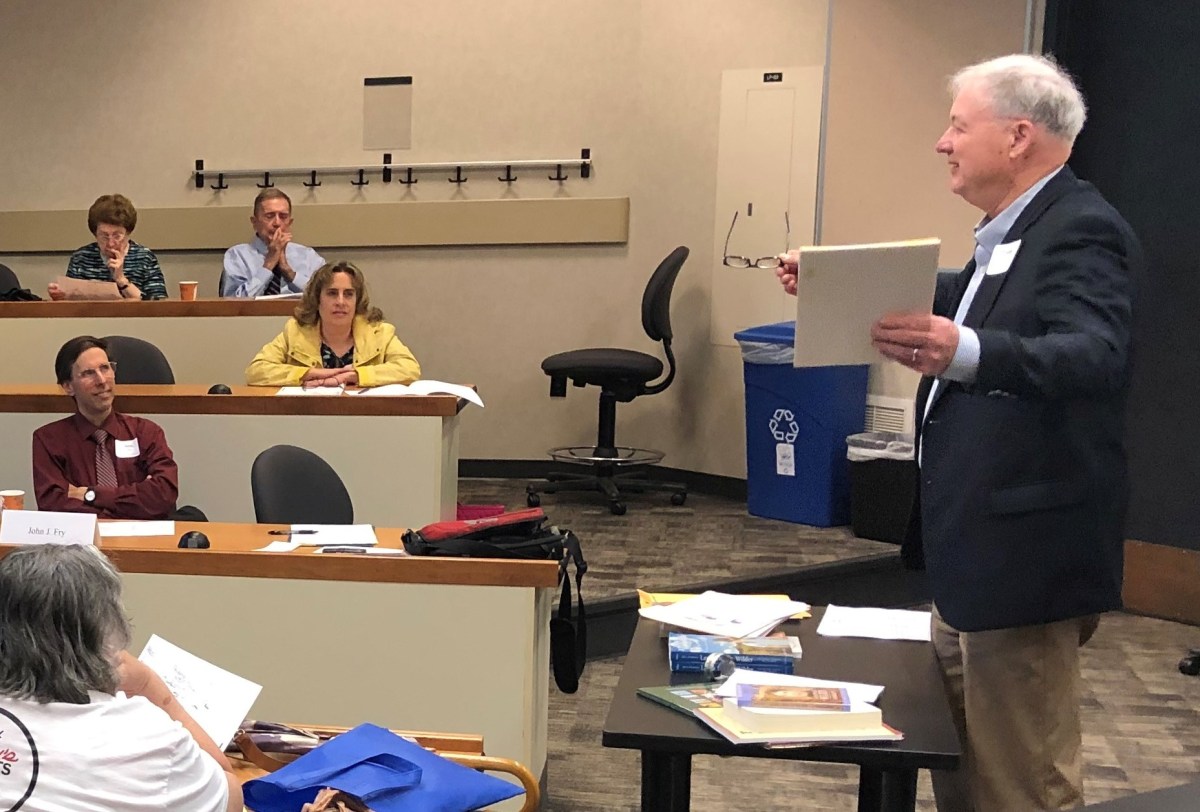
April has been in-person appearance month. On April 4, I spoke at the Blue Island Public Library. About ten people attended and we had a great talk. Many thanks to Dennis Raleigh for making that event happen. I also taught a SALT course at Trinity Christian College from April 2 to 16. SALT (Seasoned Adults Learning at Trinity) courses are for residents aged 50 and older from communities surrounding the college. There were eight students, and over the three weeks we read and discussed the book. I also shared some photos from my research trips and visits to the Ingalls and Wilder historical sites. Many thanks to Dewoun Hayes for her enthusiasm and faithful support.

On Monday of this week, I flew to Pittsburgh and drove to Grove City, PA. There I got to have lunch with my longtime friend Michael Coulter, who teaches Political Science at Grove City College, and dinner with Jan and Katie Dudt, old friends from when we lived in western PA. I spoke to about forty people that evening, about half students (all women – not entirely surprising) and half people from the community. Several were high school classmates from Grove City Christian High School and Portersville Christian school. One I had not seen for probably 30 years. It was a great time. It was also a great blessing to stay with the Dudts on their beautiful farm outside Grove City, close to where I grew up. Many thanks to Mike for his work and to Grove City’s Institute for Faith and Freedom and Departments of English and History for sponsoring the talk.

Then on Tuesday, I drove from Grove City to Geneva College in Beaver Falls, PA. It was a nostalgic trip, especially the stretch down the hilly and twisty back roads between Portersville and Eastvale. It is still pretty early spring, so it wasn’t always beautiful, but it was home. At Geneva I got to spend some time with Jeff Cole and Eric Miller, members of the History Department, and Kae Kirkwood in the Archives. Geneva is my alma mater, so I knew Kae from when I attended in the late 80s and early 90s. And two of my sons, Ben and Daniel, currently go to Geneva, so we were able to get together for dinner (and ice cream after my talk). There were probably sixty people at the talk; most were students, but some were from the community, including several from Grace OPC in Sewickley, the church I attended when I was in college. The talk was part of Geneva’s Visiting Artist and Lecture Series (GVALS). Many thanks to Jeff and Eric, Provost Melinda Stephens, and Marlene Luciano-Kerr for the invitation and their hospitality.

I now have a page on the website dedicated to Book Talks, both upcoming ones and previous ones.

If you are interested in having me speak at your local bookstore, church, public library, or other community group, please contact me at john.fry@trnty.edu.

Thanks again for your support!

Links:

Trinity Christian College

Eerdmans Publishers

Midwestern History Conference

Blue Island Public Library

SALT at Trinity (click on Classes and then Session 3A to see the information about my course)

Geneva College

Grace OPC

Wilder Podcast

Life, Books, Television Series, Merchandise

I don’t spend much time on Facebook, but in June I learned from some of the groups that I lurk around that a new podcast was being released this summer. It was just called “Wilder,” and it was the idea of Glynnis MacNicol, a New York City-based writer and podcaster who read and loved the Little House books when she was growing up. As an adult, she returned to the books with the eyes of a twenty-first century woman and decided that she couldn’t treat them in the same way. So she decided to do a deep dive into the history of Laura’s life, the way that the books were written, the books themselves, the television series “Little House on the Prairie,” the merchandise surrounding the books and TV show, and the historic sites. She ended up taking two collaborators, Emily Marinoff and Jo Piazza, on a tour of the of Wilder historic sites in Kansas, Missouri, Wisconsin, Minnesota, Iowa, and South Dakota. They also interviewed a number of the most important scholars and writers who have helped us understand Laura.  The resulting podcast series included 12 episodes released between June 7 and August 31.

The podcast had a lot of excellent content and also some questionable takes. I thought I’d do a thorough review, so this is a little longer post than I’ve done in a while. First, a brief summary of each episode:

Episode 1 – “Now is Now” Released 7 June 2023

This episode previews the entire series of podcasts. It starts with the creators attending the Laura Ingalls Wilder pageant in Walnut Grove, Minnesota. It also tells the story of the Hmong population that now lives in and around the town. They moved to the area partially because the daughter of a family in the Twin Cities had read the Little House books. The episode also addresses the translation of The Long Winter and the other Little House books into Japanese during the United States occupation of Japan after World War II.  The episode ends with quotes from librarians and others who argue that it is not good for children to read the Little House books today.

Episode 2 – “Heroine with a Thousand Faces,” released 15 June 2023

This episode provides an overview of Laura’s life and describes how the books came to be published. It makes excellent use of Wilder scholars Bill Anderson, Pamela Smith Hill, Nancy Tystad Koupal, and Caroline Fraser. The comments on the role of Garth Williams’s illustrations in the ongoing popularity of the books are well made. MacNicol ultimately settles on the metaphor of a family being behind the making of the books, which is fascinating. Unfortunately, there are some factual inaccuracies in the review of Wilder’s life, and MacNicol says Almanzo’s name the way it was said on the television series, not how it was pronounced in the 1800s.

Episode 3 – “Daughter Dearest, Part 1: The Hurricane,” released 22 June 2023

This is the first of two episodes examining the collaboration between Laura and Rose in the writing of the books. It begins with a narrative of Rose’s life which, like the telling of Laura’s life in the previous episode, has some inaccuracies. The podcast sets up a fascinating difference in interpretation between Anderson / Koupal—Laura was fine with Rose using material from Pioneer Girl, the problem was how she used it in Let the Hurricane Roar—and Hill / Fraser—Laura was not OK with Rose using material from Pioneer Girl. I’m not completely sure that disagreement is described the way those authors would describe it.

Episode 4 – “Daughter Dearest, Part 2: Politics and Rose,” released 29 June 2023

This episode presents more about Laura and Rose’s collaboration, particularly in relation to Rose’s political views. MacNicol does a good job of saying that it’s not best to see the Little House books as only libertarian propaganda. They were a lot more than just that. The creators also make good use of quotes from Anderson, Fraser, Koupal, and Rev. Nicholas Inman, the Director of the Laura Ingalls Wilder Home and Museum outside Mansfield, Missouri. I thought that this episode was very well-done.

Episode 5 – “This American Life,” released 6 July 2023

This episode “Fact Checks” the Little House books, comparing their contents to what we know about Laura’s childhood. In this episode, it becomes clear that the creators of the podcast have adopted the interpretation of Laura’s life in Caroline Fraser’s Prairie Fires, that Laura had a terrible childhood that she then transformed when she wrote the books. They also apply a number of twenty-first categories to people who lived in the nineteenth century, calling Charles Ingalls “problematic” and an abuser and emphasizing the multiple horrors (“traumas”) of Laura’s childhood.

Episode 6 – “Outside the Little Houses,” released 12 July 2023

In this episode, the creators address the broader history of the late nineteenth century in the upper Midwest that doesn’t get engaged much in the Little House books. They tell the story of the United States – Dakota War of 1862, which ended with the execution of 38 Dakota at one time in Mankato, Minnesota. They again draw heavily on the work of Caroline Fraser, as well as Gwen Westerman, who has written a narrative of the Dakota, and environmental historians Dr. Chris Wells and Dr. Flannery Burke.

Episode 7 – “The Problem of Laura,” released 20 July 2023

This episode directly addresses the negative views of Native Americans and Black Americans presented in the Little House books. Unfortunately, it has two significant inaccuracies – it is said that the character of Big Jerry and that the minstrel show in Little Town on the Prairie were both made up by Rose. I’m not sure where that impression came from, since both accounts appear in the original draft of Pioneer Girl. The creators interview academics who say that the books should not be given to children; they should only be used in a college course on propaganda. They also talk with a professor of Children’s Literature at New York University about teaching several of the Little House books in her course, and they interview some of the students in that course. None of the students had read any of the Little House books before, and none of them liked them at all. The creators probably would have gotten a different view if they had talked with a professor from a university Midwest, like Pamela Riney Kehrberg, a historian at Iowa State University who regularly used some of the Little House books in her class because they connected with the experiences of her students.

Episode 8 – “Little Landon on the Prairie,” released 27 July 2023

I learned a lot from this episode. I have seen only a few of the episodes of “Little House on the Prairie,” but I did understand that it was Michael Landon’s vision of the west. This episode explained how Landon took the concerns of the 1970s and moved them into the world of the 1870s so that they could be examined, including disability, race relations, and sexual assault. I also did not realize to what extent the popularity of the series was built by the sex appeal of Landon’s bare chest. I believe that the creators of the podcast were spot on in terms of the ways that the popularity of the television series reinforced the popularity of the books and the popularity of the historic sites.

Episode 9 – “The Business of Laura,” released 3 August 2023

This episode was also very enlightening to me. I did not know about the niche market of “Prairie Core” clothing, which in some cases can be very expensive. They interview the founder of The Queen’s Treasures, which sells authorized Little House on the Prairie dolls and other merchandise.  The dolls are very much like the American Girl dolls that my daughter coveted when she was growing up, and their prices are similar ($79.99 and up on the website). The episode also included quotes from an interview with Melissa Gilbert about her Modern Prairie line of clothing and home goods. At the end of the episode, the creators criticize women who connect to these products out of a longing for a simpler way of life; they argue that Laura’s life wasn’t simpler, it was terrible (by our standards).

“Bonus: A Chat with Melissa Gilbert,” released 10 August 2023

The creators took several weeks to put together their last episode with their conclusions about Laura, Rose, and the Little House books. So they released this bonus episode: a 50-minute interview with Melissa Gilbert. She talks about being cast as Laura for the show, working with Michael Landon, and her lifelong friendship with Alison Arngrim (who played Nellie Oleson). She also describes her website Modern Prairie as a community for women her age working out who they want to be, as well as a place for women to buy products that are pretty, fit their lifestyle, and conjure up an earlier way of living.

“Bonus: Caroline Fraser’s Prairie Fires,” released 17 August 2023

This episode is a second bonus interview, this time a forty-five minute interview with Caroline Fraser, the author of Prairie Fires: The American Dreams of Laura Ingalls Wilder, which won the Pulitzer Prize for biography in 2018. Fraser’s book and their interview with her had a significant impact on the creators’ understanding and interpretation of Laura’s life.

Episode 10 – “‘It Can Never Be a Long Time Ago,’” released 31 August 2023

In the final episode, the creators travel west from where the Ingalls family finally settled, to the Black Hills, Mount Rushmore, and the Little Bighorn Battlefield National Monument. They provide a view of the nineteenth and early twentieth centuries that foregrounds Native Americans and their treatment by the United States government, by popular culture outlets at the time, and by those who tell the story of American History. MacNicol concludes that she can still love the Little House books, but she shouldn’t give out copies of them to friends who have children the way that she once did. She and the other creators also conclude that they should not ever be used in classrooms, lest anyone be harmed by their depictions of Indigenous Peoples, Blacks, and other minority groups. The episode concludes with some voice memos (they had been inviting listeners to send voice memos since the middle episodes) from women whose minds had been changed by the podcast, and one from a woman whose mind was not changed.

In many ways, I enjoyed listening to this podcast. It shared a lot of material about Laura Ingalls Wilder and Rose Wilder Lane with a larger audience. Since I have not watched many episodes of “Little House on the Prairie,” I learned quite a bit about how it was made and what it portrayed.  I also appreciated the coverage of the Laura and other prairie merchandise available. The interview with Melissa Gilbert was fascinating.

I sent a voice memo to the email address given on the podcast, but it was not used in the final episode. That did not surprise me – they probably received dozens if not hundreds of voice memos, and they only used several. In it, I introduced my work, invited them to check it out, and thanked them for doing the podcast. I also outlined several significant differences in opinion I had with the podcast.

First, I believe that Caroline Fraser, and therefore the podcast at times, applies twenty-first century standards to a life lived in the rural nineteenth century. This is tricky. One of the tasks of a historian is to try to think what it would have been like to experience what people in the past experienced. But because there is a gulf of time between us, we must be really careful that we’re not applying our ideas of what it must have been like in the place of their ideas of what it was like. We have to consider carefully what the person who was there in the past said before substituting our judgment.

Fraser and the creators of the podcast decided that Laura’s childhood must have been an almost uniformly horrible experience that she then transformed when she wrote about it, partially because it would have been horrible for us if it had happened to us. I don’t want to deny or discount the extremely difficult situations that the Ingalls family faced, but it would have been fundamentally different for her and her family because they never experienced the prosperity and affluence that we do today. No one they knew had much more than they did, and they didn’t have access to information about others like we do. Historians who do census research have found that during the nineteenth century, about 30% of the population of many areas in the American West had moved within ten years. Hundreds of thousands of families were in the same situation as the Ingalls – short on cash, moving multiple times in search of economic opportunity, and deferential to the male head of household. As a result, it is not unbelievable that Laura’s childhood was difficult, but she experienced real comfort in her family. These same themes of both difficulty and family security came through every single time she wrote about her childhood – in the Missouri Ruralist, in Pioneer Girl, and in the Little House books. She was not just imagining or lying when she wrote about it in her sixties.

I’m not saying that we can’t judge people in the past for actions and thoughts we believe are wrong. But we should try to understand things from their point of view first, and we should not think that their descriptions of their experiences are not credible because we would not have described them that way.

I also was sorry that the podcast overlooks several things I see as important:

  • There is almost no discussion of faith at all, apart from 1) a mention in Episode 6 that Jo had learned about Manifest Destiny from a religious studies course, and 2) a description of an episode of the television series where Laura goes up a mountain and meets God. The podcast joins many other works about Wilder, including the very popular PBS American Masters documentary, in pretty much completely ignoring her Christian faith. That’s too bad, since it was clearly important to her and it’s important to many women who read and appreciate the Little House books.
  • The podcast also overlooks the work of John E. Miller, who wrote Becoming Laura Ingalls Wilder the first scholarly biography of Laura, and later wrote another book about Laura and Rose’s collaboration: Laura Ingalls Wilder and Rose Wilder Lane: Authorship, Place, Time and Culture. In the interview with Caroline Fraser, Fraser says that no one had really taken on the relationship between Laura and Rose in the writing of the books before her, when Miller had written an entire book on that subject that was published ten years before Prairie Fires. John Miller died in early 2020, so he can no longer speak for himself, but before that he wrote an excellent extended book review of Prairie Fires for the Middle West Review.
  • Finally, I believe that the podcast failed to mention the Laura Ingalls Wilder Research and Legacy Association, which maintains a newsletter and an online presence, and has sponsored periodic LauraPalooza conferences, which combine fan events with scholarly considerations of Laura, Rose, and the books.

I do understand that when people create a podcast, they get to decide what’s in and what’s out. But then folks like me who blog have something to write about. I was glad to learn that many Americans are still interested in Wilder, Rose, the Little House books, and how we talk about history.

Thanks for reading!

Links:

Wilder podcast at iHeart

Glynnis Macnicol

Hollywood Reporter news story

Pamela Riney Kehrberg

The Queen’s Treasures

Modern Prairie

John E. Miller

John Miller’s “Midwestern Dreams or Nightmares”

The Laura Ingalls Wilder Legacy and Research Association (LIWLRA)

LauraPalooza

Independence, Kansas

It had taken a long time to get here

When I did my research trip to Missouri two weeks ago, I took a day to drive to Independence, Kansas, and the Little House on the Prairie Museum. This was the last of the places that Laura Ingalls Wilder had lived in the Midwest that I wanted to visit while writing my book.

After spending a day and a half in the State Historical Society of Missouri office in Rolla (discussed in my post last week), I drove to Joplin, Missouri, and stayed overnight, and then finished the trip to Independence the next morning. I was surprised by how quickly I left the rolling hills of the Ozark mountains and entered the flat plains of southeastern Kansas, and it occurred almost at the moment when I drove out of Missouri. It was nice to be off interstate highways, although I did have to pay attention to the road to dodge small turtles who occasionally were slowly making their way across my lane. I drove through the town of Independence and arrived at the Little House on the Prairie Museum in the middle of the morning.

I was welcomed by the donkeys in the pasture next to the barn (it was striking how loud they were) and then by Rhonda Stephen in the Welcome Center / Gift Shop. This property was where the Ingalls family lived in 1869 and 1870, when Laura was 2-3 years old. It was also where Laura’s younger sister Carrie was born. The site was immortalized in the third Little House book, Little House on the Prairie. Unfortunately, unlike De Smet, South Dakota, and Mansfield, Missouri, this site does not have an actual house where Laura lived; the log cabin here was just a replica. The Museum has also moved a historic Post Office from Wayside, Kansas, and a one-room schoolhouse from Sunnyside, Kansas, to the property; both are from the late 1800s. The farmhouse on the property, now used as the gift shop, was built in the late 1880s as well. But none of these structures has a direct connection to the Ingalls family.

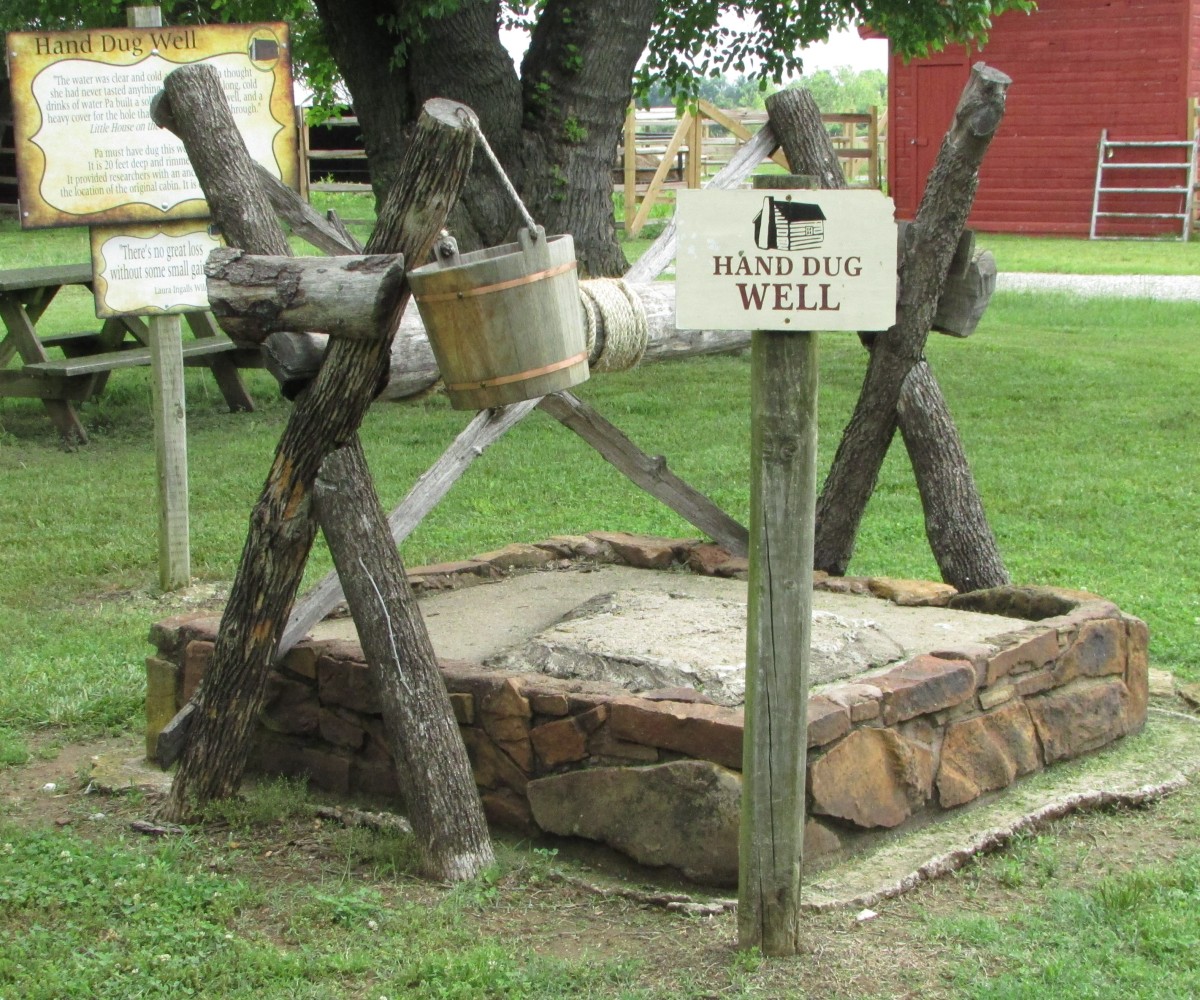
There is, however, a hand dug well on the property, which was probably dug by Charles Ingalls and one of his neighbors. The existence of this well helped researchers during the 1960s decide that this was where the Ingalls family lived, since the first legal land filings were in 1871, after the Ingalls had left the area to move back to Wisconsin. I sat a bit in the back yard to look at the hand dug well with rocks around it. I thought I should stay a while, since it had taken a long time to get here. A long time in several different senses: First, the site is over 650 miles from my home, and I had done the trip by driving six hours to Rolla, then three hours to Joplin, then two hours to the site. Second, I had been planning to visit this site since I began my work on Laura Ingalls Wilder’s faith in 2016. Third, I’ve actually been reading and thinking about Laura since 1995. Finally, it must have taken the Ingalls family an incredibly long time to travel to this place. Google maps says that it is almost 650 miles from Pepin, Wisconsin.

The well has been filled with concrete, so one can’t look down into it. But one can imagine. The space surrounding the homestead is no longer that empty; U. S. Route 75 is visible in the distance, and there are other roads and trees in most directions. The land behind the property has folds and gullies; there are flat fields in front. Obviously, much has changed in the 150 years since the Ingalls family moved away. It was good to be there, looking at something that Charles Ingalls had made, and thinking about the passage of time.

In the hour I had been there, several older couples and one family with young children had arrived. So after a second brief conversation with Rhonda, I headed back to Independence. I wanted to find out if there were churches in the area when the Wilders were living there. So I went to the Independence Historical Museum. Sylvia Augustine is the Coordinator there, and she brought out a Montgomery County History published in 1995 that had information about the first churches founded in Independence. It turns out that Roman Catholic missionaries had reached out to the Osage in previous decades, and they established a mission station in Independence in 1869. Father John Schoenmakers was taking the sacraments to Catholic settlers that year and the next. A group of Methodists also began meeting for worship in Independence several times a month in 1869. As the white population of both Independence and the land around it increased, more churches were planted; by the time the Ingalls left the area, there were Baptist and Presbyterian congregations meeting in Independence. It does not appear that the Ingalls had any contact with these groups. I was grateful for Sylvia’s assistance.

On my way out of town, I pulled off U. S. Route 160 to a county road with an incredibly scenic bridge over the Verdigris River. I took some pictures of the river, and some of the bridge. I then continued east between fields of pastureland and corn, back towards Missouri. I had appointments at the Laura Ingalls Wilder Historic Home and Museum in Mansfield the next morning, which I will describe in my next post.

Thanks again to my institution, Trinity Christian College, for funding my travel. Thanks to all of you for reading.

Links:

My post about research in Rolla last week

Little House on the Prairie Museum

Independence Historical Museum and Art Center

Trinity Christian College

The Long Winter and the Coronavirus

This book probably read differently when it was released in 1940.

I wrote a first draft of this on Friday, May 1. The next day I learned that John Miller had died and I immediately began work on my tribute to him. My time since then has been dominated by videoconference meetings for my work at Trinity, and I wasn’t able to get back to this until yesterday. The piece seems dated now, since the weather is warmer, some states have reopen their economies, and there are more arguments in the states that haven’t. School is also now out for many American children. But I thought that I would edit and post it anyway.

I have remarked to members of my family and others that things read differently when one is living under a stay-at-home order. The book of Philippians in the New Testament reads differently when you think about the fact that the Apostle Paul wrote it while under house arrest in Rome. Other parts of the Bible also sound different given the reality in which we are living. Little House in the Big Woods sounded different when I read it several weeks ago. Yesterday I decided to read The Long Winter.

When I blogged about The Long Winter four years ago in February 2016 (it is hard to believe I’ve been doing this so long), I marveled at the tightness of the narrative in the book. Some glimpses at its artistry:

  • The first chapters describe Laura and Pa cutting and stacking the hay that saves their life later in the book by providing fuel for their fire.
  • Multiple events early in the book foreshadow the crisis that is to come, including the thickness of a muskrat’s house, a warning from an older Native American, an early blizzard, and Pa’s and Laura’s premonitions of disaster. A brooding malice is depicted as lurking behind even fine weather.
  • The description of peril when the schoolchildren have to walk home in a blizzard is gripping.
  • The depictions of privation are vivid. The Ingalls family goes to bed early to save coal and kerosene, eats the same food again and again, and eventually must spend all their time just grinding grain and twisting hay to get enough food and fuel to survive.
  • The structure of the book is relentless: first there is no meat, then no coal, then no kerosene. Hopes are pinned on the arrival of the next train again, and again, and again. Then on page 213, Pa says “I hate to tell you… The train isn’t coming.” That chapter ends “The wheat and the potatoes were not enough.” (224) Later, Laura asks, “Ma, will we starve?” (243)
  • The narrative reaches its nadir when Pa’s fingers are too cold to play the fiddle, the activity that has always rallied the family’s spirits in earlier books.

I find the book to be incredibly effective fiction, even for adults, especially those with families.

I can imagine that this book read differently when it was released in 1940. The generation that had lived through the Great Depression and read it for the first time during the Second World War understood peril and privation in ways that our generation does not. Or perhaps not until now. Peril has been brought home to us in media reports and stories from acquaintances about the coronavirus. Privation may be coming, for the millions of Americans who have lost their jobs or even for society more broadly.

Interesting comparisons in the book to our current situation:

  • In the first half of the book, Ma serves as the voice of naïve optimism in the face of realities that she would rather not face. She repeatedly says that surely, now there will be good weather for a while. Pa and Laura are more realistic interpreters of reality; they understand that it will remain bad for quite some time.
  • Before the situation becomes dire, the school-age children continue their studies from home. Their motivation is primarily internal, although Ma is a driving force as well. Their concern is to not fall behind their classmates.
  • The book also speaks for the enduring value of the arts. One chapter gives examples of how literature can inspire courage, especially poetry. Throughout the book, music is a source of inspiration, comfort, and hope.

Christianity and faith are depicted in many ways. In the first chapter, Pa explains to Laura that God tells muskrats when to build houses with thicker walls. Scripture is quoted three different times: Psalm 55:6, Psalm 23, and Proverbs 16:18. Laura’s schoolteacher opens the day by reading Psalm 23. Bedtime prayers are mentioned four different times. To pass the time during a blizzard, Mary, Laura, and Carrie have a contest to see how many Bible verses they have memorized. When the mail is anticipated, we are told that Ma looks forward to receiving church papers (probably the Christian Advance). The Ingalls family receives a letter and later a Christmas barrel from Reverend Alden’s church in Minnesota. Carrie gazes at a Sunday school card with a picture of the Good Shepherd. Laura and Mary pray for the safety of Almanzo Wilder and Cap Garland during their trip to locate food for the starving town. The family sings portions of at least ten different hymns. Finally, at the end of the book, as the family sits down to a loaded table for a belated Christmas dinner in April, Pa thanks God for his bounty. All in all, the book is by far the Little House book that mentions faith and Christianity the most.

This is where the original post came to an end. It does feel like the world has moved on from where it was when I wrote this. The weather is warmer, the daily number of new cases of COVID-19 and deaths have dropped significantly. Many in Illinois are talking about reopening soon—some to celebrate the idea, some to condemn it. It’s too bad that the COVID crisis can’t end the way that it did in The Long Winter: quickly and neatly. Less than twenty-five pages after Laura hears the chinook blowing, the train has arrived, the cupboards are filled, God has been thanked, and the book has concluded.

Thanks much for reading.

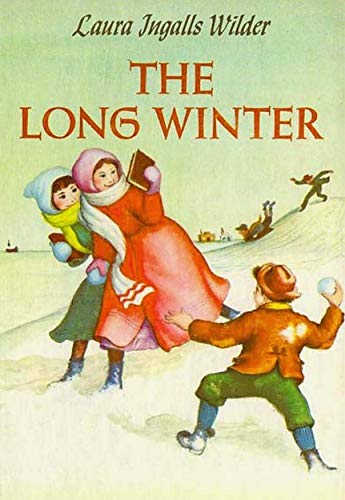
[Page numbers are from the 1953 edition of the book: Laura Ingalls Wilder, The Long Winter, illustrated by Garth Williams, revised edition (New York: Harper and Row, 1953)—the edition with the snowball fight on the front that gives an entirely incorrect feel for the contents of the book…]

Links:

Trinity Christian College

Tribute to John Miller

Original post on The Long Winter from 2016


John E. Miller, 1945-2020

John Miller passed away last Friday. John was an excellent historian, a prolific writer, and a kind and good man. There have been a number of biographies and tributes to his accomplishments online (links are at the bottom of this page), including his contributions to South Dakota History and Laura Ingalls Wilder studies. This is the story of what he meant to my life and career, in five accounts of how he went out of his way to help me with my research:

One. During the mid-1990s, I was in graduate school at Duquesne University in Pittsburgh and writing about Laura Ingalls Wilder. In the course of my research, I contacted the two most prominent living experts on Wilder: William (Bill) Anderson in Michigan and John Miller in South Dakota. Both wrote back, and this started an email correspondence that has lasted to this day.

At the time, I was making the mental transition that most make when they have read the Little House books and then do research on Wilder’s life: one must realize that not everything in the novels is exactly how it happened. The Little House books are so straightforward and sound so authoritative that one comes to believe that this must have been exactly how it was. By the 1990s, however, through the work of Anderson, Donald Zochert, and others, it had become clear that this was not the case. The world of those who love the Little House books had also been rocked by the publication of The Ghost in the Little House by William Holtz. Holtz argued that most of what we love about the Little House books had been provided by Laura’s daughter Rose Wilder Lane—Rose was, in effect, a ghost-writer for the series.

John Miller encouraged me as I waded into these interpretive waters. He was writing a biography of Laura for the University of Missouri Press (in the same series as Holtz’s book), and he assured me that he had looked at the original manuscripts of the Little House Books and thought that they were a collaboration, not that Rose was a ghost writer. There was nothing in it for John to write long emails answering questions about Wilder and Midwestern history for a student in Pennsylvania. He was busy with his teaching at South Dakota State University and writing Becoming Laura Ingalls Wilder. But his help and encouragement enabled me to finish my Master’s degree and get accepted to the Ph. D. program at the University of Iowa.

Two. In the summer of 2000, the Organization of American Historians held a regional conference in Ames, Iowa on the history of the Midwest. Both John and I presented papers at the conference. My paper was on Midwestern farm newspapers, the topic of my dissertation, and their recommendations for the rural church. John’s paper was on Midwestern small-town boys who had gone on to influence national life, including Johnny Carson and Ronald Reagan (this research led later to Small Town Dreams: Stories of Midwestern Boys who Shaped America).

When I found out that John was going to be at the conference, I asked if he would read my dissertation prospectus and give me comments on it. I was hoping to defend it before my dissertation committee that fall, and I knew that John would give me good recommendations. John said to send it and we’d have dinner together at the conference to talk about it. I don’t remember exactly what advice he gave, but I know that it included both encouragement and constructive criticism. Again, there really was nothing in it for him to read a fifty page document and prepare a list of comments, questions, and suggestions for a graduate student at another institution. But he did exactly that for me.

Three. Early in 2010, I saw an announcement that the first LauraPalooza Conference was going to be held in Mankato, Minnesota, that summer , and that both Bill and John would be speaking at it. My institution, Trinity Christian College, provided me funding to attend. I went so I could see John, meet Bill in person, and hear what people were saying. I was in the middle of a book project, hoping to get a publisher to accept a memoir I was editing by a woman from Iowa who homesteaded in Wyoming during the 1910s.

LauraPalooza has since been held four more times. It is partially an academic conference and partially a fan celebration of everything Little House: books, television series, historical sites, and memorabilia. The last day of the conference in 2010, most of the sessions were dedicated to craft, homeschooling, and educational uses of the Little House books. So John suggested that he and I go to downtown Mankato to find some used bookstores. He drove and we talked about my book and the several research projects he was working on at the time. He then decided that we should go to a small publisher (I think it was Minnesota Heritage Publishing) to see if there was an editor there that we could talk to about my book and one of his (there wasn’t). Then we went out to lunch together. We talked about history, the Midwest, our teaching, and politics. John had gone from being mainly a mentor to being a good friend.

Four. I got back in touch with John after my book Almost Pioneers had been published and I had decided that my next project would be about Wilder. We saw each other twice in 2017, the one hundred and fiftieth anniversary of Laura’s birth in 1867. The first time was in Sioux Falls, South Dakota, at a conference sponsored by the South Dakota State Historical Society. The second was in Springfield, Missouri, at LauraPalooza 2017. He spoke at both conferences; I just spoke at the second. In 2018, I did a research trip to the upper Midwest, stopping in Burr Oak, Iowa, Pepin, Wisconsin, Walnut Grove, Minnesota, and De Smet, South Dakota. The night before I went to De Smet, I stayed with John and his wife Kathy in Brookings. We talked late into the night.

The next morning, I followed him to De Smet and he took me to the church building that Charles Ingalls had helped build, and to the De Smet News, where he introduced me to the editor. We then went to the Laura Ingalls Wilder Memorial Society, where he introduced me to the director. John and I then sat reading materials from their archives all morning. I was looking for material about Laura’s faith. I can’t remember what he was looking for, but he was thinking he might write another article about Laura sometime. He left before lunch to go home for a church meeting. I stayed a bit longer, took the tour of the homes in De Smet, and visited the Ingalls Homestead. I greatly appreciated the time that he took to help me with my research, even though he was busy.

Five. In the fall of 2018, John suggested that he and Bill Anderson and I do a panel at the 2019 Midwestern History Conference in Grand Rapids, Michigan. Bill said that we should all tell our stories about how we came to write about Laura. Thus was born “‘Everyone Has a Wilder Story:’ Laura Ingalls Wilder, the Midwest, and Historical Research.” I have never had such a good time in a session at a conference. Bill has told me several times that he is concerned that I will not find enough information to write a biography of Laura that pays particular attention to her faith. John never doubted that I would be able to do it. He encouraged me in my project at every step. This conference was the last time that I saw John. I thought that when I was done with my manuscript, that I would be able to ask John to read it and let me know what he thought. Now I won’t be able to.

John was a historian, a teacher, a scholar, a husband, a father, a churchman, and a good man. To me, he was both a mentor and a good friend. It is a blessing that he published so much; we still have some access to his keen mind and gracious spirit. I trust that I will see him again someday. Right now, I am very sad that he is gone.

Thanks for reading.

Links:

My blog entries that mention John or his work on Laura

John’s Amazon Page

John’s Obituary

Tributes: Argus-Leader, South Dakota Magazine, Capital Journal, South Dakota Governors (1), South Dakota Governors (2)

Duquesne University

The University of Iowa Department of History

LauraPalooza 2010, LauraPalooza 2012, LauraPalooza 2015, LauraPalooza 2017, LauraPalooza 2019

Trinity Christian College

Minnesota Heritage Publishing

South Dakota State Historical Society 2017 History Conference

2019 Midwestern History Conference

The Big Woods and COVID-19

“She was glad that the cozy house, and Pa and Ma and the firelight and the music, were now. They could not be forgotten, she thought, because now is now. It can never be a long time ago.” (95)

It was just over a month ago when the administration of Trinity Christian College, where I work, announced that due to COVID-19, courses for the rest of the spring semester would be conducted online, all of the resident students had to move home, and all spring events on campus (athletic, theater, music, art, etc.) were canceled. It was Thursday, March 12. The announcement came at noon, and the Chaplain’s office quickly organized a final worship service that afternoon as a way for students, faculty members, and staff members to communally grieve the losses that confronted us and express our trust in God and our Lord Jesus Christ. I found my daughter, who is a senior at Trinity, and she put her head on my shoulder and we cried together. That event now seems like a long time ago.

The next week, the Governor of Illinois issued a stay-at-home order. I moved enough out of my office to teach and do my work as an Academic Dean from home. My oldest son was sent home from his college in Pennsylvania to finish the semester online, and plans were underway for my two sons who are in high school to begin online classes. So my four children and I are now all doing online education. So far the bandwidth has held out. My wife is also at home because her work as a nanny and a volunteer at a thrift store both were suspended. Everyday life at my home during the last month has been transformed completely. Now is now.

I would not want to put my losses up against others who have lost a lot more. I am able to work from home and receive a paycheck. Although they have lost paying jobs at their schools, several of my children work at a local greenhouse which is still open, so they can still make some money for college. And there have been compensations. There are six people at the table every day for dinner. My wife has been baking large loaves of delicious homemade bread that we’ve been toasting and covering with the apple butter she made and canned last fall. There is more time for board games in the evening. We have popped corn and watched movies together. There are livestream services on Sunday morning and evening, and Sunday School, Youth Group, and mid-week Bible studies online.

Several weeks into the online, stay-at-home version of life and work, Bill Anderson (William Anderson, author and probably the greatest living authority on Laura Ingalls Wilder) emailed me a link for a New Yorker article that mentions Little House in the Big Woods in relation to the author and her family’s entry into quarantine in London. Margaret Mead, a long-time author for the New Yorker, she speaks of how her husband, her son, and her three stepsons, had all loved the book when they were children. Mead read the book out loud to her son again, and they decided to grow some vegetables in their window boxes. She ends by describing her stepson who lives in rural upstate New York with his partner and their son.

Last week, I got an email from a librarian at the Christian college I attended in Pennsylvania (and where two of our sons will be attending this fall). It included a link to a blog entry from a young Christian woman reflecting on the importance of stories when confronting new realities, like COVID-19. She specifically mentions the Little House books and the Lord of the Rings trilogy by J. R. R. Tolkien.

In between these emails, I was contacted by Jared Burkholder, a historian at a Christian college in Indiana. He is teaching an online course on the History of the American West and wondered if we could record an interview about Laura Ingalls Wilder and the Little House books that he could have his students watch. I said I’d be glad to do so. We recorded the interview this past Monday, using Zoom. It was a lot of fun.

One of the questions he asked me about concerned reasons for the persistent popularity of the Little House books. I thought about the New Yorker author and the Christian blogger and said that I thought that the books combine two features that are often seen as appealing to either the cultural right or the cultural left: an incredibly attractive vision of family life and loving depictions of wilderness and the natural world. Cultural conservatives are often drawn to the Little House books’ depictions of the nuclear family. Pa represents the male head of household and the provider; Ma is the civilizer of the home. Together they support their children, and the books describe how real girls and young women feel when confronted with real challenges in growing up. Cultural liberals and environmentalists are drawn to the books’ detailed and evocative descriptions of wilderness, wild animals, and the landscape of the American west. And in fact, both of these things transcend cultural (and political) categories. Mead, who I would think leans to the left, appreciates Big Woods’s description of a happy home. I lean to the right and love the Little House books’ description of the physical environment, animals, and nature. The result is that the books continue to speak to tens of thousands of people.

So I decided to read Little House in the Big Woods yesterday and think about what it might say to the world in which I live today, the world shaped by COVID-19. It was especially appropriate for me to do it yesterday morning, because an April storm had caused several inches of snow to fall in Chicagoland. I immediately identified with the events in Chapter 7, “The Sugar Snow,” except we don’t have any real maple syrup in the house. I was again amazed at the book’s detailed descriptions of how food was prepared and preserved, its depictions of how young children feel and act, and its vision of how a family could feel they had everything they need, even as they have so much less than we do today. This is the accomplishment of the collaboration between Laura Ingalls Wilder and her daughter Rose Wilder Lane: many people today, 150 years after the events depicted and almost 100 years after the words were written, can identify with the stories. When I’ve been surprised by the usefulness of an online tool during the last several weeks, I’ve found myself thinking—like Pa did of the mechanical thresher in Chapter 12, “That machine’s a great invention!” (91) The very next chapter (the last of the book) depicts Pa’s love for natural beauty and wildlife as being so great that he is unable to shoot the deer or bear that walked into the clearing where he was hunting to bring home meat for his family. When he tells Ma and the girls, Laura says “I’m glad you didn’t shoot them!” and Mary adds “We can eat bread and butter.” (94) I agreed.

As a historian, I know that the world that is created in Little House in the Big Woods was not exactly how it was for Laura Ingalls Wilder during the years that she and her family lived in the log cabin outside of Pepin, Wisconsin. They had relatives and neighbors much nearer than the book suggests.  But ultimately, Little House in the Big Woods is a book of stories, and stories can teach even when they are not historically accurate.

I may try to read The Long Winter next week as a different way into the COVID-19 quarantine experience.

I realize that this entry has been mostly about me. Thanks for reading anyway.

(Quotes and page numbers are from Laura Ingalls Wilder, The Little House Books, edited by Caroline Fraser, Volume I (New York: Library of America, 2012).

Links:

Trinity Christian College, where I work.

Geneva College, where two of my sons will attend next fall, Lord-willing

Margaret Mead, “Returning Once More to a Little House in the Big Woods,” New Yorker, March 4, 2020.

Venia “On Stories and Facing a Quarantine,” Sola Gratia, April 3,

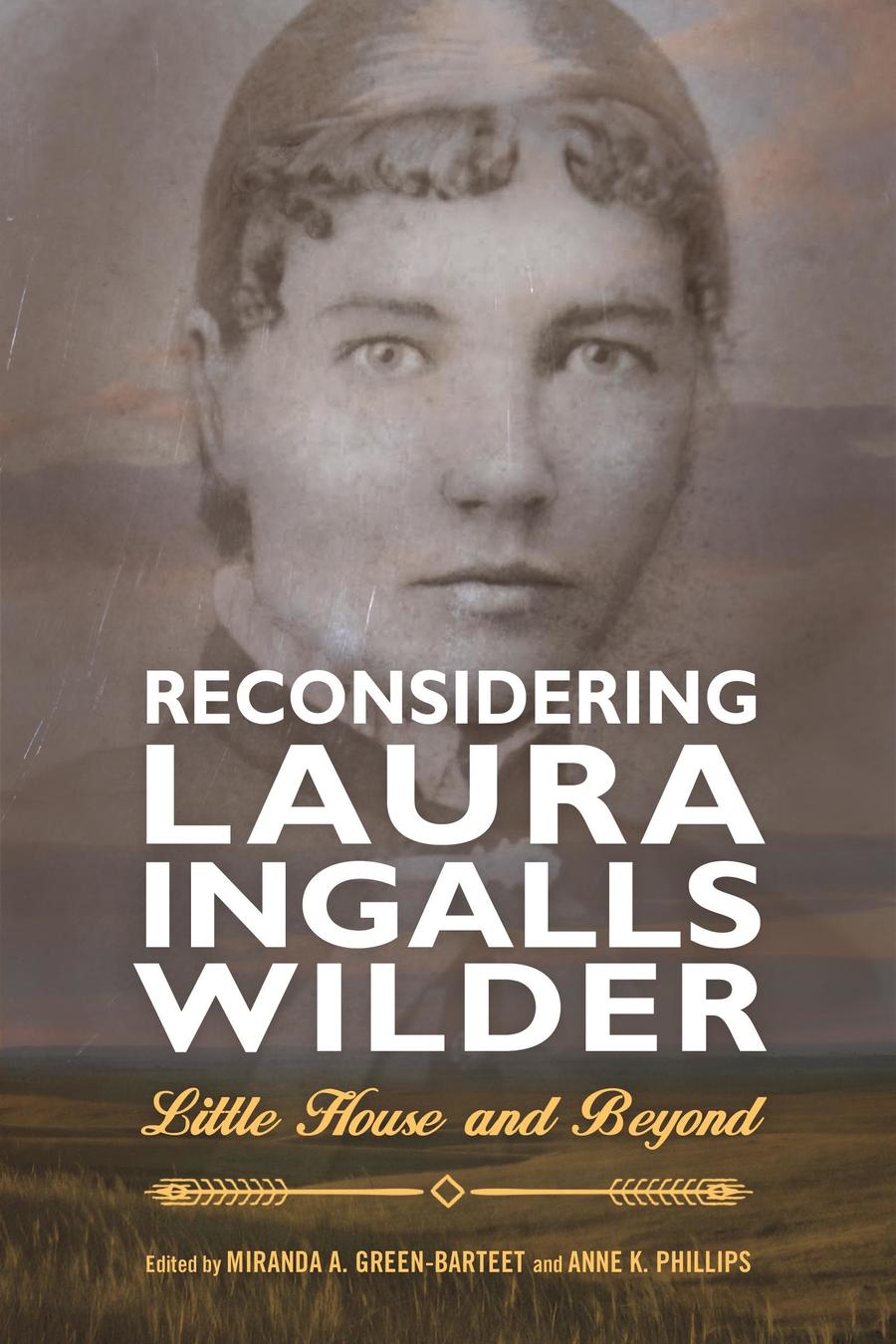
Reconsidering Laura Ingalls Wilder

When I sat down to write this entry, I was shocked to realize that it has been five months since I have contributed anything to The Faith of Laura Ingalls Wilder. Actually, I wasn’t shocked. I knew that it has been a long time. But I have tried to keep doing some reading about Laura Ingalls Wilder. During this semester, that has meant reading a couple of essays in Reconsidering Laura Ingalls Wilder: Little House and Beyond each week. I finished the book yesterday.

Published by the University of Mississippi Press earlier this year, Reconsidering Laura Ingalls Wilder contains fifteen essays by scholars, and it presents some of the most recent academic scholarship on Wilder and the Little House books. Most of the authors are literature scholars; several have degrees in creative writing, American studies, women’s studies, and gender studies. There are no historians. Like most books of essays, I found some of the pieces to be stronger than others. Five stood out to me as providing particularly helpful examinations of Wilder’s writing:

  • Keri Holt and Christine Cooper-Rompato, “The Complicated Politics of Disability: Reading the Little House Books and Helen Keller.” The authors examine the Little House books’ depiction of Mary’s blindness, which is central to the later novels. They point out that the ways that the books depict Mary’s contributions to family life show her “individualism, self-sufficiency, and independence,” (35) which was a contrast to most other children’s books’ depictions of people with disabilities. These traits were also stressed by Helen Keller in her writing during the early twentieth century. Ironically, however, both Wilder and Keller stressed independence and distanced themselves from outside support; the Little House books do not mention that Dakota Territory paid for Mary’s tuition at the Iowa School for the Blind, and Keller often publicly refused monetary gifts and quietly accepted them later. I greatly appreciated Holt and Cooper-Rompato’s nuanced description of the complicated nature of these individuals’ lives and works.
  • Vera R. Foley, “Naked Horses on the Prairie: Laura Ingalls Wilder’s Imagined Anglo-Indian Womanhood.” This essay provided a close reading of Laura’s interactions with horses in the Little House books and The First Four Years. Foley describes Laura as “a young girl caught between the influence of a genteel mother and an unstable frontier.” (51) The result, Foley argues, was that Laura embraced an outdoor, active femininity, not Ma’s domesticity. (49-50) A key part of how the books describe this process involves horses: from the Indians riding away on ponies at the end of Little House on the Prairie, to her racing with Lena across the plains in By The Shores of Silver Lake, to her courtship which is conducted almost exclusively on buggy and sleigh rides, to her riding of Trixy in the First Four Years. Fascinating.
  • Jenna Brack, “Her Own Baby: Dolls and Family in ‘Indians Ride Away.’” This essay presents the most multidimensional explanation of Laura’s shocking demand for a Native American baby at the end of Little House on the Prairie that I have read. You may not agree with her interpretation; I don’t agree with it completely. Unfortunately, it is impossible to describe in a short space.
  • Jericho Williams, “Breathing Literary Lives from the Prairie: Laura Ingalls Wilder and the Promises of Rural Women’s Education in the Little House Series.” This essay compares the description of Laura’s career as a teacher to depictions of teachers in Hamlin Garland’s Rose of Dutcher’s Coolly and Willa Cather’s The Song of the Lark. While the female protagonists in Garland and Cather’s books leave their small towns for success in urban areas, Wilder’s works reject the idea that “rural women lead inferior lives.” (134) Williams continues: “In Wilder’s view, rather than just a means for talented women to leave their hometowns, education is a multifaceted process that consists of learning rural arts and skills, living within one’s means, adapting to one’s environment, and assisting one’s family members and community.” (134) I think that this is an insightful statement about key aspects of Laura’s overall worldview, not just her view of education.
  • Christiane E. Farnan, “The Undergraduate American Studies Classroom: Teaching American Myths and Memories with Laura Ingalls Wilder.” Farnan has her college students read Little House in the Big Woods, Farmer Boy, and Little House on the Prairie in conversation with other classic books about farming and the frontier by Mary Rowlandson, Thomas Jefferson, Hector St. John Crevecoeur, Horace Greeley, Frederick Jackson Turner, James Agee and Walker Evans, and Henry Nash Smith. The essay asserts that her current students easily understand Big Woods and Farmer Boy as depictions of the agrarian ideal, but they often interpret Little House on the Prairie as a critique of Native American removal and agrarian occupation. Pa uproots his family, takes them into danger in many forms (the frozen lake, the high river, fire, wolves, hostile Native Americans), then abandons all of their work because of a rumor. Nobody is better off at the end of the book. It was a reading that I hadn’t thought about before, and not one that I especially share, but I can see how her students come to it.

Unfortunately for my particular project, most of the authors ignore religion and faith. The one significant consideration is in Anna Thompson Hajdik’s “The Wilder Mystique: Antimodernism, Tourism, and Authenticity in Laura Ingalls Wilder Country,” a review of the development of some of the Wilder historic homesites and an examination of some of the sources of their appeal during the late twentieth and early twenty-first centuries. Hajdik notes the importance of the books to Christian homeschooling families and the Amish. The homeschooling connection has been mentioned by other authors (and I have numerous personal examples), but this is the first time I’ve read about the Amish. The citation for this observation was a personal conversation from 2006.

Reconsidering Laura Ingalls Wilder provides a number of fresh looks at the Little House books. I was pleasantly surprised that the authors are willing to consider the works on their own terms, not just condemn them for not living up to how people today would deal with the subject matter. It does not provide any new biographical or historical information about Wilder, but it does provide some new and interesting ways to approach Wilder’s work.

As always, thanks much for reading.

(All citations are from: Reconsidering Laura Ingalls Wilder: Little House and Beyond. Edited by Miranda A. Green-Barteet and Anne K. Phillips. Jackson: University of Mississippi Press, 2019.)

Publisher’s site and picture credit: https://www.upress.state.ms.us/Books/R/Reconsidering-Laura-Ingalls-Wilder