All Blog Posts

Reconsidering Laura Ingalls Wilder

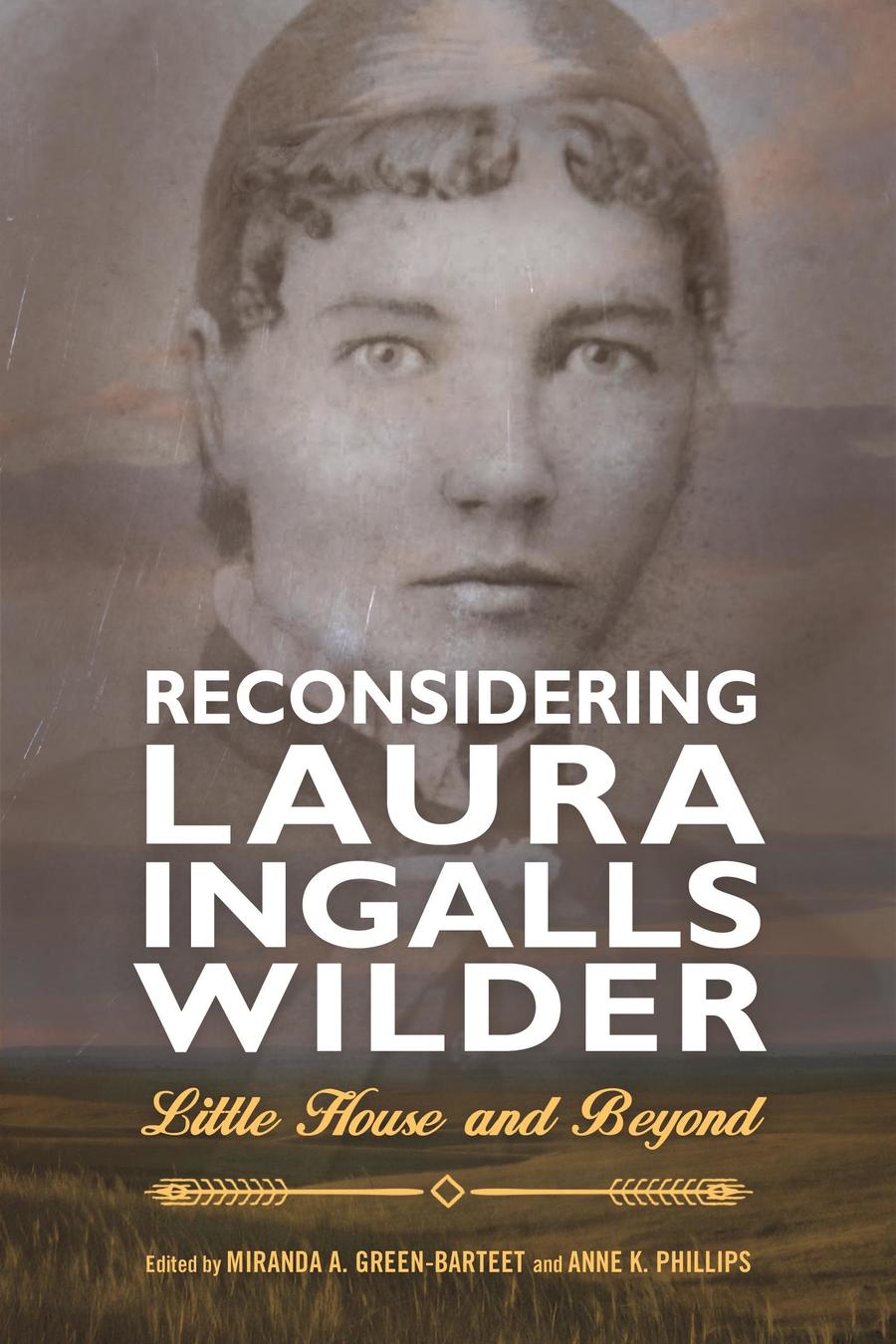
When I sat down to write this entry, I was shocked to realize that it has been five months since I have contributed anything to The Faith of Laura Ingalls Wilder. Actually, I wasn’t shocked. I knew that it has been a long time. But I have tried to keep doing some reading about Laura Ingalls Wilder. During this semester, that has meant reading a couple of essays in Reconsidering Laura Ingalls Wilder: Little House and Beyond each week. I finished the book yesterday.

Published by the University of Mississippi Press earlier this year, Reconsidering Laura Ingalls Wilder contains fifteen essays by scholars, and it presents some of the most recent academic scholarship on Wilder and the Little House books. Most of the authors are literature scholars; several have degrees in creative writing, American studies, women’s studies, and gender studies. There are no historians. Like most books of essays, I found some of the pieces to be stronger than others. Five stood out to me as providing particularly helpful examinations of Wilder’s writing:

  • Keri Holt and Christine Cooper-Rompato, “The Complicated Politics of Disability: Reading the Little House Books and Helen Keller.” The authors examine the Little House books’ depiction of Mary’s blindness, which is central to the later novels. They point out that the ways that the books depict Mary’s contributions to family life show her “individualism, self-sufficiency, and independence,” (35) which was a contrast to most other children’s books’ depictions of people with disabilities. These traits were also stressed by Helen Keller in her writing during the early twentieth century. Ironically, however, both Wilder and Keller stressed independence and distanced themselves from outside support; the Little House books do not mention that Dakota Territory paid for Mary’s tuition at the Iowa School for the Blind, and Keller often publicly refused monetary gifts and quietly accepted them later. I greatly appreciated Holt and Cooper-Rompato’s nuanced description of the complicated nature of these individuals’ lives and works.
  • Vera R. Foley, “Naked Horses on the Prairie: Laura Ingalls Wilder’s Imagined Anglo-Indian Womanhood.” This essay provided a close reading of Laura’s interactions with horses in the Little House books and The First Four Years. Foley describes Laura as “a young girl caught between the influence of a genteel mother and an unstable frontier.” (51) The result, Foley argues, was that Laura embraced an outdoor, active femininity, not Ma’s domesticity. (49-50) A key part of how the books describe this process involves horses: from the Indians riding away on ponies at the end of Little House on the Prairie, to her racing with Lena across the plains in By The Shores of Silver Lake, to her courtship which is conducted almost exclusively on buggy and sleigh rides, to her riding of Trixy in the First Four Years. Fascinating.
  • Jenna Brack, “Her Own Baby: Dolls and Family in ‘Indians Ride Away.’” This essay presents the most multidimensional explanation of Laura’s shocking demand for a Native American baby at the end of Little House on the Prairie that I have read. You may not agree with her interpretation; I don’t agree with it completely. Unfortunately, it is impossible to describe in a short space.
  • Jericho Williams, “Breathing Literary Lives from the Prairie: Laura Ingalls Wilder and the Promises of Rural Women’s Education in the Little House Series.” This essay compares the description of Laura’s career as a teacher to depictions of teachers in Hamlin Garland’s Rose of Dutcher’s Coolly and Willa Cather’s The Song of the Lark. While the female protagonists in Garland and Cather’s books leave their small towns for success in urban areas, Wilder’s works reject the idea that “rural women lead inferior lives.” (134) Williams continues: “In Wilder’s view, rather than just a means for talented women to leave their hometowns, education is a multifaceted process that consists of learning rural arts and skills, living within one’s means, adapting to one’s environment, and assisting one’s family members and community.” (134) I think that this is an insightful statement about key aspects of Laura’s overall worldview, not just her view of education.
  • Christiane E. Farnan, “The Undergraduate American Studies Classroom: Teaching American Myths and Memories with Laura Ingalls Wilder.” Farnan has her college students read Little House in the Big Woods, Farmer Boy, and Little House on the Prairie in conversation with other classic books about farming and the frontier by Mary Rowlandson, Thomas Jefferson, Hector St. John Crevecoeur, Horace Greeley, Frederick Jackson Turner, James Agee and Walker Evans, and Henry Nash Smith. The essay asserts that her current students easily understand Big Woods and Farmer Boy as depictions of the agrarian ideal, but they often interpret Little House on the Prairie as a critique of Native American removal and agrarian occupation. Pa uproots his family, takes them into danger in many forms (the frozen lake, the high river, fire, wolves, hostile Native Americans), then abandons all of their work because of a rumor. Nobody is better off at the end of the book. It was a reading that I hadn’t thought about before, and not one that I especially share, but I can see how her students come to it.

Unfortunately for my particular project, most of the authors ignore religion and faith. The one significant consideration is in Anna Thompson Hajdik’s “The Wilder Mystique: Antimodernism, Tourism, and Authenticity in Laura Ingalls Wilder Country,” a review of the development of some of the Wilder historic homesites and an examination of some of the sources of their appeal during the late twentieth and early twenty-first centuries. Hajdik notes the importance of the books to Christian homeschooling families and the Amish. The homeschooling connection has been mentioned by other authors (and I have numerous personal examples), but this is the first time I’ve read about the Amish. The citation for this observation was a personal conversation from 2006.

Reconsidering Laura Ingalls Wilder provides a number of fresh looks at the Little House books. I was pleasantly surprised that the authors are willing to consider the works on their own terms, not just condemn them for not living up to how people today would deal with the subject matter. It does not provide any new biographical or historical information about Wilder, but it does provide some new and interesting ways to approach Wilder’s work.

As always, thanks much for reading.

(All citations are from: Reconsidering Laura Ingalls Wilder: Little House and Beyond. Edited by Miranda A. Green-Barteet and Anne K. Phillips. Jackson: University of Mississippi Press, 2019.)

Publisher’s site and picture credit: https://www.upress.state.ms.us/Books/R/Reconsidering-Laura-Ingalls-Wilder
The Good Neighbor

During the last several weeks, my wife and I have been reading The Good Neighbor: The Life and Work of Fred Rogers, by Maxwell King. We read out loud to each other when we’re in the car or doing chores at home. I found out about the book in the alumni magazine from Duquesne University in Pittsburgh, where I received my M. A. in History. At Duquesne’s commencement this year, King and Rogers’s widow Joanne Rogers both received honorary doctorates. The book came out last year, and it’s the first full biography of Rogers.

I remember watching Mister Rogers’ Neighborhood when I was growing up in Western Pennsylvania in the early 1970s. At some point, I decided that I was too old, that the show was too slow, and that I liked Sesame Street and The Electric Company better. I did not realize that Rogers and his program were key to the development of WQED in Pittsburgh and Public Broadcasting nationally. This book sets Rogers’s life in context of the national development of educational television for kids. It also provides evidence that for many children – often those going through difficult life situations – watching Mister Rogers’ Neighborhood was a transformative experience.

Rogers grew up in the small town of Latrobe, Pennsylvania, east of Pittsburgh. He was the only child of a wealthy family, and he struggled with asthma and social awkwardness at school. So he often would go to his attic and play with puppets, writing elaborate scripts for puppet shows and performing them for his family. He also played the concert grand piano (!) that his grandmother bought for him. He got his B. A. in music, became a concert-level musician, and wrote an opera at Rollins College in Florida. After he graduated, he decided he wanted to work in broadcast television.

He began his career with NBC in New York City, then went to work for WQED, a public station in Pittsburgh. There he wrote and operated the puppets for The Children’s Corner for seven years. At the same time, he attended Pittsburgh Theological Seminary and became an ordained minister in the mainline Presbyterian Church with the call to serve the community through television. In 1963 he moved to Toronto and created Misterogers for the Canadian Broadcasting Company. He returned to Pittsburgh three years later and recreated the show for WQED. By the early 1970s, the show was broadcast nationally.

King’s book does an excellent job describing the influences on Rogers’ development, including his mother’s love, his father’s money, his grandparents’ encouragement, the outlet of music and puppetry, and the educational theory of Benjamin Spock, Erik Erikson, and especially Margaret McFarland. King is also at pains to explain that Fred Rogers was in real life who he was on the television screen: a kind, encouraging man who cared about everyone he met. He especially cared about children. Born into a wealthy family, he never wanted for anything, but he was not pretentious. He was highly creative and had a perfectionist streak, which at times led him to become angry with coworkers and with his own two sons. Finally, he was intensely dedicated to friends, and he put off getting treatment for the ailment that eventually killed him—stomach cancer—because he did not want to back out on commitments he had previously made to others.

The author, Maxwell King, was a journalist for the Philadelphia Inquirer for almost 30 years, eventually serving as Editor. He was then President of the Heinz Endowments, directed the Fred Rogers Center for Early Learning and Children’s Media at Saint Vincent College in Latrobe, and most recently was President and CEO of the Pittsburgh Foundation. Because he was writing the biography of a late twentieth century television celebrity, there are thousands of hours of shows and interviews, and reams of material to sift through. King’s training in journalism is evident, as he often allows his sources to tell the story: Fred himself, his wife Joanne, his coworkers, relatives, acquaintances, and fans of his work. However, this often means long sections of direct quotes, some of which repeat points made previously. While early chapters are chronological, later chapters are thematic, which also makes for quite a bit of repetition. Perhaps my wife and I noted this more because we were reading it out loud, but at the end of the book’s 360-plus pages of text, we thought that it might have been perhaps a 80-100 pages shorter.

There are some interesting comparisons between Fred Rogers and Laura Ingalls Wilder. Both created artistic works for children that had widespread influence almost immediately. Both used materials from their upbringing – Laura’s life story and Fred’s memory of his family’s neighborhood in small-town Latrobe. Both shared an upbringing and lifelong affiliation with the church, although Fred became a pastor and Laura never officially joined a congregation. The most striking difference between the two was the Rogers’s family’s wealth in comparison to the Ingalls’s family’s relative poverty.

I’ve been writing the chapter about Laura and Almanzo’s early years in Mansfield, Missouri, and that has brought me face to face with their daughter Rose Wilder Lane’s childhood. In fact, there might be more interesting comparisons between Fred Rogers and Rose Wilder Lane. Both were only children brought up in families with strong mother figures. Both were very artistic and creative individuals who followed their own paths. Ultimately, however, Fred was much more comfortable with who he was and a much more successful person. He never had to work for a living the way that Rose had to, and he didn’t face the difficulties or financial reverses that she faced. But I also think that his settled Christian faith provided ballast for the difficulties in life that he did face, and that kind of faith was one thing that Rose did not have for most of her adult life.

I certainly have a lot fewer sources for Laura’s life than King had for Fred’s, and I’m planning for my book to be much shorter than his. Caroline Fraser (Prairie Fires) has written the long and exhaustive book on Laura and Rose. I’m just hoping to tell their story in light of Laura’s faith commitments.

Thanks again for reading.

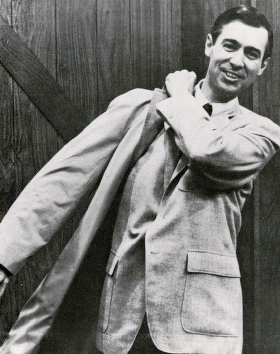
Picture credit: KHUT (CC0) at the Wikimedia Commons

Links:

Publisher’s site for The Good Neighbor

Duquesne’s May 2019 Commencement

Dr. Margaret McFarland

The Fred Rogers Center for Early Learning and Children’s Media at Saint Vincent College

Maxwell King

My blog entry on Caroline Fraser’s Prairie Fires

Homesteading the Plains

This month, I’ve been reading Homesteading the Plains: Toward a New History, by Richard Edwards, Jacob K. Friefeld, and Rebecca S. Wingo. I was able to finish it this week. The book was published in 2017 by the University of Nebraska Press. It is about the administration of the Homestead Act of 1862, which figures largely in the Little House books, especially the last four. The Homestead Act provided one hundred and sixty acres of land free from the Federal Government to anyone who would pay a small filing fee, build a house on the land, raise crops, and live there for five years.

The book begins with a fascinating paradox. In the popular imagination, the Homestead Act was an incredible success, providing ordinary people with access to free land and economic opportunity. In general, the works of authors such as Willa Cather, Elinore Pruitt Stewart, and Laura Ingalls Wilder depict its impact positively. (Stewart’s work was turned into the movie Heartland in 1979.) More recently, the Act has been praised by figures from both sides of the political spectrum; the book includes quotes from Barack Obama and George Will. (2-3) At the same time, academic historians normally see the Homestead Act as a failure. Scholars believe that 1) most homesteaders failed to prove up on their claims, 2) homesteading was full of fraud and corruption, and 3) homesteading caused Native American land dispossession. (13)

Which understanding of homesteading is correct?

The three authors of Homesteading the Plains attempt to answer this question, using several approaches. First, they examine the numbers in government reports used by previous history scholars to make their claims about the failure of the Homestead Act. Second, they investigate the way that the General Land Office enforced the provisions of the act. Third, and perhaps most importantly, they take advantage of the digitization of large numbers of homestead records and their free availability to researchers. Their team created a database of records for a study area of ten townships in two counties in Nebraska (five in each): Custer County in central part of the state and Dawes County in the northwest. A careful analysis of all of these sources enables them to consider the claims of scholars in detail.

By the end of the book, the authors recommend that scholars should revise their previous understanding of homesteading on pretty much all fronts:

– A majority of homesteaders did succeed in proving up and obtaining title to their land – by their estimate, between 56% and 69% of homesteaders between 1862 and 1880, and 55% of those between 1881 and 1900. (40)

– Scholars’ ideas about the frequency of fraud have been unduly influenced by anecdotes told by General Land Office administrators. Fraud was actually less than ten percent of claims – perhaps as low as 3.2%, no higher than 8.5%. (87) (Strikingly, the authors note that recent studies suggest that the incidence of fraud in the Medicare program averages about 8.3%.)

– In many states, homesteading was not part of the story of Native American land dispossession, because Indian land claims had been extinguished before large-scale homesteading began there. However, the authors admit that homesteading was deeply implicated in the western parts of North and South Dakota and the entire state of Oklahoma.

The authors also encourage scholars and those who write history textbooks to recognize the importance of the Homestead Act to the settlement of the west, to take note of what homesteading meant for women (both single women and widows), and to understand that homesteading always involved community building, not just individual effort.

I’ve been thinking about that 55% figure for success for homesteaders after 1881 and before 1900, because I’ve been working on the chapter in my book about Laura and Almanzo’s early years of marriage. Laura’s father, Charles Ingalls, was able to prove up on his homestead in 1886. However, Charles and his family moved to their house on Third Street in De Smet in 1887 and never again lived on the homestead. They sold their land outside of town in 1892. Almanzo Wilder also was able to prove up on his homestead, but debt, diphtheria, fire, and dry weather forced Laura and Almanzo off the farm and into town in 1890. How this happened is discussed in The First Four Years, the adult novel Laura wrote sometime in the 1930s but was not published until 1971, after she and her daughter Rose had passed away. Certainly, 55% is a majority of homesteaders, but it’s not an overwhelming majority. And those who did succeed in getting title to the land did not always stay on the farm.

The Homestead Act actually also comes in for a bit of abuse in the Little House books. The descriptions of how the Act works in the books set in Dakota Territory (especially By the Shores of Silver Lake, Little Town on the Prairie, and These Happy Golden Years) is not always positive. Pa’s description of homesteading as a “bet” against the Federal Government and the necessity of Mrs. McKee’s living on the homestead when her husband must work in town to support the family are two examples. This makes me wonder if Laura and Rose had ever read descriptions of some of the reports from the General Land Office during the late 1800s and early 1900s, or even whether they were aware of the work of Fred Shannon, a historian during the 1930s and 1940s who wrote a number of the negative descriptions of homesteading that have been quoted by subsequent authors. This is akin to the wonderings of those who write about Wilder concerning how much exposure Laura and Rose had to the ideas of historian Frederick Jackson Turner and his frontier thesis.

These are individual stories and concerns however. As far as the book goes, I think that Edwards, Friefeld, and Wingo do a superb job of supporting their claims. I hope that other researchers can make use of the digitized homesteading records in ways to continue to help us understand the experience of farmers on the plains during the late 1800s, both individually and in the aggregate.

As always, thanks for following along.

(Page numbers are taken from Richard Edwards, Jacob K. Friefeld, and Rebecca S. Wingo, Homesteading the Plains: Toward a New History [Lincoln: University of Nebraska, 2017].)

Links:

Homesteading the Plains

My blog entry for The First Four Years

2019 Midwestern History Conference

Last Thursday and Friday, I attended the Midwestern History Conference in Grand Rapids, Michigan. I had a great time.

The conference was sponsored by the Midwestern History Association and hosted by the Hauenstein Center for Presidential Studies at Grand Valley State University (GVSU). It was held at GVSU’s Pew Campus in downtown Grand Rapids.

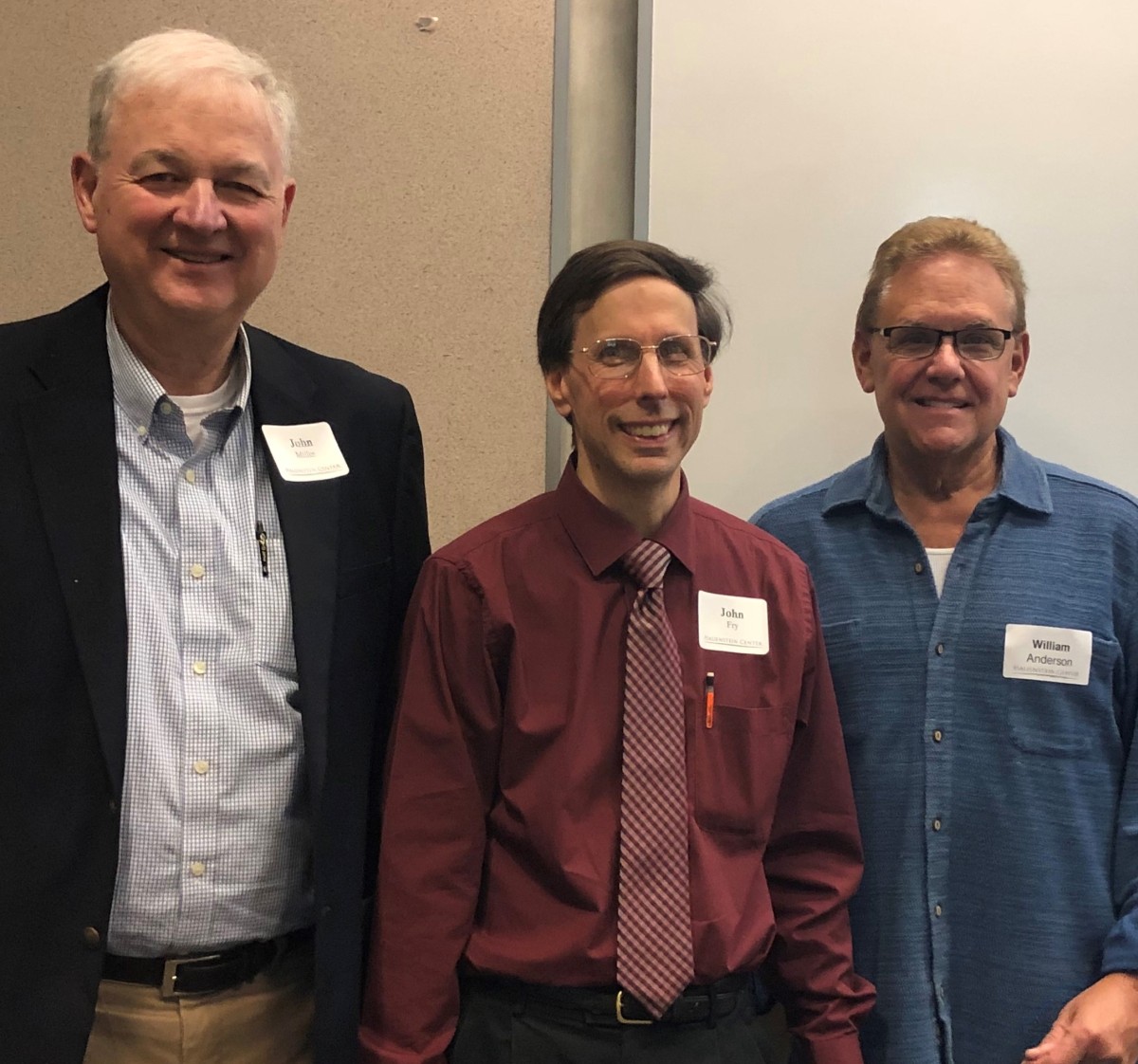
I presented on a panel on Thursday morning titled “‘Everyone Has a Wilder Story:’ Laura Ingalls Wilder, the Midwest, and Historical Research.” It was a privilege to join Bill Anderson and John Miller. We each told the story of how we came to research and write about Laura Ingalls Wilder. Bill has been writing about Laura since the 1960s and has published over twenty-five books. I have previously mentioned four on this blog (links are at the end). John has written three books about Wilder and De Smet, South Dakota, including the most scholarly biography to date, Becoming Laura Ingalls Wilder. They included me, even though I did not read the Little House books when I was a child and I did not grow up in the Midwest. There were around fifteen attendees at our session, which was respectable, given the fact that there were nine other sessions going on at the same time. (I attended other sessions with only five people in the audience.) Discussion during the Q&A was also robust.

I used some of my presentation to reflect on “Everyone has a Wilder Story” in a second way. I think that many people today have a story that they tell about Wilder – about who she really was, and about how we should understand her life and respond to it today. This “Wilder story” guides how they read the Little House books and Wilder’s other writings, and it guides how they view her legacy. So I used my presentation to roll out some possible “Wilder stories,” some tentative ways of understanding Laura’s faith. I don’t think that any of these will come as a surprise to regular readers of this blog

– First, Laura was a committed Christian, attended Christian worship services, read the Bible, and prayed her entire life. She engaged in Christian practices that built her relationship with God and Jesus Christ.

– On the other hand, she never publicly identified with an individual body of believers – she never officially joined any church.

– On a third (?) hand, the original, handwritten manuscripts of the Little House books have more straightforward and positive descriptions of God, Christianity, and the church than appear in the published Little House books. These accounts were changed—most likely by her daughter Rose, who was agnostic when they were written—into the more negative depictions that appear in the published books.

– On a fourth (!) hand, Laura can probably not be understood as an Evangelical Christian. Her descriptions of God, Christianity, and church emphasize God’s power, His laws, and individual moral choices. Her writings almost never mention Christ, forgiveness of sins, or salvation.

It’s complicated. The more I engage the faith of Laura Ingalls Wilder, the more I despair of having just one ‘Wilder story,’ or a simple way of describing her faith. But if I was to have to give an overarching narrative for Laura’s life, I might say that she believed that people do not live by bread alone. Bread is necessary, but faith, community, and family relationships are more important. There are ironies here, too. Her relationship to the church she attended and the community she lived in was often ambivalent. Her own relationship with her own daughter was marked by misunderstandings and, at times, open conflict. Yet in the midst of these difficulties, Laura and Rose together created, in the Little House books, an immensely attractive vision of human flourishing that influenced millions of Americans during the middle to late twentieth century.

Other highlights of the conference included Anna Lisa Cox’s plenary talk on Thursday night and a session I chaired on Friday about music in the Midwest. Many thanks to Trinity Christian College for a travel grant to go to the conference. Thanks also to David Zwart, who teaches at GVSU, for letting me crash at his place on Wednesday and Thursday night.

As always, thanks for following along.

Links:

2019 Midwestern History Conference

Hauenstein Center

Post on Bill Anderson’s Laura Ingalls Wilder: A Biography

Post on Bill Anderson’s The Selected Letters of Laura Ingalls Wilder

Post on Bill Anderson’s Little House Sampler and Little House Reader

Post on John Miller’s Becoming Laura Ingalls Wilder

Anna Lisa Cox

Trinity Christian College

David Zwart


Little Lodges on the Prairie

Those interested in the faith of Laura Ingalls Wilder would be forgiven if they assumed that this blog had gone dormant. Indeed, it did go dormant during the spring semester here at Trinity Christian College. My work as an Academic Dean at Trinity meant that I was involved intimately with the work of developing a new structure for the Foundations (core) curriculum at the College and getting it approved by the faculty. The Foundations committee met nine times during the fall semester. It met eighteen times during the spring semester. I was involved in dozens of other meetings with key faculty members across campus. The proposed new Foundations curriculum was approved by the faculty this month. Between Foundations work, teaching, and my other duties as an Academic Dean, I spent no time at all with Laura Ingalls Wilder materials between December and May 15.

As a result, it has been a blessing to jump back into work on the project during the last several weeks. After a little bit of a slow start, I was able to pick up where I had left off early last fall on Chapter 4 of the book. I finished a draft of Chapter four last week. I’m hoping to write drafts of at least two more chapters this summer. I’m also presenting a paper, along with Bill Anderson and John Miller, at the Midwestern Historical Conference at the end of this week. I pulled my paper proposal from consideration for LauraPalooza to make the summer less hectic; I may be helping my parents move.

Last week I was also able to read Little Lodges on the Prairie: Freemasonry and Laura Ingalls Wilder by Teresa Lynn. I met Teresa at LauraPalooza in 2017. Her research on Laura’s family, the Freemasons, and the Order of the Eastern Star touches many of the same sources and themes that mine does. Full disclosure: Teresa then sent me a free copy of her book last year. I had been looking forward to having the time to read it. It’s a delightful book.

About the first third of the book describes the history of the Freemasons and the Eastern Star and explains how the Lodge and the Order are organized. This was incredibly helpful. I grew up in a conservative Presbyterian church in Western Pennsylvania, and in my church when “secret societies” like the Freemasons were talked about, the normal assumption was that membership in one of those organizations was incompatible with Christianity. I wasn’t taught that Freemasonry involved the worship of Satan, although I have subsequently known Christians who did believe that. I think it was that the leaders of our church suspected an organization where people never revealed to others what went on in meetings. The idea was also that our first allegiance should be to God and to the church, and Freemasonry interfered with that. At any rate, it was intriguing to learn about how local chapters and Grand Chapters (state organizations) work, about the various offices in both the Masonic Lodge and the Order of the Eastern Star, and about the values that undergird the work of both organizations. This section of the book filled in many blanks in my understanding, first and foremost that only men can become Freemasons, while both women and men can be members of the Eastern Star, although some offices in the Eastern Star are reserved for women.

After giving an introduction to Freemasonry and the Eastern Star, the book narrates Laura Ingalls Wilder’s life, paying particular attention to the Lodges and chapters of the Eastern Star that touched it: in De Smet, South Dakota, in Keystone, South Dakota (where her sister Carrie lived much of her adult life), and in Mansfield, Missouri. Laura’s father, Charles Ingalls, petitioned to become a Mason in De Smet in 1885, several months after Laura’s marriage to Almanzo Wilder. In 1891, Laura’s mother and younger sister Carrie were charter members of the Eastern Star chapter in De Smet. Charles and Laura became members of the Eastern Star in 1893.

Laura and Almanzo moved to Mansfield in 1894, so it is there that most of their participation in the Lodge and Order occurred. Laura became a member of the Eastern Star chapter in Mansfield in 1897; Almanzo joined the Lodge in 1898 and the Eastern Star chapter in 1902. Between 1897 and 1931, when they demitted their membership (possibly to save money as the Depression deepened), Laura served as an officer over twenty-five times. She was Worthy Matron—essentially the President of the Chapter—three different times, attended Grand Chapter of Missouri meetings in Sedalia, Kansas City, and St. Louis, and even served as a district officer that visited other chapters and reported on their health to the Grand Chapter.

It is clear that Lynn has done her homework. She has read all of the chapter minutes for the De Smet, Keystone, and Mansfield Lodges and Eastern Star chapters for the years under study. She has also read the local newspapers—the De Smet News and the Mansfield Mirror—to supplement her chronology. The book reproduces sections of Lodge or Eastern Star Chapter minutes, newspaper articles, and pictures of the people being described. The narrative of Laura’s life follows that established by other biographers like Bill Anderson and John Miller. The book argues that the values of the Freemasons and Eastern Star—“family, faith, education, charity, courage, independence, patriotism, fortitude, and self-improvement” (272)—basically were Laura Ingalls Wilder’s values. It’s hard to disagree with this.

Teresa told me when we spoke in 2017 about a Watch Meeting that Laura had called on December 31, 1909. Here is how it is described in the book:

Watch meetings, also called watch night services, were first held by John Wesley, founder of the Methodist church. (The Wilders were attending the Methodist Church in Mansfield. Many other Chapter members were also Methodists.) The meetings generally included singing hymns, prayer, scripture reading, uplifting conversation, and reflection on the old year and resolutions for the new. The purpose of these meetings was to provide an alternative to the drunken parties often held on New Year’s Eve. (236)

This is fascinating, and I wouldn’t have known about it apart from Lynn’s research. It appears that there are a number of things about Laura’s life in Mansfield that we wouldn’t know apart from this book.

As I think about my project, I’m trying to understand Wilder’s formal membership in the Freemasons, the Eastern Star, and at least four other women’s clubs in Mansfield and Hartville, when she never officially became a member of any church. Previous biographers have noted that Laura and Almanzo never became a member of the Methodist Church in Mansfield. The more I study, the more indications I find that Laura never became a member of any church. For someone who went to church regularly her entire life, knew the Bible well, and prayed every night, I’m not exactly sure how to explain her refusal to formally join the body of Christ. I continue to think about what that might mean.

Thanks for reading.

(Quotes are from Teresa Lynn, Little Lodges on the Prairie: Freemasonry and Laura Ingalls Wilder (Austin, TX: Tranquility Press, 2014).

Links:

Trinity Christian College

Midwestern History Conference

LauraPalooza 2019

Little Lodges on the Prairie


Francis Schaeffer and the Shaping of Evangelical America

(Photo credit: Pete Unseth, Wikimedia Commons)

I know that I have not posted much this fall. My time has been taken up with Academic Dean duties here at Trinity Christian College. I had hoped to get some writing done on chapter four of my book, but that hasn’t happened. In other research project news, however, I did propose a paper for LauraPalooza 2019. John Miller, Bill Anderson, and I are also looking at doing a session proposal for the Midwestern History Conference. And last week, a group of professors at Trinity read the first chapter of my book and give me comments on it. I got some great critiques and words of encouragement.

Over Thanksgiving break I read a biography in the series from Eerdmans publishers that I’m writing for: Francis Schaeffer and the Shaping of Evangelical America by Barry Hankins. It’s a very good book. I met Hankins at a meeting of the Conference on Faith and History (CFH) a while ago. He is the Chair of the History Department at Baylor University in Texas. The book came out in 2008. Since then, he has written books on the 1920s, American Baptists, and Woodrow Wilson.

Francis Schaeffer was a Presbyterian pastor during the twentieth century. He became a missionary to Europe and ran a Christian study center called L’Abri in Switzerland from the 1950s to the 1970s. It became a place where young Europeans who were questioning the meaning of life could come and hear Christian answers to their questions. Francis talked with them, Edith made them meals, and they could stay as long as they wanted. The theme of his teaching was that only Christianity provided philosophically supportable answers to the most important questions of life. He spoke cogently about art, culture, philosophy, politics, and many other topics. Eventually, L’Abri employed a large staff and thousands of young people from the United States and Europe visited. InterVarsity Press turned some of his talks into books, and during the 1960s he spoke at many Christian colleges in the United States. A number of the students who heard him became Christian scholars and college professors as a result of his inspiration. In the 1970s his son Frank Schaeffer and he made two movie series: How Should We Then Live and Whatever Happened to the Human Race? The first gave a history of western thought and culture, described where it had gone wrong, and gave instructions for how Christians should respond. The second was about the dangers of abortion, infanticide, and euthanasia.

Hankins’s biography was a trip down memory lane for me. I grew up in a home and a church where people read Schaeffer’s books and talked about them. My Mom read books by Edith. I remember reading Schaeffer’s books—I can only remember Escape from Reason and A Christian Manifesto specifically, but I know that I read more—when I was in high school and college. Both movie series were shown at my church. I think that I would give Schaeffer some of the credit for why my best friend in high school and I both became academics (he’s now a Professor of Political Science). For us, Schaeffer made the idea of studying culture and history from a Christian perspective cool.

Once I became a historian, I went back and re-read several of Schaeffer’s books. I found that they have a number of historical arguments and assertions that I just don’t think are correct. Schaeffer wasn’t a trained historian. He was a pastor, and he tended to use stories about the past to make the points he wanted to make about the world, God, and Christian answers to life’s questions. Other Christian historians have also found his historical narratives wanting, even those who were launched on their path to becoming academic historians by hearing Schaeffer speak or reading his works. Hankins notes this. It’s a fascinating story.

As I read Hankins’s biography, I also thought a bit about its structure in relation to what I am planning for my book on Laura Ingalls Wilder’s life. In many ways, Hankins’s biography is very different than what I think mine will be. Only one small section of one chapter is about Schaeffer’s childhood, mainly because there are few sources about it. I am projecting that three of the eleven chapters in my book will be on Laura’s childhood. Also, three of the main chapters of Hankins’s work are thematic: they’re about Schaeffer’s works on 1) philosophy, 2) culture, and 3) the Bible. The chapters are not chronological; the time periods covered overlap. I think that my book will mainly be chronological, and the chapters will be pretty self-contained.

This is likely the last post that I’m doing during 2018. I hope that everyone has a blessed Christmas and a good start to 2019.

Links:

Trinity Christian College

LauraPalooza 2019 Call for Papers

Midwest History Conference Call for papers

Francis Schaeffer and the Shaping of Evangelical America

Conference on Faith and History 2018

It is Reading Day break here at Trinity Christian College. That means that yesterday and today, most faculty and many students are off campus. It’s very quiet in my building this morning. I’m getting caught up on projects and grading.

Last weekend I attended the Conference on Faith and History (CFH) Biennial Meeting. It was held at Calvin College in Grand Rapids, Michigan. One of my students presented at the undergraduate conference. I participated in a roundtable discussion of “Biography and the Search for Meaning.” It was a fascinating session; I learned how Christian historians are approaching the writing of biographies of Americans as diverse as John Jay, Elizabeth Ann Seaton, and Sojourner Truth. The conference also made it possible for me to have a brief conversation with Margaret Bendroth, who wrote a book on Congregationalism that I read for this project and who directs the Congregational Library and Archives in Boston. You’ll remember that Laura Ingalls Wilder grew up in Congregational churches during the 1870s and 1880s. The Congregational Library has some materials that I hope to look at, either by traveling there next summer or by getting them to scan them for me. It was also very good to see a number of old friends, including Jared Burkholder, Jay Case, John Fea, Jay Green, Brad Gundlach, Jim Hommes, Eric Miller, Steven Keillor, David Zwart.

This fall I have been very busy with my work as an Academic Dean. I’ve been struggling to keep working at least some each week on Wilder’s faith. I’ve started writing chapter 4. I’ve also spoken to several members of our Psychology department about resources on childhood spiritual formation, since I’m writing the sections of the book on Laura’s childhood. Finally, I’m considering whether to propose a presentation for LauraPalooza 2019, which will be held in Wisconsin.

Thanks, as always, for reading.

Links:

Trinity Christian College

2018 Conference on Faith and History and the Program

My blog post on The Last Puritans by Margaret Bendroth

The Congregational Library and Archives

LauraPalooza 2019 Call for Papers


End of Summer 2018

This week, students began to return to the campus of Trinity Christian College, where I work as a History professor and Academic Dean. Athletes, student leaders, and others came last Sunday, new first time freshmen report on Friday, and returning students begin to arrive next Sunday. So summer is pretty much officially over.

I’ve had a great summer. I did not teach a summer course for the first time in twelve years because I have a new colleague in the History Department, and he taught summer Western Civ instead of me. That meant that I had a lot of time to write. During May and June, I wrote the first chapter of the book. Then in June I did my research trip. In July, I was able to write two more chapters. So I met my goal of having three draft chapters by the end of this summer. God is good.

In the middle of the summer, of course, Laura Ingalls Wilder hit the national media because a committee of the American Library Association decided to rename the Laura Ingalls Wilder Award the Children’s Literature Legacy Award. The decision did not surprise me. Wilder grew up in the 1870s and 1880s, and she wrote in the 1930s and 1940s, so she didn’t think the way we do today about a lot of things. But this the case with everyone we encounter in history. Showing love to our neighbor who lived one hundred years ago means putting their words in context and attempting to understand why they said what they did. It doesn’t mean excusing them for not loving others. Coming to understand people in the past who don’t think like us gives us practice in coming to understand people today who don’t think like us. This is a critical skill, and it’s sorely needed in American society and culture today. I also think that Laura’s attitude towards Native Americans was more complex than it was depicted in some of the pieces written about the renaming of the award. I’ve put links to the ALA statement and two good online articles about the issue below.

This fall I hope to put in at least one morning a week on the book project. I will also be returning to the Conference on Faith and History Biennial Meeting, which will be held at Calvin College at the beginning of October, to be part of a roundtable discussion of “Biography and the Search for Meaning.” Others on the panel will be talking about their work on biographies of John Jay, Alexis de Toqueville, Sojourner Truth, and Elizabeth Ann Seaton. It should be a fascinating session.

Many thanks to the Provost’s office and the Faculty Development Committee at Trinity Christian College for their generous support of my summer writing project and research trip to Iowa, Wisconsin, Minnesota, and South Dakota.

Thanks for reading.

Links:

Trinity Christian College

Announcement from the American Library Association about the Laura Ingalls Wilder Award

Two good articles about the Renaming of the Laura Ingalls Wilder Award:

Sarah Uthoff at Trundle Bed Tales – Includes some good background on the award

Pamela Smith Hill

Conference on Faith and History

31st Biennial Meeting of the Conference on Faith & History

De Smet, South Dakota

On Thursday, June 21, I visited De Smet, South Dakota.

I went to De Smet with John Miller, Laura Ingalls Wilder scholar and author of Becoming Laura Ingalls Wilder. We had a great time. He is thinking of writing something more about De Smet, so he wanted to go to the Laura Ingalls Wilder Memorial Society and see what they had in their archives. I wanted to look through their archives for information about the Congregational Church and its pastors. So I followed him west on U. S. route 14 from his home in Brookings to De Smet.

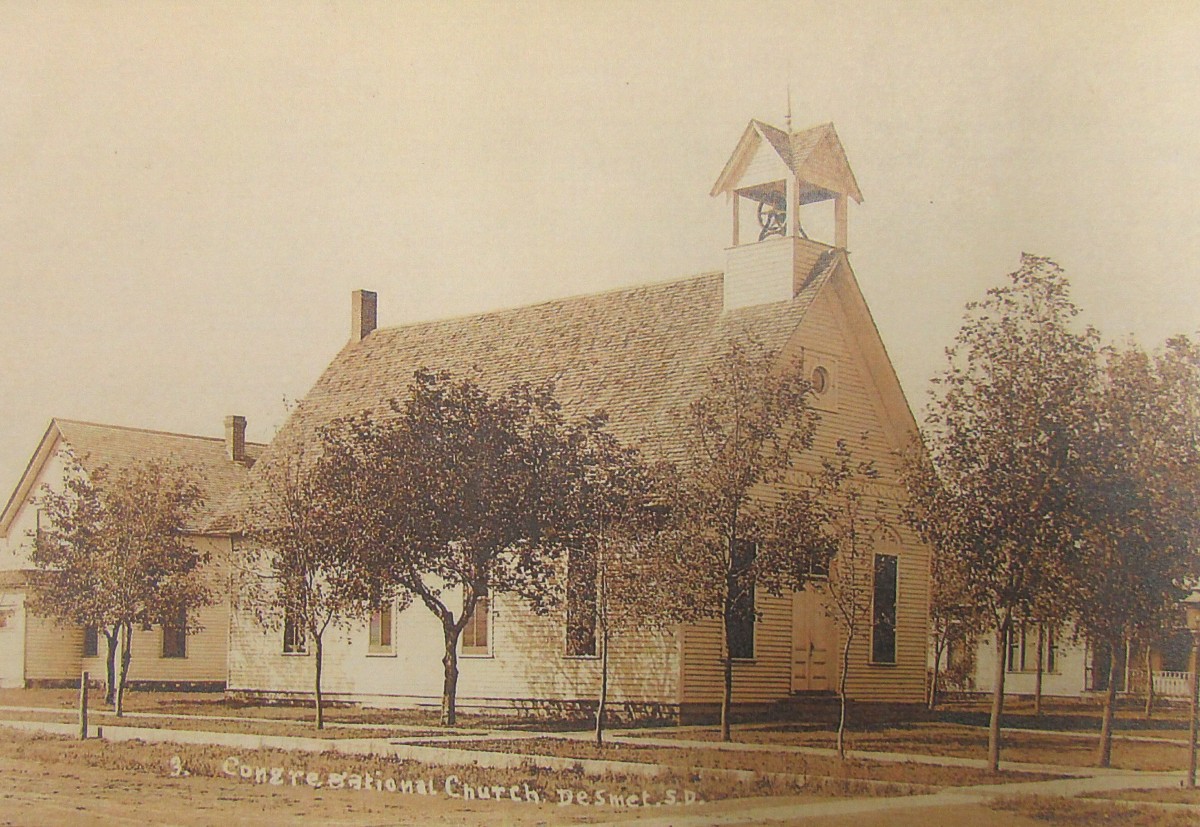
Our first stop was at the De Smet Community Church, which until last year was the De Smet Congregational Church. Laura’s parents and sister Mary were founding members of this congregation in 1880. The church moved to a new building on route 14 in 1966, and the old Congregational Church building was taken over by a Christian and Missionary Alliance (CMA) Church. So we also stopped by the CMA Church building. Charles Ingalls helped to build part of this structure in 1882. It was greatly enlarged (another wing was added) in 1909.

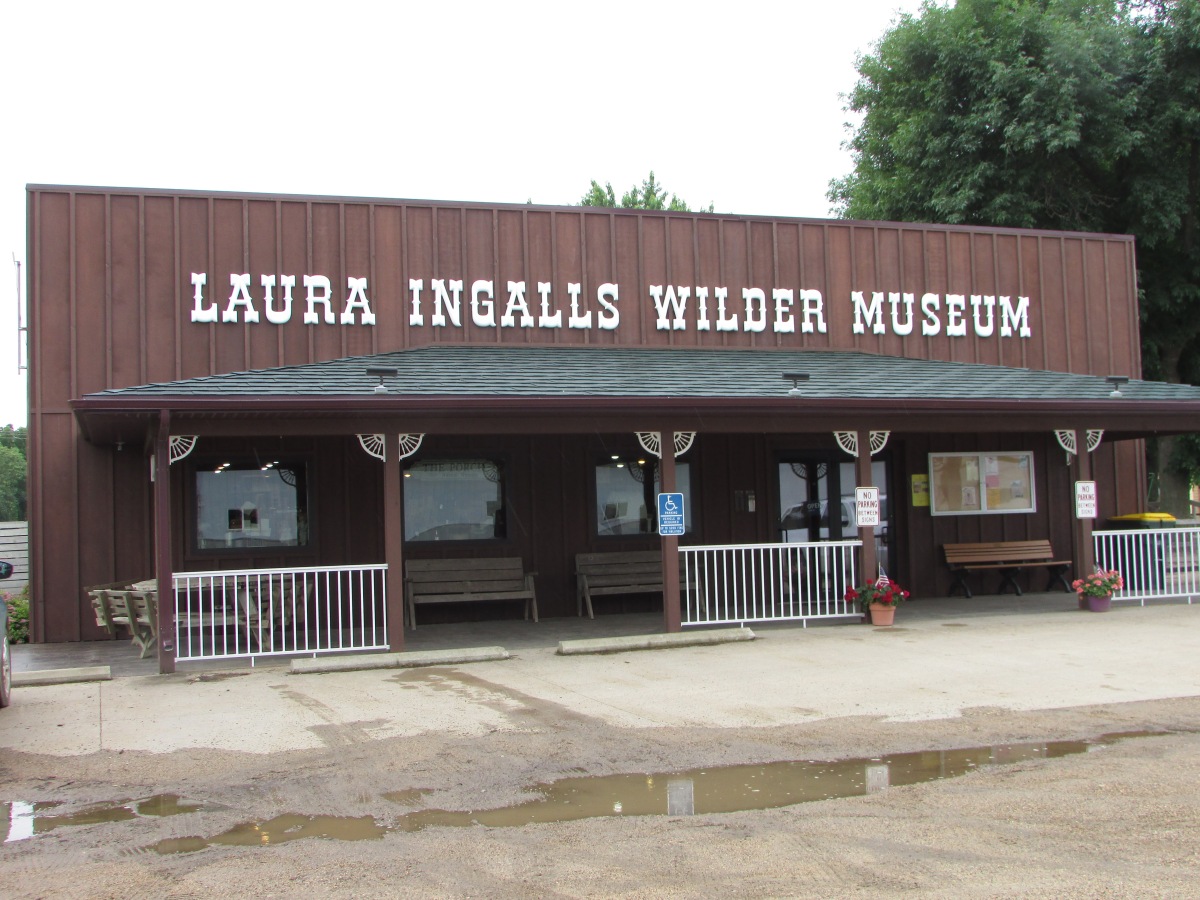
We then visited the Laura Ingalls Wilder Memorial Society. Tessa Flak, the director of the Memorial Society, very graciously gave us access to whatever we wanted to look at in their archives. I worked through several vertical file folders on the Congregational Church, Reverend Edward Brown, and Reverend Edwin Alden. I also looked at some letters written in 1930 by Laura and her sister Carrie Ingalls Swanzey about their early experiences in De Smet, including descriptions of early church services. By far the most fascinating piece from Carrie’s letter:

At the time there was just one other little girl in town my age. The first Sunday services were to be held in the depot. The men fixed the benches early in the morning and father came home and said the seats were all ready. So this little girl and I went over to take a look. No one was there and we went in and found that the seats were just a good jump apart. We started. I was the best jumper, could go the whole length without a miss or stop. The other girl did her best which was not bad, and I suppose we “yelled” our best too. Fun, never have had so much since. Then in the door came Rev. Woodworth-who was to preach that morning and he said “I don’t think that [sic] a very good way for little girls to act in the House of the Lord.” We disappeared.

But that goes to show how these early pioneer church people remembered a place which, if only for the time being was dedicated to the worship of God.

I found some other primary source material that will be a great help for the project. More on this later.

By the time I had looked at what I thought there was to see in the archives, it was early afternoon. I said goodbye to John because I wanted to take the Memorial Society’s tour of the Surveyors’ House and he had to head back to Brookings for a book discussion. The Ingalls family lived in the Surveyors’ House during the winter of 1879-1880. It has been moved into De Smet from outside town where it sat next to Silver Lake. This house is described in Pioneer Girl and (appropriately enough) By the Shores of Silver Lake. Like other historic homes connected with Laura, this house is quite small, much smaller than the impression you get from reading the novel. It is truly a little house.

After the Surveyors’ House, I drove to the historical marker where Laura and Almanzo’s homestead was located, north of town. All one can really see is a rise surrounded by hay fields. Then I went to the site of Silver Lake, to the southeast of town. The lake no longer exists, though there is a wetland. Then I drove past the grounds for the Wilder Pageant (“These Happy Golden Years,” plays weekends in July) to the Ingalls Homestead.

There is a rock with a historical marker on the northwest corner of the homestead, facing across the fields and big slough towards De Smet. This corner belongs to the Memorial Society, so there are signs for the Memorial Society’s homes and tour there. But the rest of the 160 acres that was proved up on by Charles and Caroline Ingalls belongs to a family-owned business called the “Ingalls Homestead: Laura’s Living Prairie.” The owners have created a hands-on experience for families that immerses you in the world of Laura Ingalls Wilder. There is a building with information about all of the places where the Ingalls family lived. There are replicas of a dugout cabin and the house that the Ingalls built on the homestead. There is a stable, and pony rides, and covered-wagon rides, and fields of corn, oats, and wheat. One can twist hay and make a rope. One can also camp there – there are spots for RVs and tents, or you can sleep in one of their covered wagons. There is an authentic one-room schoolhouse on the southwest corner of the property.

Finally, there is a church on the northeast corner of the property. The West Bethany Lutheran Church was built in 1905 about ten miles north and east of De Smet. The last services were held there in 1969. In 2009, the building was moved to the Ingalls Homestead. So I walked across the fields to this church. The building is incredibly well preserved and restored. I would estimate it could hold 60-70 people. There is also a full basement, and I thought – they must hold weddings here. It could be the perfect site for a destination wedding and reception for a Laura Ingalls Wilder enthusiast. One of the employees later told me that they have had several weddings in the church.

So I spent the late afternoon walking over the Ingalls Homestead, imagining what the land might have looked like and been like when Laura spent her adolescent years there.

My final stop in De Smet was at the De Smet Cemetery, where I visited the graves of Charles and Caroline Ingalls, their daughters Mary and Carrie, and the infant son of Laura. I then got on the road home. I drove the rest of the way from Sioux Falls, South Dakota, to Chicagoland on Friday, June 22.

I am very appreciative to my family for allowing me to take an entire week in Laura Ingalls Wilder country. It was good to see the places where she grew up in the upper Midwest. I still have not visited the Little House on the Prairie site in Kansas, but I hope to get there next year. I am just about done with chapter 2.

Thanks again for reading.

(The quote from Carrie Ingalls Swanzey is from her letter to Mr. Mallery, 11 April 1930, Collections IIA4a, Box 028A; and the picture of the De Smet Congregational Church is from the Congregational Church Folder in the Vertical File, both at the Laura Ingalls Wilder Memorial Society Archives, De Smet, South Dakota.)

Links:

The Laura Ingalls Wilder Memorial Society

The Ingalls Homestead

John Miller’s Amazon Page

My post on Becoming Laura Ingalls Wilder


Walnut Grove, Minnesota

On Wednesday, June 20, I visited Walnut Grove, Minnesota.

The Ingalls family lived on a farm about a mile and a half north of Walnut Grove from 1874 to 1876.  They initially lived in a dugout cabin next to Plum Creek, then Charles Ingalls built a wood frame house for the family in 1875. Unfortunately, a locust infestation destroyed the family’s wheat crop, and while he was able to get work in Eastern Minnesota to support the family, Charles could not pay off the debts involved in buying the frame house. These events are detailed in On the Banks of Plum Creek.

When they finally lost the farm, the family moved to Burr Oak, Iowa for a year. They returned and lived in the town of Walnut Grove from 1877 to 1879. Laura attended school and church in town and worked serving at a hotel. It was also during these years that Mary Ingalls got sick and became blind. These stories are presented in Pioneer Girl, but not in the Little House books. Much of this period is lost in the gap between On the Banks of Plum Creek and By the Shores of Silver Lake. Some of the events and themes of town life from this period are included in the later Little House books set in De Smet, South Dakota.

The land where the Ingalls dugout once stood is now owned by the Gordon family. They have prepared a parking area near to Plum Creek and the dugout site. Visitors who pay $5 per car ($30 per tour bus) can drive back, wade in Plum Creek like Laura, and see where the dugout was located. There are also two half-mile hiking trails.

The forecast that morning was for rain starting at around ten o’clock in the morning, so I hurried from my hotel in Springfield, Minnesota, to the dugout site. I arrived at about quarter to nine, put my $5 in the pay box (it’s completely on the honor system), and drove to the creek. When I got out of the car, I was shocked at how quiet it was. I could hear the creek, which was running very high and fast because it had rained most of the previous day. I could hear the birds in the trees around the creek. And that was it. There wasn’t any distant traffic noise. I was the only one visiting the site. I walked to the creek, crossed it on the bridge provided, and walk up the bank to where it is believed that the dugout was. I could see what Laura described in Plum Creek as the tableland. I looked across the fields and see the water tower in Walnut Grove.

I walked both hiking trails. The uneven landscape reminded me of the farm I grew up on in Western Pennsylvania. As I child I had also played next to a creek, though it was much smaller than this one. I have lived so many years right next to Chicago that I had forgotten what exactly this was like. However, eventually my shoes and socks were soaking because of the wet grass I was walking through; each step brought a squish. As a result, the spell was a bit broken by the time I got back to the rental car. I took off my shoes and socks and put on a pair of sandals. I then walked back to the creek and put one foot in, just so I could say that I did. The water was very cold. As I drove back to town a little after ten, the rain started.

The Laura Ingalls Wilder Museum in Walnut Grove is much larger than its counterpart in Pepin. There are eight different buildings, each containing historical materials of different types. There is a railroad depot (pulled to Walnut Grove from another town) with two main rooms. One room contains materials about the Little House books and the historic Walnut Grove, including a quilt owned by Laura (and donated by Roger MacBride) and a pew from the Congregational Church. The other room is dedicated to the Little House on the Prairie television show, which was set in Walnut Grove during its entire nine year run (although it was shot in California). There is a replica sod house the size of the dugout on Plum Creek, and a replica settler’s house the size of the frame house the Ingalls lived in on their farm. “Grandma’s House” was built in 1890 and brought to the site. It includes exhibits of sketches by Garth Williams, the illustrator of the 1953 edition of the Little House books, old time kitchens, dolls, and military service.  There are also areas for children to play. There is a replica one-room schoolhouse and a small chapel built by a high school shop class in 1983. The last building, “Heritage Lane,” contains old print shop equipment, a telephone switchboard, a post office, a telephone booth, a covered wagon, and materials about American railroads. In between the buildings there are prairie grasses and flowers.  So there is a lot to look at and do in a small area. It would provide a lot of opportunities to families with young children.

Charles and Caroline Ingalls were founding members of the Congregational Church in Walnut Grove in 1875. When the family lived in town, Laura attended both the Congregational Church service on Sunday morning and the Methodist Church service on Sunday afternoon for a year.  This was because the Methodist Church was having a contest to see who could memorize 104 Bible verses, two for each week of the year. Laura succeeded and was awarded a reference Bible. The Methodist Church did not have their own building, so they met in a hall upstairs of the grocery store owned by William Masters. Pioneer Girl also describes revival services in both churches, a Sunday School picnic, and an experience with God’s presence which caused Laura to observe, “’That is what men call God.’” (Pioneer Girl, 137)

The Laura Ingalls Wilder Museum recently was able to purchase the Masters Building. Charles Ingalls helped to build this building, and this is where the Methodist Church held services at the beginning. Laura also lived in an apartment there while helping William Masters’s son Will’s wife Nannie. I was privileged to sit in the upstairs of that building with Joel McKinney, the Collections Manager for the Museum. The building was used as a private residence from about 1900 to several years ago. The inside has just been gutted, so Joel showed me the original floor joists, which are exactly two inches by twelve inches, and studs, which are exactly 2 inches by four inches. We talked about the history of the town and about what Laura would have seen when she looked out of the windows that floor of the building during a Methodist worship service. I really appreciated his hospitality and his insights.

The Congregational Church in Walnut Grove closed in 1952, and the historical papers of the church were given to the Methodist Church. Unfortunately, the Methodist Church experienced a break-in some years ago, and someone poured ink on all of the historical papers of both the Methodist and Congregational Churches. They had to be thrown out. Certainly a great loss for my project.

Next stop: De Smet, South Dakota.  Thanks for reading.

(Quote is from Laura Ingalls Wilder, Pioneer Girl: The Annotated Autobiography, edited by Pamela Smith Hill, [Pierre: South Dakota State Historical Society Press, 2014].)

Links:

Walnut Grove, Minnesota

The Laura Ingalls Wilder Museum in Walnut Grove

The Dugout site