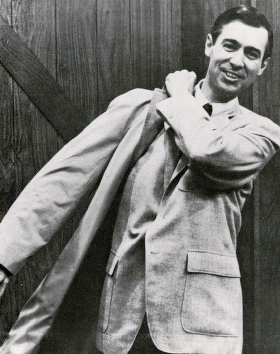
The Good Neighbor

During the last several weeks, my wife and I have been reading The Good Neighbor: The Life and Work of Fred Rogers, by Maxwell King. We read out loud to each other when we’re in the car or doing chores at home. I found out about the book in the alumni magazine from Duquesne University in Pittsburgh, where I received my M. A. in History. At Duquesne’s commencement this year, King and Rogers’s widow Joanne Rogers both received honorary doctorates. The book came out last year, and it’s the first full biography of Rogers.

I remember watching Mister Rogers’ Neighborhood when I was growing up in Western Pennsylvania in the early 1970s. At some point, I decided that I was too old, that the show was too slow, and that I liked Sesame Street and The Electric Company better. I did not realize that Rogers and his program were key to the development of WQED in Pittsburgh and Public Broadcasting nationally. This book sets Rogers’s life in context of the national development of educational television for kids. It also provides evidence that for many children – often those going through difficult life situations – watching Mister Rogers’ Neighborhood was a transformative experience.

Rogers grew up in the small town of Latrobe, Pennsylvania, east of Pittsburgh. He was the only child of a wealthy family, and he struggled with asthma and social awkwardness at school. So he often would go to his attic and play with puppets, writing elaborate scripts for puppet shows and performing them for his family. He also played the concert grand piano (!) that his grandmother bought for him. He got his B. A. in music, became a concert-level musician, and wrote an opera at Rollins College in Florida. After he graduated, he decided he wanted to work in broadcast television.

He began his career with NBC in New York City, then went to work for WQED, a public station in Pittsburgh. There he wrote and operated the puppets for The Children’s Corner for seven years. At the same time, he attended Pittsburgh Theological Seminary and became an ordained minister in the mainline Presbyterian Church with the call to serve the community through television. In 1963 he moved to Toronto and created Misterogers for the Canadian Broadcasting Company. He returned to Pittsburgh three years later and recreated the show for WQED. By the early 1970s, the show was broadcast nationally.

King’s book does an excellent job describing the influences on Rogers’ development, including his mother’s love, his father’s money, his grandparents’ encouragement, the outlet of music and puppetry, and the educational theory of Benjamin Spock, Erik Erikson, and especially Margaret McFarland. King is also at pains to explain that Fred Rogers was in real life who he was on the television screen: a kind, encouraging man who cared about everyone he met. He especially cared about children. Born into a wealthy family, he never wanted for anything, but he was not pretentious. He was highly creative and had a perfectionist streak, which at times led him to become angry with coworkers and with his own two sons. Finally, he was intensely dedicated to friends, and he put off getting treatment for the ailment that eventually killed him—stomach cancer—because he did not want to back out on commitments he had previously made to others.

The author, Maxwell King, was a journalist for the Philadelphia Inquirer for almost 30 years, eventually serving as Editor. He was then President of the Heinz Endowments, directed the Fred Rogers Center for Early Learning and Children’s Media at Saint Vincent College in Latrobe, and most recently was President and CEO of the Pittsburgh Foundation. Because he was writing the biography of a late twentieth century television celebrity, there are thousands of hours of shows and interviews, and reams of material to sift through. King’s training in journalism is evident, as he often allows his sources to tell the story: Fred himself, his wife Joanne, his coworkers, relatives, acquaintances, and fans of his work. However, this often means long sections of direct quotes, some of which repeat points made previously. While early chapters are chronological, later chapters are thematic, which also makes for quite a bit of repetition. Perhaps my wife and I noted this more because we were reading it out loud, but at the end of the book’s 360-plus pages of text, we thought that it might have been perhaps a 80-100 pages shorter.
There are some interesting comparisons between Fred Rogers and Laura Ingalls Wilder. Both created artistic works for children that had widespread influence almost immediately. Both used materials from their upbringing – Laura’s life story and Fred’s memory of his family’s neighborhood in small-town Latrobe. Both shared an upbringing and lifelong affiliation with the church, although Fred became a pastor and Laura never officially joined a congregation. The most striking difference between the two was the Rogers’s family’s wealth in comparison to the Ingalls’s family’s relative poverty.

I’ve been writing the chapter about Laura and Almanzo’s early years in Mansfield, Missouri, and that has brought me face to face with their daughter Rose Wilder Lane’s childhood. In fact, there might be more interesting comparisons between Fred Rogers and Rose Wilder Lane. Both were only children brought up in families with strong mother figures. Both were very artistic and creative individuals who followed their own paths. Ultimately, however, Fred was much more comfortable with who he was and a much more successful person. He never had to work for a living the way that Rose had to, and he didn’t face the difficulties or financial reverses that she faced. But I also think that his settled Christian faith provided ballast for the difficulties in life that he did face, and that kind of faith was one thing that Rose did not have for most of her adult life.

I certainly have a lot fewer sources for Laura’s life than King had for Fred’s, and I’m planning for my book to be much shorter than his. Caroline Fraser (Prairie Fires) has written the long and exhaustive book on Laura and Rose. I’m just hoping to tell their story in light of Laura’s faith commitments.

Thanks again for reading.

Picture credit: KHUT (CC0) at the Wikimedia Commons

Links:

Publisher’s site for The Good Neighbor

Duquesne’s May 2019 Commencement

Dr. Margaret McFarland

The Fred Rogers Center for Early Learning and Children’s Media at Saint Vincent College

Maxwell King

My blog entry on Caroline Fraser’s Prairie Fires

Homesteading the Plains

This month, I’ve been reading Homesteading the Plains: Toward a New History, by Richard Edwards, Jacob K. Friefeld, and Rebecca S. Wingo. I was able to finish it this week. The book was published in 2017 by the University of Nebraska Press. It is about the administration of the Homestead Act of 1862, which figures largely in the Little House books, especially the last four. The Homestead Act provided one hundred and sixty acres of land free from the Federal Government to anyone who would pay a small filing fee, build a house on the land, raise crops, and live there for five years.

The book begins with a fascinating paradox. In the popular imagination, the Homestead Act was an incredible success, providing ordinary people with access to free land and economic opportunity. In general, the works of authors such as Willa Cather, Elinore Pruitt Stewart, and Laura Ingalls Wilder depict its impact positively. (Stewart’s work was turned into the movie Heartland in 1979.) More recently, the Act has been praised by figures from both sides of the political spectrum; the book includes quotes from Barack Obama and George Will. (2-3) At the same time, academic historians normally see the Homestead Act as a failure. Scholars believe that 1) most homesteaders failed to prove up on their claims, 2) homesteading was full of fraud and corruption, and 3) homesteading caused Native American land dispossession. (13)

Which understanding of homesteading is correct?

The three authors of Homesteading the Plains attempt to answer this question, using several approaches. First, they examine the numbers in government reports used by previous history scholars to make their claims about the failure of the Homestead Act. Second, they investigate the way that the General Land Office enforced the provisions of the act. Third, and perhaps most importantly, they take advantage of the digitization of large numbers of homestead records and their free availability to researchers. Their team created a database of records for a study area of ten townships in two counties in Nebraska (five in each): Custer County in central part of the state and Dawes County in the northwest. A careful analysis of all of these sources enables them to consider the claims of scholars in detail.

By the end of the book, the authors recommend that scholars should revise their previous understanding of homesteading on pretty much all fronts:

– A majority of homesteaders did succeed in proving up and obtaining title to their land – by their estimate, between 56% and 69% of homesteaders between 1862 and 1880, and 55% of those between 1881 and 1900. (40)

– Scholars’ ideas about the frequency of fraud have been unduly influenced by anecdotes told by General Land Office administrators. Fraud was actually less than ten percent of claims – perhaps as low as 3.2%, no higher than 8.5%. (87) (Strikingly, the authors note that recent studies suggest that the incidence of fraud in the Medicare program averages about 8.3%.)

– In many states, homesteading was not part of the story of Native American land dispossession, because Indian land claims had been extinguished before large-scale homesteading began there. However, the authors admit that homesteading was deeply implicated in the western parts of North and South Dakota and the entire state of Oklahoma.

The authors also encourage scholars and those who write history textbooks to recognize the importance of the Homestead Act to the settlement of the west, to take note of what homesteading meant for women (both single women and widows), and to understand that homesteading always involved community building, not just individual effort.

I’ve been thinking about that 55% figure for success for homesteaders after 1881 and before 1900, because I’ve been working on the chapter in my book about Laura and Almanzo’s early years of marriage. Laura’s father, Charles Ingalls, was able to prove up on his homestead in 1886. However, Charles and his family moved to their house on Third Street in De Smet in 1887 and never again lived on the homestead. They sold their land outside of town in 1892. Almanzo Wilder also was able to prove up on his homestead, but debt, diphtheria, fire, and dry weather forced Laura and Almanzo off the farm and into town in 1890. How this happened is discussed in The First Four Years, the adult novel Laura wrote sometime in the 1930s but was not published until 1971, after she and her daughter Rose had passed away. Certainly, 55% is a majority of homesteaders, but it’s not an overwhelming majority. And those who did succeed in getting title to the land did not always stay on the farm.

The Homestead Act actually also comes in for a bit of abuse in the Little House books. The descriptions of how the Act works in the books set in Dakota Territory (especially By the Shores of Silver Lake, Little Town on the Prairie, and These Happy Golden Years) is not always positive. Pa’s description of homesteading as a “bet” against the Federal Government and the necessity of Mrs. McKee’s living on the homestead when her husband must work in town to support the family are two examples. This makes me wonder if Laura and Rose had ever read descriptions of some of the reports from the General Land Office during the late 1800s and early 1900s, or even whether they were aware of the work of Fred Shannon, a historian during the 1930s and 1940s who wrote a number of the negative descriptions of homesteading that have been quoted by subsequent authors. This is akin to the wonderings of those who write about Wilder concerning how much exposure Laura and Rose had to the ideas of historian Frederick Jackson Turner and his frontier thesis.

These are individual stories and concerns however. As far as the book goes, I think that Edwards, Friefeld, and Wingo do a superb job of supporting their claims. I hope that other researchers can make use of the digitized homesteading records in ways to continue to help us understand the experience of farmers on the plains during the late 1800s, both individually and in the aggregate.

As always, thanks for following along.

(Page numbers are taken from Richard Edwards, Jacob K. Friefeld, and Rebecca S. Wingo, Homesteading the Plains: Toward a New History [Lincoln: University of Nebraska, 2017].)

Links:

Homesteading the Plains

My blog entry for The First Four Years

2019 Midwestern History Conference

Last Thursday and Friday, I attended the Midwestern History Conference in Grand Rapids, Michigan. I had a great time.

The conference was sponsored by the Midwestern History Association and hosted by the Hauenstein Center for Presidential Studies at Grand Valley State University (GVSU). It was held at GVSU’s Pew Campus in downtown Grand Rapids.

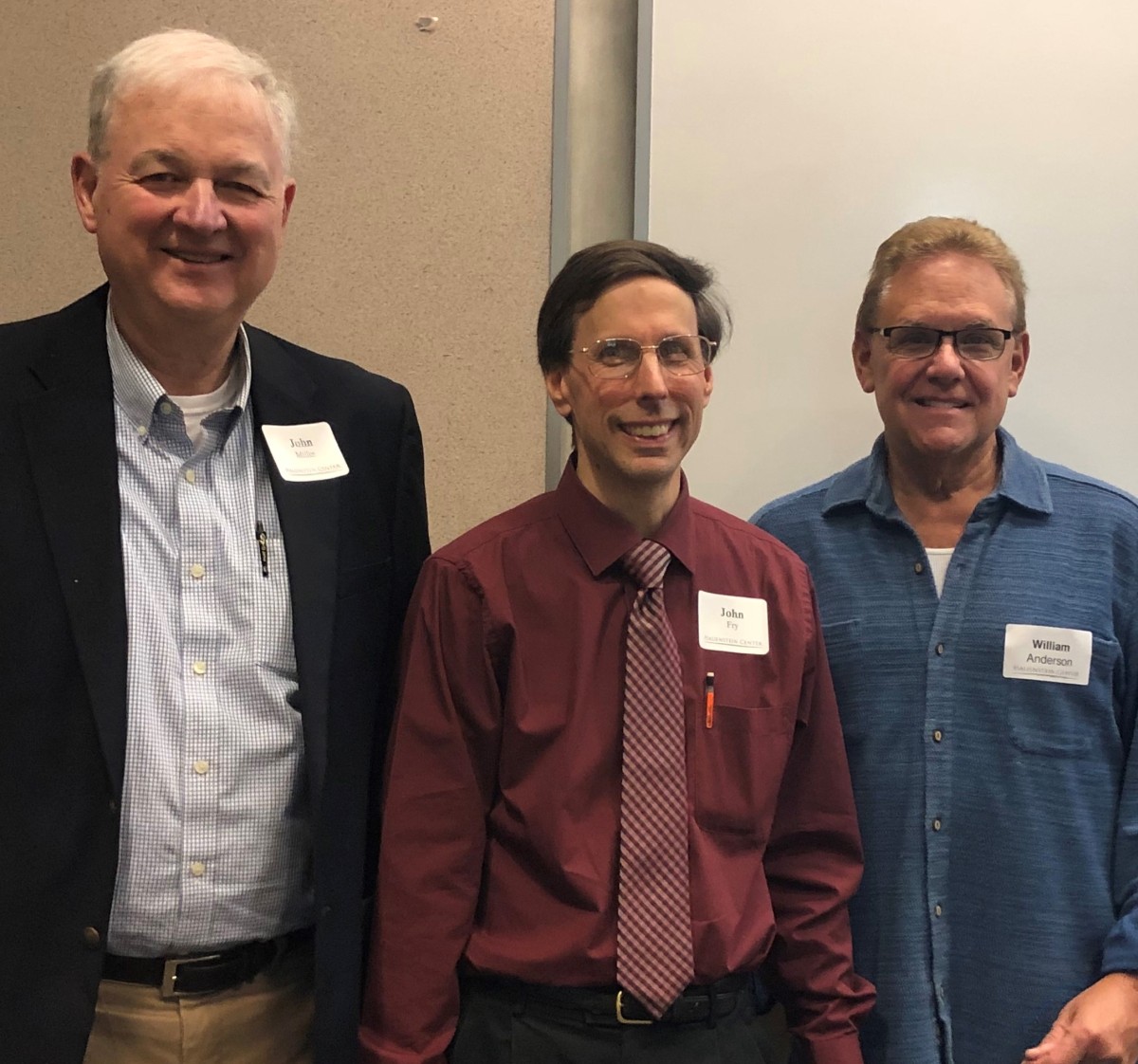
I presented on a panel on Thursday morning titled “‘Everyone Has a Wilder Story:’ Laura Ingalls Wilder, the Midwest, and Historical Research.” It was a privilege to join Bill Anderson and John Miller. We each told the story of how we came to research and write about Laura Ingalls Wilder. Bill has been writing about Laura since the 1960s and has published over twenty-five books. I have previously mentioned four on this blog (links are at the end). John has written three books about Wilder and De Smet, South Dakota, including the most scholarly biography to date, Becoming Laura Ingalls Wilder. They included me, even though I did not read the Little House books when I was a child and I did not grow up in the Midwest. There were around fifteen attendees at our session, which was respectable, given the fact that there were nine other sessions going on at the same time. (I attended other sessions with only five people in the audience.) Discussion during the Q&A was also robust.

I used some of my presentation to reflect on “Everyone has a Wilder Story” in a second way. I think that many people today have a story that they tell about Wilder – about who she really was, and about how we should understand her life and respond to it today. This “Wilder story” guides how they read the Little House books and Wilder’s other writings, and it guides how they view her legacy. So I used my presentation to roll out some possible “Wilder stories,” some tentative ways of understanding Laura’s faith. I don’t think that any of these will come as a surprise to regular readers of this blog

– First, Laura was a committed Christian, attended Christian worship services, read the Bible, and prayed her entire life. She engaged in Christian practices that built her relationship with God and Jesus Christ.

– On the other hand, she never publicly identified with an individual body of believers – she never officially joined any church.

– On a third (?) hand, the original, handwritten manuscripts of the Little House books have more straightforward and positive descriptions of God, Christianity, and the church than appear in the published Little House books. These accounts were changed—most likely by her daughter Rose, who was agnostic when they were written—into the more negative depictions that appear in the published books.

– On a fourth (!) hand, Laura can probably not be understood as an Evangelical Christian. Her descriptions of God, Christianity, and church emphasize God’s power, His laws, and individual moral choices. Her writings almost never mention Christ, forgiveness of sins, or salvation.

It’s complicated. The more I engage the faith of Laura Ingalls Wilder, the more I despair of having just one ‘Wilder story,’ or a simple way of describing her faith. But if I was to have to give an overarching narrative for Laura’s life, I might say that she believed that people do not live by bread alone. Bread is necessary, but faith, community, and family relationships are more important. There are ironies here, too. Her relationship to the church she attended and the community she lived in was often ambivalent. Her own relationship with her own daughter was marked by misunderstandings and, at times, open conflict. Yet in the midst of these difficulties, Laura and Rose together created, in the Little House books, an immensely attractive vision of human flourishing that influenced millions of Americans during the middle to late twentieth century.

Other highlights of the conference included Anna Lisa Cox’s plenary talk on Thursday night and a session I chaired on Friday about music in the Midwest. Many thanks to Trinity Christian College for a travel grant to go to the conference. Thanks also to David Zwart, who teaches at GVSU, for letting me crash at his place on Wednesday and Thursday night.

As always, thanks for following along.

Links:

2019 Midwestern History Conference

Hauenstein Center

Post on Bill Anderson’s Laura Ingalls Wilder: A Biography

Post on Bill Anderson’s The Selected Letters of Laura Ingalls Wilder

Post on Bill Anderson’s Little House Sampler and Little House Reader

Post on John Miller’s Becoming Laura Ingalls Wilder

Anna Lisa Cox

Trinity Christian College

David Zwart